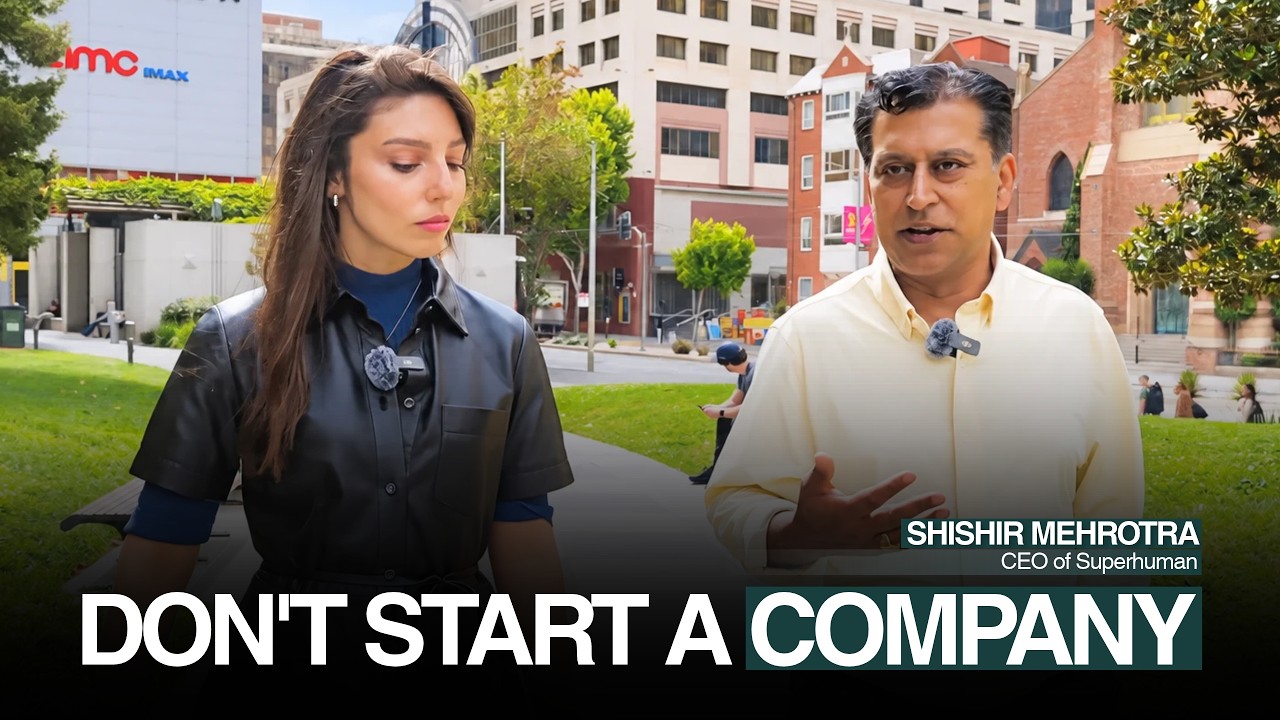
Shishir Mehrotra, CEO of Superhuman (the company formerly known as Grammarly), walks through his career from MIT startup founder to YouTube executive to Coda founder to leading Grammarly’s transformation into an AI-powered productivity platform, sharing a philosophy that most people shouldn’t start companies unless cursed by an idea they can’t stop thinking about.
Lego robotics as a masterclass in small-team dynamics
Mehrotra coached his daughters’ Lego robotics team for seven years, reaching world championships four times with teams of two to five girls.
The experience taught him that smaller teams outperform larger ones: adding more kids created chaos and coordination overhead, while teams of three to five developed a “hive mind” where everyone thinks the same thing.
He applies this at Superhuman: quarterly hackathons require teams of two to five people; beyond five, coordination consumes more time than actual work.
The principle scales: Superhuman has 1,500 people but organizes into small, autonomous units where four to five people work closely together.
Upbringing and the “50-year-old books” rule
Both parents were computer scientists; Mehrotra grew up moving between university towns (Buffalo, Charlottesville, West Lafayette, Virginia) with a father who spent 30+ years at NASA.
In college, he called his dad to announce a CS major; his father refused to pay tuition unless he majored in a field where textbooks were at least 50 years old, arguing CS changes too fast and is too vocational.
Mehrotra double-majored in math and CS; his daughter now follows the same path (math first, CS second at Princeton).
The deeper lesson: fundamental subjects force you to peel back layers of how concepts fit together, teaching how to think rather than just what to know.
Accidental entrepreneurship and the Vinod Khosla $500K wire
Mehrotra entered MIT’s $50K entrepreneurship competition in 1999 with a friend, not intending to start a company; they placed second, attracted investor interest, and found themselves with a committed team before deciding to launch Centra.
Centra aimed to build an on-demand cloud computing utility (precursor to AWS) but was 5–7 years too early; VMware’s virtualization technology didn’t exist yet.
Raising capital: East Coast investors dragged their feet; a Sunday email from Vinod Khosla (all lowercase, misspelled) changed everything — by the time Mehrotra walked back from confirming Khosla’s identity, $500K had appeared in the account.
Khosla’s influence: think big, act fast, never take no for an answer; he required the company move to Silicon Valley within days (email Sunday, met Tuesday, term sheet Thursday, moving truck Saturday).
Joining YouTube when it lost money on every view
YouTube was Google’s “big mistake”: losing hundreds of millions annually, net negative on every view (more views = worse business), facing a $1B Viacom lawsuit, perceived as a site for grainy cat videos.
A small “pirate” group (including Salar Kamangar, Noam Lovinsky) saw it differently: YouTube would do to cable what cable did to broadcast — millions of channels replacing hundreds.
They manufactured intermediate signals: hit $1B revenue (from ~$30M) and achieve profitability in at least one country (US) within two years.
Quarterly board meetings with Eric Schmidt repeatedly asked: “Should we shut this down or sell it?” — existential pressure fueled by responsibility to millions of creators and users.
A chance airplane conversation with a creator who said “YouTube sends me my check, so I just say I work on YouTube” grounded the mission in real human impact.
The skip button that went from $0 to $1B in 18 months
Mehrotra’s core idea: skippable ads (TrueView) where advertisers pay only when ads aren’t skipped, rebalancing power like Google AdWords did for search.
Two years in, he hadn’t shipped it; Dean Gilbert’s “marginal utility” framework (three lists: goals, what wouldn’t happen without you, what you’d regret years later) kept him at YouTube — the skip button was on the final list of five things.
True View launched, grew from $0 to $1B revenue in 18 months; now tens of billions annually.
Grammarly later became a top-10 YouTube advertiser, illustrating the model: products needing explanation can find audiences efficiently through skippable ads.
Susan Wojcicki’s ecosystem thinking and the 55/45 split
Wojcicki (who hired Mehrotra) built AdSense on a non-zero-sum ecosystem: Google, publishers, advertisers all win; she applied the same logic to YouTube.
Despite losing hundreds of millions, YouTube opened the Partner Program to all creators (not just major studios) and committed to a 55/45 revenue split (creator/YouTube) — still unique among major media platforms.
The principle: share revenue even when it hurts, because a reliable economic model makes creators invest; arbitrary funds or no payment creates a race to the bottom.
Value: “even playing fields, invite play” — expand the pie rather than fight over slices.
Coda: sketched on a notepad, 11 years building
After a six-month sabbatical (which he hated — “worst six months of my life”), Mehrotra couldn’t stop sketching Coda on a bedside notepad: productivity tools hadn’t changed in decades; documents, spreadsheets, presentations are separate metaphors but actually serve as application surfaces (every CRM starts as a spreadsheet).
He didn’t want to start a company (views it as the hardest way to get an idea out); tried to place the idea at Google, Microsoft, Dropbox, Box — all wanted his co-founder Alex but dismissed the idea as too hard/unlikely.
The marginal utility test flipped: if they didn’t build it, nobody would; his wife noted he’d been obsessed for weeks.
Coda’s tagline: “the doc as powerful as an app” — rethinking formulas, surfaces, and the boundary between documents and applications.
Selling Coda to Grammarly: the AI superhighway
Haymon Tannan (General Catalyst) urged Mehrotra to meet Grammarly’s founders (Max and Alex) before closing Coda’s next funding round.
Grammarly was far larger than perceived: tens of millions of DAU, $700M+ revenue, but core tech wasn’t grammar — it was an “AI superhighway” bringing AI to the edge across a million unique applications daily.
Grammarly ran only one “car” on that highway (grammar correction); the opportunity: run many cars (sales coach, favorite author, professor) as agents alongside users.
The acquisition wasn’t an exit; it felt like starting a new company — same marginal utility test passed.
Superhuman now does 100B+ LLM queries/week; for users, Grammarly is the #1 source of LLM interaction (thousands per day per user, at typing speed) — the “last mile of AI.”
Purpose over ownership: zero startup pride
Mehrotra has no attachment to ownership or control: “when you have a great idea, you should be obsessed with getting that to the world the fastest way possible.”
Starting a company is often the most painful path; if an easier platform exists (YouTube, Grammarly), take it.
Advises students: don’t keep a list of startup ideas; keep a list of “things I’d like to see different in the world” and stay open to the best vehicle for each.
His bundling theory (developed with Daniel Ek at Spotify) became a board role, not a company — the idea still happened without ownership.
Superhuman’s bundling strategy and AI agents
Bundling principle (from “Four Myths of Bundling” paper): minimize super-fan overlap, maximize casual-fan overlap — bring together products with deep but distinct followings to build bridges across audiences.
Superhuman bundles: Superhuman Mail (beloved email client), Superhuman Docs (Coda rebranded), Grammarly (AI writing assistant), GPTZero (authenticity), Superhuman Go (platform layer bringing agents to any app).
Each product wins its core audience; the bundle captures cross-product value.
AI autodraft milestone: >60% of auto-drafted emails sent, half with zero edits — email shifts from “workplace for me to work” to “place for me to work with my agent.”
Vision: agents with ubiquity (where you work), proactivity (act before asked), and context (know everything you know) — virtual teammates reading sales, support, docs, past correspondence.
Why AI will make teams bigger, not smaller
Contrary to “AI replaces teams” narrative, Mehrotra believes teams grow: virtual teammates + human teammates = more complex teamwork problems.
He’s writing a book on “Rituals of Great Teams” and constantly learns new patterns; Dean Gilbert’s early advice: “You spend too much time in the YouTube building, get out” — learning from peers (Chris Cox at Facebook), boards (Spotify, Walmart), and diverse perspectives.
Current learning sources: Daniel Ek (sees world-scale and detail-scale, learning mindset), Haymon Tannan (magical connector), Reid Hoffman (sees people reflected in products they build — LinkedIn from viewing every relationship as unknown opportunity).
The happy version of Alvin Fernald
Childhood book series (Alvin Fernald) about a kid inventor whose cool inventions always ended in disaster — made Mehrotra sad; his role models are people who take ideas and make them happen in the world, propelling things forward.
“I just want to be the happy version of Alvin Fernald.”