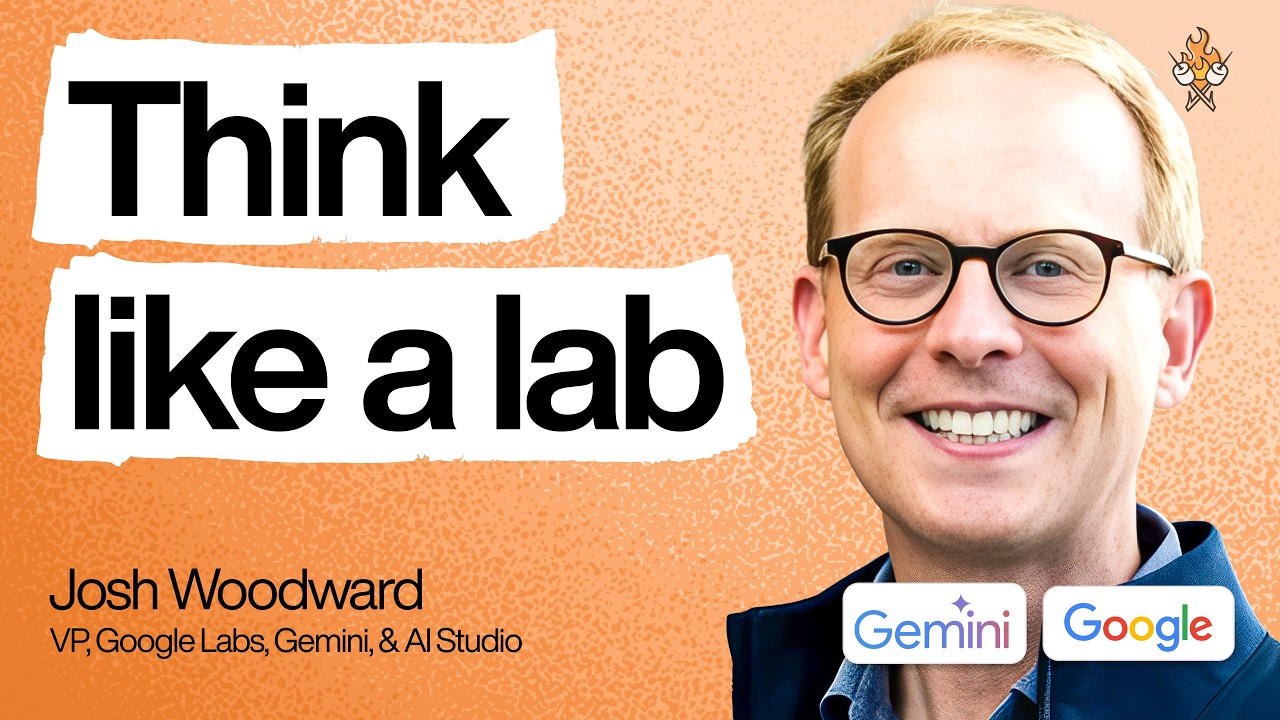
Josh Woodward leads Google Labs, the Gemini app, and AI Studio; his premise is that every company must now think and operate like a labs team because AI capabilities shift so fast that organizations need to continuously experiment at the frontier to discover what’s newly possible before competitors or startups do.
The labs mindset and why it matters
The core thesis: the underlying technology is changing so rapidly that what’s possible changes weekly, so every company needs a dedicated group whose job is to live at the frontier, test the latest models, and surface new opportunities.
Startups are inherently labs; the challenge is importing that methodology, energy, and speed into larger or mid-sized organizations without distracting the core business.
A labs team must have real independence — it cannot be nested under an existing business unit — and it needs a culture where weird, early ideas can grow without premature pressure to justify themselves.
Where the best ideas come from
They rarely come from design sprints, scheduled brainstorms, or “microwaved” ideation sessions.
They emerge from small, obsessed groups — often two to four people — who are passionately curious about a side project and simply won’t stop building it; examples include NotebookLM’s audio overviews and Google Flow/Whisk’s image animation.
The team maintains an “almost possible” list (82 predictions framed as “we believe the future is…”) tracking technical phase shifts — e.g., when latency, modality, or language support cross a threshold that unlocks a new experience.
They pair that technical watchlist with behavioral trend-spotting, deliberately looking outside the Bay Area (classrooms, other cities) for shifts in how people live and work.
Ideas are filtered by three lenses: a surprising technical capability that just became real, a universal or shifting user pain point, and a path to value so strong people would pay for it.
Recognizing product–market fit (and when to kill)
Early PMF is more art than science; the clearest signal is watching users’ eyes — pupils dilate, they lean in, they say “I want that” — not dashboards, DAU/MAU, or retention curves.
The team falls in love with the problem, not the first solution; it typically takes three to five pivots before something clicks or the effort is abandoned.
When PMF hits (e.g., NotebookLM podcasts going viral, Nana Banana on Gemini), the team “swarms and holds on for dear life” — exhausting but unmistakable.
The team usually knows an idea is dead before the leader does: passion drains, every angle has been tried, and the energy simply isn’t there. A healthy culture lets the team call that out safely — e.g., a PM recently killed a planned Gemini launch because early user reactions were flat, and leadership celebrated the honesty.
Structuring Labs and Gemini under one leader
Labs (0→1, tiny user counts) and Gemini (1B+ users) sit together because they share the same builder DNA, AI-obsessed culture, and a unifying priority order: users first, Google second, product third.
Labs now runs all-AI projects (software and adjacent hardware like Google Beam’s 3D “magic mirror” telepresence), having gone all-in on AI several years ago.
Internal staging: “zero-to-one labs,” “one-to-10 labs,” and “10-to-100 labs” — each stage has different metrics (eyeballs → waterfalls/CPAs → scaling) but retains the same innovative energy.
Consumer AI opportunities
Entertainment is wide open: will feeds persist, or will AI create new shared, immersive, possibly IRL experiences? The bot-vs-people spectrum is unresolved.
Messaging/chat, once considered solved, is being reinvented by AI agents and new interaction models.
Big scarce resources — time, money, memorable IRL experiences — remain fertile ground for new consumer products, whether they take the form of chatbots, personal agents, or something not yet invented.
Google’s “personal intelligence” vision: a Gemini that is personal, proactive, powerful, and works across Gmail, Calendar, Docs, etc., without mode toggles — one prompt box that just does things. Features are shipping soon.
Underhyped vs. overhyped
Underhyped: explicit discussion of principles and values encoded in products — what future do we actually want to build? Products speak those values.
Overhyped: model benchmarks (ELO ratings, leaderboards). Most users never care; the industry over-rotates on speeds-and-feeds proxies and loses sight of delivering real user value.
Skills trending up (and down)
Unlearning rate: how fast someone can learn something, then discard it when evidence says it’s wrong — more valuable than raw learning rate.
Explosive endurance (borrowed from Roger Federer): the ability to sprint hard repeatedly over years without burning out; labs structures “seasons” (intense sprints around model releases, then deliberate hack/recharge periods) to sustain this.
Collaboration and trust-building: as execution cost drops, more products get built by fluid, small teams (2–4 people) that form, jam, and disband like musicians; the ability to build trust quickly across humans and agent swarms becomes a multiplier.
Major/minor specialties: roles are not blurring into a single “builder” role. PMs, designers, engineers, strategists, marketers each keep a primary craft (major) while gaining secondary skills (minor). PMs happen to adapt horizontally faster because the role already simulates other functions.
Planning horizons and the frontier-team model
Planning horizon is roughly six months, driven by model release cadences; best labs teams go from idea to meaningful milestone in 50–100 days.
Culture is designed to unblock builders so they can “just cook.”
Endorses Dan Shipper’s frontier-team model: a dedicated group with eight $200/mo subscriptions, plugged into the hive mind, whose job is to test everything new and report back.
Three failure modes for corporate labs: (1) no real independence, (2) unclear mission (graduation vs. new categories), (3) inability to bridge back to the mothership — labs must create “good trouble” that challenges company processes (e.g., piloting a new “builder” job ladder) not just products.
Hiring for a labs team
Look for people who can’t stop building, show intellectual curiosity (reading, X, podcasts), obsess over user problems not ego, and add energy in every conversation (“I’d run through a wall with them”).
Interview signals: “let me show you what I just built” = instant credibility; energized by unstructured, unknown problems = huge credibility.
Zero-to-one people differ from one-to-10 and 10-to-100 people; create common culture but respect stage-specific wiring.
Org-structure pitfalls
Rushing to consolidate into clean thematic groups too early; sometimes you must live in the messiness and let multiple small bets run in parallel before structure emerges.
Hiring too fast (vanity metric: headcount growth) before product–market fit — a classic trap at both big companies and startups.
The future of Google’s product count
Debate: 10,000 products vs. 5? Woodward leans toward neither — AI may enable bespoke, agent-generated experiences surfaced through common interfaces rather than thousands of branded surfaces or a single super-app. Labs is running experiments on both consolidation and fragmentation paths.
Closing the feedback loop with AI
Next frontier: using AI to synthesize user feedback at scale — agents that summarize overnight, surface insights, and augment PM intuition — effectively giving every team a “top-percentile PM” partner for opportunity detection.
Team culture: ritual awards that encode values
TPU Harvester (miniature rake + cash): rewards the grungy work of reclaiming TPU capacity so new features can ship.
Golden Band-Aid: for fixing accumulated paper cuts that make a product delightful.
LLM Whisperer (giant ears + mechanical keyboard): for pushing models to surprising frontier behaviors that unlock breakthroughs.
Secret Appreciation Society: surprise calendar invite with 4–5 leaders, no agenda — they go around the circle telling the person why they’re valued; “this is not a bad meeting.”