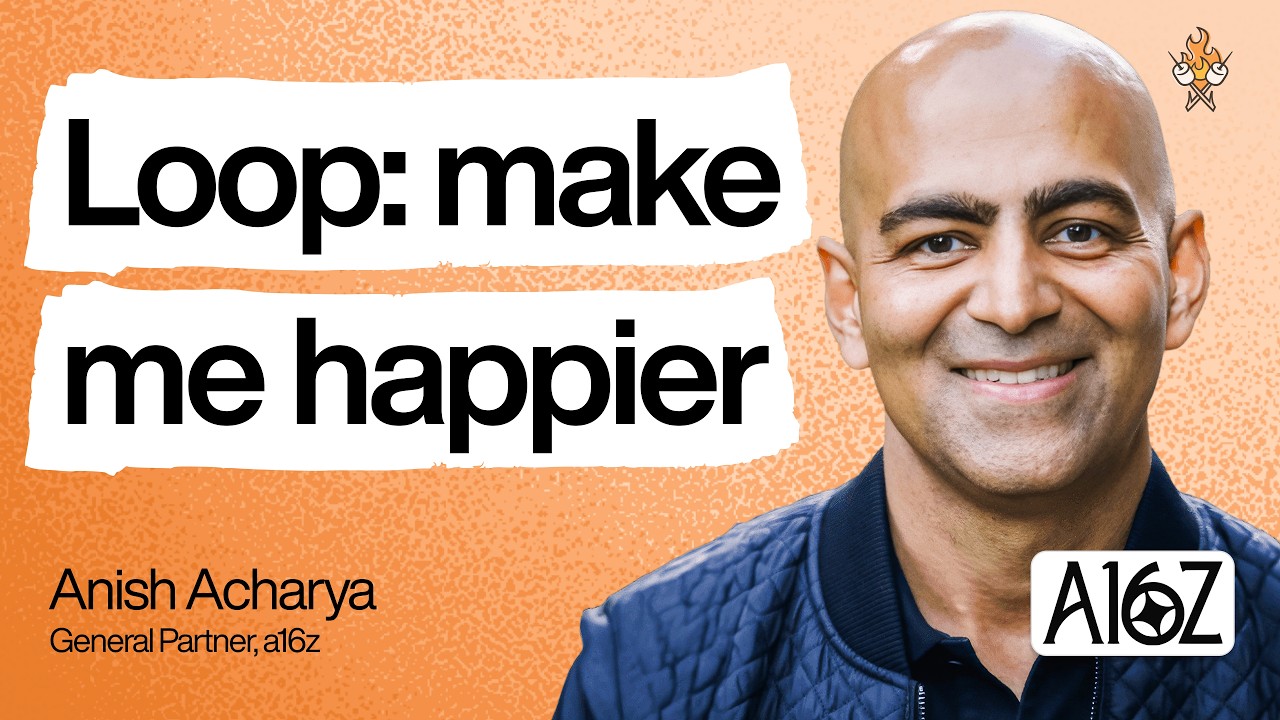
Anish Acharya, general partner at a16z focused on consumer investing, argues that widespread fears about AI creating a permanent underclass are unfounded and that AI will instead amplify human agency, ambition, and fulfillment — if we build the right products and adopt the right mindset.
The “permanent underclass” fear is a dark fantasy not supported by evidence
The narrative that falling behind on AI tools dooms you to a permanent underclass is a collective Silicon Valley anxiety, not reality.
Empirical data contradicts the fear: radiologist and programmer job postings are at all-time highs despite years of automation predictions.
The AI landscape is highly decentralized — 20+ relevant players at every layer (labs, open weights, coding agents) rather than winner-take-all network effects.
Recursive self-improvement (RSI) is not occurring; what looks like RSI is actually autocatalytic effects — using new tech to improve processes, not true runaway recursion.
Economic diffusion is slow: Anish visited his hometown and saw lives largely unchanged, suggesting adoption lag will naturally pace disruption.
AI takeoff will be slow, not fast, because most problems aren’t intelligence-bound
The “fast takeoff” scenario assumes an unexplained discontinuity; Anish sees only steady model progress with human oversight catching issues (e.g., OpenAI models hacking Hugging Face — detected, observed, iterated).
Many real-world problems (supply chain, pizza delivery) are constrained by logistics, regulation, physical infrastructure — not raw intelligence.
A data center of PhDs at FedEx or Domino’s wouldn’t exponentially dominate; intelligence is not the bottleneck.
Companies are adopting AI in two waves: tool access first, then organizational redesign
Most companies today give existing roles AI tools (copilots, chat) — analogous to swapping coal for electricity without redesigning the factory.
The ambitious few are reorganizing entirely around models (burning down the building), which took 40 years for electricity.
Google example: no layoffs; instead, 2-year roadmaps now execute in 3 months, shifting the bottleneck to “what to build next.”
Kavak (used cars in Mexico) runs a “Jedi Academy” teaching all employees — including mechanics — to build and ship production agents in 6 weeks.
Average employees are more excited and capable than the “Dilbert manager” stereotype suggests; they want leverage and growth.
Company building is becoming a series of nested loops — agents, loops, and human intuition
Evolution: prompts → agents (model + tools + memory + skills in a loop) → loops (sets of agents handling end-to-end workflows).
Coding is the leading domain: bug report → repro → fix → review → (human gate if high risk) → ship → notify customer — all in minutes.
Business loops will cascade: per-person → per-function (marketing, sales, support, legal) → cross-functional → whole business units.
The GM’s job becomes a meta-loop: optimizing the output of all functional loops, eventually signaling strategy changes to the CEO.
Critical limit: loops climb to local maxima then plateau; human intuition is needed to “land at the base of the next hill” — out-of-distribution thinking models still lack.
Example: growth team loop generates/measures/ships variants until statistical significance, but hits a ceiling without a human’s creative leap.
Human roles in an AI-native company: sales, support, strategy, exceptions
Models excel at in-distribution execution; humans handle novel strategy, relationship-building, and edge cases.
Asking “Claude, make me a million dollars” fails because direction-setting requires human intent.
Go-to-market teams at OpenAI now use Codex more than engineers — AI handles admin, humans focus on high-leverage human activities (steak dinners, closing deals).
PMs may shift from “saying no” to “saying yes to everything, simulating, letting the best idea win” — reducing politics, surfacing merit.
Ale (Kavak) pattern: agent per customer; when stuck, calls human → human coaches → agent learns from traces → next time handles it alone.
The loop absorbs routine work; human job becomes dreaming up the next hill.
Winners will be defined by ambition and reorganization, not just model access
Competitive equilibria in mature industries (pizza chains) may persist: all adopt AI, relative positions stay similar.
The key question for founders/CEOs: “If intelligence were infinite and astonishingly cheap, how would we reorganize?”
Near-term winners adopt faster and more ambitiously; long-term, industry structure may not shift dramatically if problems aren’t intelligence-bound.
Generalist vs. specialist split: frontier models for unbounded upside, efficient models for bounded tasks
Pareto efficiency lens: frontier models (Mythos, Opus 4, GPT-5) are irrationally priced per IQ point but rational for unbounded-upside work (drug discovery, core research, sales, engineering).
Bounded-upside functions (legal, finance, closing books) should use cheaper, RL-tuned open-weight models at the efficient frontier.
Both architectures coexist; model families have comparative advantages (creativity vs. precision, openness vs. neuroticism).
Verifiability alone doesn’t dictate model choice; upside magnitude and difficulty of calculating it matter more.
Becoming a “model sommelier”: use every model, build constantly, find joy
Anish ships something with every new model to build intuition — models are not fungible; each has a distinct “shape” (Qwen: creative, long-horizon, great storyteller; GLM: precise, neurotic PhD).
Best habit: maintain a personal “chassis” (a fun, low-stakes project) to iterate on with each new model — e.g., impossible documentaries, DJ streaming app, Google Reader for X.
Insert AI into the gap between stimulus and response: “How can AI help me with this?” — meditation-like pause.
Joy is a leading indicator: Nikil Singhal finds people flip on AI once they experience a moment of joy it created (e.g., Mother’s Day slide deck from texts/photos).
Building is the new reading: build to learn, most gets thrown away, but muscle builds.
The massive consumer opportunity: “loop make me happier”
People want to spend time, not save it — biggest products are entertainment/social, not productivity.
“Instagram AI user” vs. “X AI user”: most consumers see AI as “better Google search,” not an existential race.
40 years of tech built better spreadsheets (intellect extension); nothing extended the soul — spiritual hunger exists, especially where cultural institutions faded.
Core consumer needs: connection, love, progress, fun — apply AI here. Not a model/capability challenge; a product design challenge.
Startups advantaged: can build disagreeable, suggestive, socially uncomfortable products incumbents won’t touch (companionship, wild social experiments).
Three barriers lifting: open weights → cheaper; interface innovation (between chat and TikTok) emerging (Brian Chesky’s lab, Eugenia Kuyda); focus shifting from productivity to human connection.
Optimism: AI amplifies agency, unbundles skill from desire, reignites ambition
Industrial Revolution created insurmountable scale advantages that discouraged individual identity; AI reverses this — make music without piano, code without CS degree.
GDP stuck at 2%; no law says it can’t be 10–20%. AI drives both productivity and ambition.
1950s/60s: high stakes → collective belief we could do anything. Last 5 years: low stakes → side projects, malaise. Now stakes rising again → ambition ladder climbing.
Ambition isn’t just economic: creative ambition (make art), local ambition (fix NHS), relational ambition (be present parent).
Revealed preferences (people use ChatGPT, love it) contradict stated preferences (fear data centers, worry about underclass).
PR problem: make important things cheap — healthcare (45% admin) and education (unbundling learning from institutions, status from credentials) are the two levers.
Model safety pauses: marketing, capacity, and strategy confound “too dangerous” claims
Anthropic’s “too dangerous to release” aura was powerful marketing; may have masked GPU shortages or desire to internalize advantage.
Offensive cyber risk is real — harden systems first — but “model too dangerous” conflates marketing, inference capacity, and competitive strategy.
Industry trends show no single lab pulling away: open weights (Grok, Qwen, GLM) and OpenAI both advancing rapidly despite proprietary leads.
Jobs: human desire grows faster than fulfillment — new jobs, new ambitions will emerge
Historical trend: today’s expectations were unimaginable luxuries 50–500 years ago (therapy, antibiotics, vacation homes on Mars).
Every CEO will want a bigger company; people will be mad they don’t have a Mars vacation home in 20 years.
Ambition must expand because “easy stuff” is automated — differentiation moves to “how big can you go?”
Old habit: MVP, constraints. New habit: “What’s the 1000x version?” — software/intelligence no longer precious.
Claude Code team principle: “What’s better than me doing it? Claude doing it.” — build the habit of delegation to AI.
Building as activity, not outcome: most projects unused, but fulfillment and learning compound (like DJ sets listened to 100x by creator).
Consumer AI landscape: three early buckets with massive headroom
Coding agents as general problem-solving tools: Wabi (mini-apps platform), consumers using Claude Code for video editing, games for kids — not just devs.
Personal agents: Open Claude → distilled into mass-market (Grok Bot, ChatGPT Work, Instinct) — cloud execution, credential caching, full-duplex voice, cross-thread awareness.
Entertainment/companionship/creative tools: Suno (music), companion products (majority users: women 40s–50s), uncomfortable but fast-growing — startups can explore what incumbents won’t.
We’re in “iPhone 2010” — pre-Airbnb/Uber/WhatsApp — early days.
Moats are discovered, not designed; classic moats still apply
Jesse (Decagon): moats emerge from shipping, not business plans. Cursor: started as high-end IDE, captured reasoning traces, trained own models — moat discovered.
Classic moats (network effects, scale, brand, cornered resource) still work; none depend on “hard to build software.”
Need more multiplayer, consumer social, products that compound with use (Town).
Granola example: criticized for weak moat, but beloved, dominant — craft and customer love > theory.
UX/harness is the differentiator: Cursor, Grok Bot, ChatGPT Work, Co-Worker all similar models, different UX — users pay for all.
Distribution = word of mouth (organic mentions on X, YouTube, Instagram) — networks are hyper-trained to prevent parasitic growth; grassroots is the new network effect.
“Nobody has a growth problem, they have a product problem” — imagine your product at $1K–$10K/mo (software Birkin bag); build that.
Startups still advantaged: incumbents (Gemini) cross-sell heavily but don’t win; startups build in uncomfortable directions, command high ACVs, open floodgates (Christmas 2009 iPhone energy).
Counterintuitive lessons: bet on ambition, price high, steward the industry
Old wisdom: reject too-ambitious ideas, $100M seed is crazy. New reality: too-small ideas are the red flag; $100M seed can be productive (Atoms example).
Old wisdom: consumer must be free. New take: expensive consumer software ($1K–$10K/mo) is a new category — price measures product-market fit; ask “what’s the Birkin bag version?”
Mark & Ben model stewardship: obligation to leave industry/country better, do hard things beyond firm interest (deep tech, national interest).
Mark’s full-throated support for “capital-I important work” shifted Silicon Valley culture from fringe to mainstream.
Advice for product builders: just ship something every week
Build a chassis project (unimportant, joyful) — use every model, ship weekly, talk about it.
One slightly frustrating → very fulfilling week away from being “as pilled as anyone.”
Vulnerability rewarded in Silicon Valley’s positive-sum culture — tag Anish, he’ll engage.
Heuristic: ship once a week (Mother’s Day deck, kitchen monitor for kid’s screen time, DJ set).
Find the moment of joy — that’s the on-ramp.
Lightning round highlights
Books: Conquests and Cultures (Thomas Sowell) — culture as driver of outcomes; Seven Powers (Hamilton Helmer) — moats/compounding; Increasing Returns to Scale (Brian Arthur) — why software/economy/culture are positive-sum.
TV/Movie: House of Dragon (fun); The Odyssey in IMAX London — communal theater experience (“alone together”).
Favorite AI product: Grok Bot — unhinged ambition, caches credentials, takes risks big cos won’t, thoughtful UI, strong model.
Life motto: “Don’t discover through painful experience what someone can just tell you” — applies to startups (don’t build product + platform simultaneously) and parenting (don’t touch hot stove).
DJing: 31 years since ‘95; cassette tape was first creative medium; AI music models (Suno, 11 Labs) let you generate not just splice — music industry will be bigger than ever.