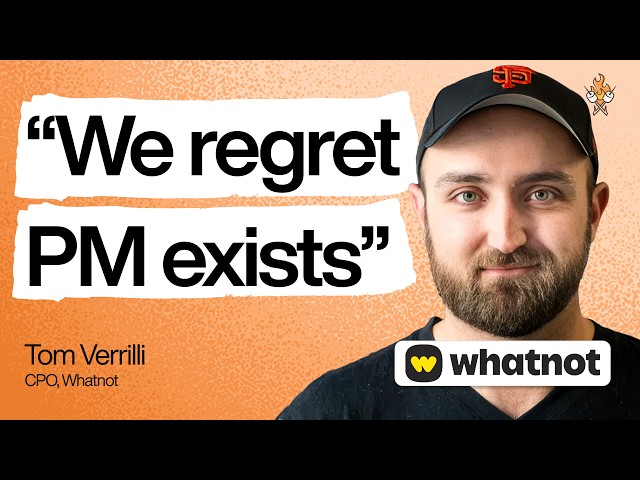
Tom Verrilli, CPO of Whatnot (live‑stream shopping marketplace, fastest‑growing US marketplace), former CPO of Twitch and director of product growth at Twitter, explains why Whatnot’s product team was founded on the premise “we regret that product management exists” and how that philosophy shapes hiring, org structure, the role of AI, and the future of the PM function.
The “we regret product management exists” philosophy
Product management is a modern specialist function that emerged to handle scale, not a fundamental necessity; the ideal state is engineers and designers having enough user context to make great decisions themselves.
The only argument for a dedicated PM function is that it’s a trade — a muscle built by reps — but abstracting engineers and designers from those reps atrophies their product judgment.
As companies scaled, an HR “pod ratio” (e.g., 6 engineers : 1 PM : 1 designer : 1 EM) became default, leading to PMs babysitting capable engineers and designers and infantilizing them.
Whatnot articulates the regret to force discipline: hire a PM only for a specific, high‑leverage need, not by default; map PMs to problems/projects, not permanently to teams.
Culture must support this: anyone can be a DRI for new product work, but everyone goes through the same product‑review rigor; if people don’t want to do the PM work, PMs can be moved in.
When specialization makes sense
Specialization works both ways: infra leads may not want to debate alignment or talk to customers; PMs can absorb that ambiguity so engineers/designers stay focused on their craft.
The “regret” framing is not anti‑PM; it’s a guard against hiring PMs reflexively and a reminder to keep engineers and designers close to users and decisions.
Consumer vs. enterprise is not the dividing line; organizational culture determines whether this model works.
AI’s role in the shift
AI is an accelerant, not the root cause: it gives ICs massive leverage (data queries, code‑base understanding, rapid prototyping) so senior PMs can cover more surface area and make faster decisions.
A broader cultural shift — top‑down decision‑making by leaders with ground‑truth context, bottom‑up roadmaps losing favor — predates AI but is amplified by it.
Senior PMs/ICs with good judgment can now do the work of multiple junior PMs, reducing the need for layers of alignment meetings.
Whatnot’s PM org structure
~21–22 PMs total (small for GMV volume), loosely grouped into buyer, seller, and trust/risk.
PMs are reassigned every 6‑month planning cycle: leadership defines outcomes/critical projects, then assigns DRIs (mostly PMs) to each; a PM may own a cross‑cutting priority that sits across multiple teams.
Not every DRI is a PM, but PMs dominate because they have the right skill‑set for the problem (financial, algorithmic, core user feature, etc.).
Hiring: what 31,832 applications and 1 hire revealed
Trending down: candidates who emphasize “driving alignment,” “stakeholder management,” or political navigation — signals of “product theater” rather than decision‑making.
Trending up: demonstrated systems thinking (macro + micro), impatience to validate and ship, specificity about novel problems they solved (not just polishing existing features), and ability to make decisions amid ambiguity.
Interview process includes a hands‑on case study with data and a verbal PRD defense; thinking often decays quickly for candidates strong at presentation but weak at substance.
Developing systems thinking
Practice mental exercises: “What do we do if this experiment is green? Red? What if usage 1000×? What knock‑on effects?”
“Know then go”: think through risks, scale breaks, legal/finance/other‑team concerns upfront, then move fast because you’ve pre‑empted many issues.
Focus on compounding vectors, not 5% statistical wins, especially in high‑growth environments.
Shift to senior ICs doing IC work
Traditional ladder promoted great PMs into directors who stopped doing hands‑on work, creating yo‑yo review cycles and slowing decisions.
At Whatnot, managers (including CPO) spend 50–90%+ time on IC work: reading support tickets, pulling data, querying code, writing specs, running stand‑ups.
Advantages: (1) senior instincts make faster, better decisions; (2) one senior PM can cover multiple workstreams, naturally aligning trade‑offs (e.g., same PM owns discovery and ads, eliminating months of negotiation).
“Why wouldn’t you want Messi playing rather than running the academy?”
Comp model: redirect the cost of a deep management hierarchy (multiple L5s, L7s, VP) into fewer, highly paid senior ICs delivering outsized impact.
Advice for PMs in today’s market
Start doing IC work in your current role: scope problems, define good, pull data, talk to customers — keep the muscle honed.
Push internally for hands‑on productivity; it helps your current role and makes you hireable.
“PMs are engineers now” is overstated; leverage comes from understanding the codebase and scoping correctly, not necessarily shipping production code (which has high overhead for non‑engineers).
How AI transformed work at Whatnot (beyond prototyping)
Data science (biggest unlock): Hex threads let PMs pull nuanced cohorts, individual user logs, build sensitivity/forecast/regression models in minutes vs. weeks; PMs now spend 10× more time in data while talking to data scientists far less.
Code‑base understanding: Query Claude/Cursor to learn system internals (boxes‑and‑lines + nuance) without distracting engineers.
Live‑product feedback loop: Watch a seller/buyer live, simultaneously analyze code in real time via AI to distinguish bugs from comprehension gaps — “feedback loop on steroids.”
The data scientist dilemma
Data scientists now review half‑baked AI‑generated analyses from non‑specialists; empathy for the role shift.
Mitigation: invest heavily in data engineering, tracking, attribution, and labeling so AI tools operate on clean foundations; senior PMs with more reps misinterpret data less often.
AI leverage doesn’t absolve responsibility for rigorous analysis.
Roles trending up vs. down
Down (per unit of output): PMs, data scientists — but total headcount may not shrink because leverage enables more projects.
Up: “Tech‑lead EM hybrids” — small‑team leads who run fast, incubated efforts on hard problems; cheaper to try things, so more small bets.
Future product team shape
Core specialist teams (PM, eng, design, DS) remain for high‑conviction, well‑scoped projects.
At the edges: “free space” where anyone (designer, eng, PM, DS) with customer context, code fluency, and macro view can ship improvements without formal assignment.
Core PM skills are the most durable in an AI world
Identifying what to build, distilling requirements, prioritizing ROI, giving design feedback, go‑to‑market strategy, translating business/tech/customer — these are the durable leverage points.
Industry has rewarded “product theater” (storytelling, alignment, frameworks) over these core skills for years; AI exposes the gap.
Whatnot’s case‑study interview filters for the core skills; theater collapses under hands‑on scrutiny.
Getting the most out of people: “hire great people and get out of their way” is wrong
Better model: verify then trust. Leadership must understand ground truth (code, data, fraud labeling SOPs) to make good macro decisions; delegate detail but stay periodically deep.
Founder/CEO example: Grant (Whatnot CEO) clears his day, sits with team, pulls tickets/code/data line‑by‑line to seek truth — sets cultural tone that reviews are “us vs. the problem,” not “PM vs. approver.”
Planning aligns on what to solve (resourcing); leadership must still go deep on how to ensure decisions are grounded.
Navigating the CPO–founder relationship
Two product‑minded founders (Grant, Logan); if they’re on a project, CPO steps back — “two dads problem” creates conflicting instructions.
CPO covers areas founders aren’t in; ensures bar‑raising coverage everywhere.
Rhythm: understand it’s their company; ask “are you open to feedback/push?” and calibrate; don’t compete for vision — translate it into reality.
Top‑down works when leadership is in the weeds
Micromanagement is a dirty word only when leaders lack ground truth; if they share data and context, teams feel unblocked, not controlled.
Best feedback comes from leaders literally in the detail; AI makes this feasible at scale.
Founder clears calendar for the 3–4 most critical things; CPO takes the rest — “what am I doing more important than nailing the five things we committed to this half?”
Advice for aspiring CPOs / first PMs joining founder‑led companies
Clarify why you want the role (it’s not “I decide the roadmap”).
Spend real time jamming with the founder before joining: how do they think, take pushes, make decisions? Be your ordinary self, not interview self.
Art of pushing: start from curiosity (“do you have context I lack?”), then “is your mind made up or open to input?” — if made up, shut up; if open, bring data; if no data exists, CEO’s opinion wins — check ego.
“Play the accordion” mental model
Stretch out (zoom out): define the system, belief, long‑term implication.
Compress in (ship V1): build the smallest test, learn.
Stretch out again: re‑evaluate based on learning, adjust plan.
Constant oscillation prevents pure iteration (spaghetti at wall) and pure roadmap (no learning).
Example: listings in live commerce — sellers don’t need them, but new buyers need search → listings help discovery but hurt seller velocity → keep stretching/compressing to find the right trade‑off.
Most US retail (~80%) is still in‑person, low‑intent, social, curation‑driven — mall experience.
Live commerce uniquely combines internet scale/convenience with social/cultural experience; 30–50 viewers on a stream = packed physical store economics (commerce ≠ CPMs).
Not winner‑take‑all; $7.5T US retail leaves room for both models.
Lessons from Twitter (2015–16 era)
Product‑market fit is visceral: if you bottle lightning, org chaos barely matters; PMF = fervor, not “graphs look okay.”
Most “complexity” is weak leadership: everyone knew 140‑char limit had to go (Japanese users tweeted 6× more due to kanji), but no one made the call for years — nobody died when it finally lifted; same for edit tweet.
Network effects are the moat: Elon changed brand, name, team, product — network held.
Failure corner: averages lie
Recurring failure mode: relying on aggregate metrics (e.g., “only 3% use this feature”) and deprecating, missing the cohort for whom it’s 100% of their workflow.
In marketplaces, that’s someone’s business; deprecating without nuance = mall cutting power before Christmas.
Bezos: “When data and anecdote disagree, trust the anecdote.”
Lightning round highlights
Books:The Hard Thing About Hard Things (best PM book), The Purpose Driven Church by Rick Warren (engineering emotional investment/community), Babel by R.F. Kuang (fiction).
Recent favorite show:Star City (Apple TV) — Soviet‑side For All Mankind.
Favorite product: Service NSW (Australian government app) — one‑click life admin (license renewal, title transfers, etc.).
Life motto: “I’ll figure it out” — most things aren’t as hard as they seem if you devote time/energy.
Best recent Whatnot purchase: Live California spiny lobster from a San Diego fisherman (e‑fish‑co) — streamed off the boat, auctioned live, UPS overnight on ice, delicious.
Online: @tdrobbo on X (product + Warriors takes), LinkedIn for longer writing.
Hiring: always hiring PMs (payments, logistics, etc.); 31,832 applicants / 1 hire reflects skill‑set bar, not discouragement — apply via Whatnot jobs or reach out to any Whatnot PM.