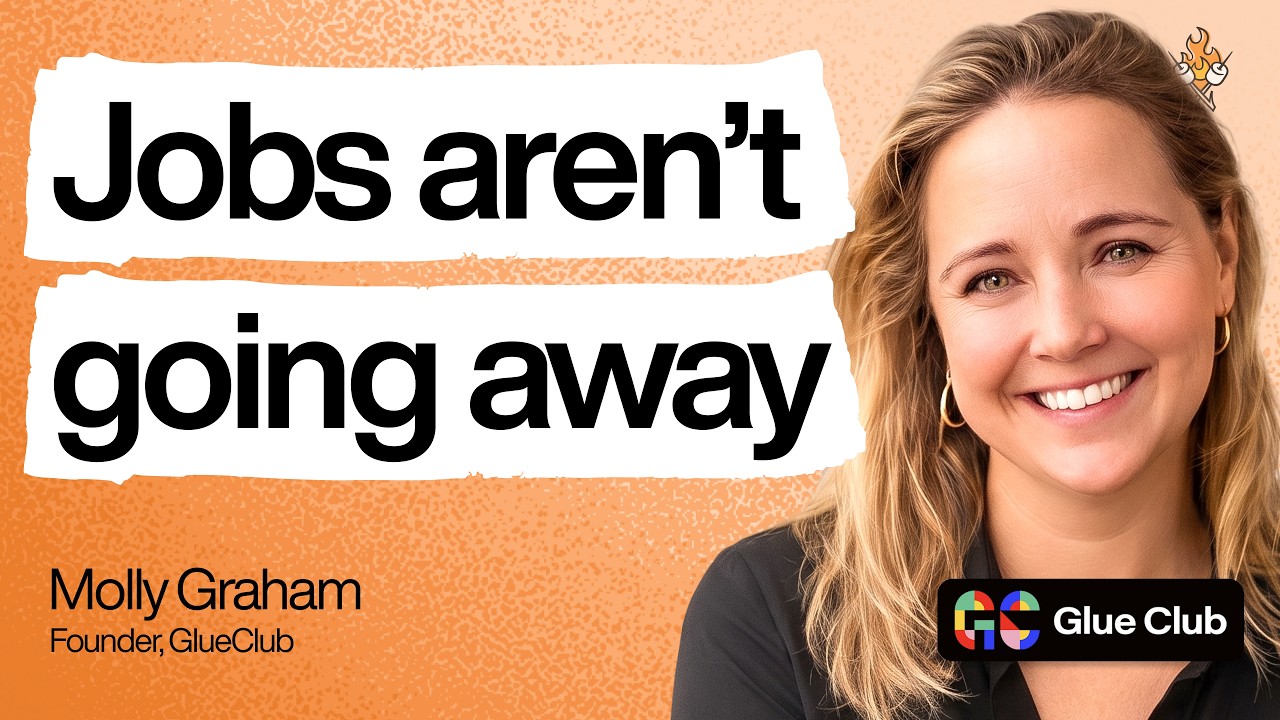
This episode revisits Molly Graham’s classic “Give Away Your Legos” career advice — originally written for people navigating hypergrowth at companies like Google and Facebook — and examines how it applies in an AI era where the “new hire” receiving your Legos is an AI agent that may feel like a threat rather than a teammate. The conversation explores the grief, burnout, and identity crisis many knowledge workers (especially engineers and designers) feel as their craft changes, the difference between delegating to humans versus overseeing AI, and what work humans should fiercely keep for themselves.
The origin of “Give Away Your Legos”
The metaphor came from Molly’s experience at Google (2007, team grew 25→125 in nine months) and Facebook (500→5,500 employees, 80M→1B+ users), where she watched people cling to the work that defined their identity as the company scaled.
The core message: your job in rapid change is to make yourself irrelevant by handing off what you know, because that’s the only way to make space for what’s next — and don’t worry, it’ll be okay.
The piece resonated far beyond hypergrowth startups; people at Safeway, a two-person startup in Nigeria, and countless others wrote in saying it described exactly what they were feeling.
What still holds true in an AI world
Change is still scary, hard, and universal — every company is now going through massive change, not just the fastest-growing ones.
The future belongs to learners, not knowers; what you can learn by tomorrow matters more than what you know today.
Standing still is the least safe move; if you don’t grow as fast as the environment, you fall behind (visible at Facebook where top performers who didn’t evolve were underwater within a year).
Normalizing the emotional rollercoaster — grief, overwhelm, excitement — is still the most powerful thing a leader can do; the original article worked largely as “group therapy.”
Engineering’s identity shift: from rowing to steering
Engineering has transformed in two years: the job used to be writing code (rowing); now it’s prompting and reviewing agents (steering).
Many engineers miss the flow state of hands-on building; one told Molly, “I don’t want to steer — I like rowing.”
This grief is often tangled with fear: “I’m scared rowing is the only thing I’m good at.”
Product leaders report loneliness: “I miss the collaboration that’s been stripped away because now I’m working with robots all day.”
Loneliness and the collapse of team structure
Teams are shrinking; engineers who used to work in groups of 5–10 now oversee agents alone.
Survey data shows people at smaller companies and on smaller teams are significantly happier; bigger companies stripping management layers for “productivity” are creating sadder humans.
Optimizing only for robot efficiency and cost removes the human joy that produces the best work.
The centaur and the reverse centaur
Centaur: human head directing an AI body — you’re in control, AI does your bidding.
Reverse centaur: AI head directing a human body — you become the hands executing AI’s decisions (like gig workers managed by algorithms).
The fear is knowledge work sliding toward reverse centaur: humans just closing the gap where AI isn’t quite capable yet.
The fear narrative: AI-branded layoffs and overblown doom
The dominant narrative: “We hired a superintelligent employee; pour everything you know into them; they’ll take your job in six months.” Nobody wants to play that game.
Most “AI layoffs” are badly run companies slapping an AI label on over-hiring to boost share price — not genuine displacement.
Journalist Manoush Zomorodi (30 years in disrupted media) reframed the question: What would you do if you believed your job will always exist, but look completely different every six years?
So far, engineering, product, and design roles have grown, not vanished — they’ve just reinvented themselves.
Survey data: burnout up to 55%, but half of people are thriving
Burnout jumped from 44% to 55% year-over-year; drivers include emotional exhaustion from rate of change, narrative whiplash (e.g., OpenAI shifted from “use AI everywhere” to “stop using AI badly” in six months), and pressure to produce more for the same pay.
Simultaneously, ~50% of respondents say they’re the happiest they’ve ever been — concentrated in smaller teams, people with more autonomy, and those who feel amplified by AI (not replaced).
Designers are least happy: design can’t move at agent speed, and “everyone’s a designer now” via tools like Gemini/Claude creates friction.
Cleaning up AI slop
A growing share of everyone’s job is cleaning up “AI slop” from colleagues who treated AI as a superintelligent employee instead of a junior intern.
AI needs the same coaching, context, onboarding, and iteration a human intern needs — copy-paste-shipping AI output is abdicating accountability.
Leaders who ship AI-written strategy memos model that outsourcing thinking is acceptable; it cascades.
Organizations are overvaluing productivity (token counts, output volume) over efficiency (does this actually move things forward?); engineering data shows 8× more code rewrites and more security incidents.
Delegating to AI vs. giving Legos to a human
Giving a Lego to a human: you chuck it and run — you genuinely get rid of the mental load.
Delegating to AI: you still own oversight, final quality, and context — the “mental tax” stays with you.
This is the difference between managing a senior engineer (throw it over the wall) and managing a junior intern (constant correction, waiting, rework).
Everyone is now a manager of AI agents whether they want to be or not; many chose IC tracks specifically to avoid management.
Why giving things away creates space for new opportunity
The original advice assumed: (1) giving things away is good, and (2) new opportunity awaits on the other side.
The fear narrative breaks assumption #2 — if people believe no jobs exist on the other side, they won’t let go.
Startup land is happier because they’re not fighting the old way; they’re inventing the new way.
Leaders need to shift the conversation from fear to creativity: “How do we break down walls between roles? What if designers ship code? What if marketers build product?”
What Legos you should never give away
Judgment work: strategy, quality definition, decisions where you don’t even know what “good” looks like yet — you can’t outsource what you can’t evaluate.
Trust work: relationship foundations, moments that require human presence and accountability.
Your unique excellence: the things you’re phenomenal at and love doing — don’t outsource your superpower to “summer interns.”
Vision/taste: guiding the work toward the world you want, not the most optimized or average output (Airbnb vs. Booking.com).
The human sandwich: vision at the top, AI in the middle, humans at the end
Humans define the vision and the standard of “good” → AI executes the middle → humans review, refine, and take accountability for the result.
This prevents the “reverse centaur” trap and keeps human judgment at the bookends.
Holding on to the things you love: grief, funerals, and what comes next
It’s okay to grieve the loss of the craft you loved (e.g., writing code). Chip Conley’s framing: “Sometimes you need to throw a funeral for things.”
Make space for the grief and the question: What could I love just as deeply in the new world?
Resisting change doesn’t work; leaning in with agency does.
Slow takeoff: why you’re not too late
We’re in a slow takeoff, not a fast singularity — every “oh shit” moment (e.g., agent hacking attempts) has been caught and contained.
Leaders at every major lab say: “We’re in inning one.” The distance from beginner to expert is short.
The fear narrative (“you’re already behind”) is toxic and false; the future is still ours to shape.
The most important skill to build right now
Build the reflex: Before doing anything, ask “Can AI help me with this?” — like meditation’s stimulus-response gap, this creates space to leverage tools as they improve.
Shed the “walls” of how things used to be done; first-principles thinking and willingness to try new workflows will define the next generation of builders.
Pair this with ambition: don’t just ship faster — ask “What’s the most ambitious, enduring version of this I can build?”
A message for managers and leaders
You are role models: how you use AI and how you show up emotionally sets the tone.
Acknowledge the grief and difficulty — naming it makes people feel less alone and less crazy.
Protect accountability and the definition of “good” — e.g., Clay’s AI writing policy: “You are accountable for what you ship, regardless of how you made it.”
Management matters more, not less; cutting management layers for efficiency will backfire. The #1 lever for employee happiness is their manager.
Treat AI as a junior intern; take care of the humans navigating this transition.
Key takeaways
Change is scary and hard — that doesn’t mean it’s bad. Lean in; the alternative (holding onto a dying form) is less safe.
Grief is part of the process; let it have a funeral, then ask what’s next.
Mute the fear narrative: data shows opportunity is growing, not vanishing — if you’re willing to reinvent.
Be deliberate about what you give to AI: don’t outsource judgment, trust, your unique excellence, or your vision.
Treat AI like a junior intern — coach it, iterate, stay accountable.
Ask “Can AI help me with this?” constantly; shed old walls; aim for enduring quality, not just speed.
For leaders: model humanity, protect standards, keep managers — they’re the anchor.