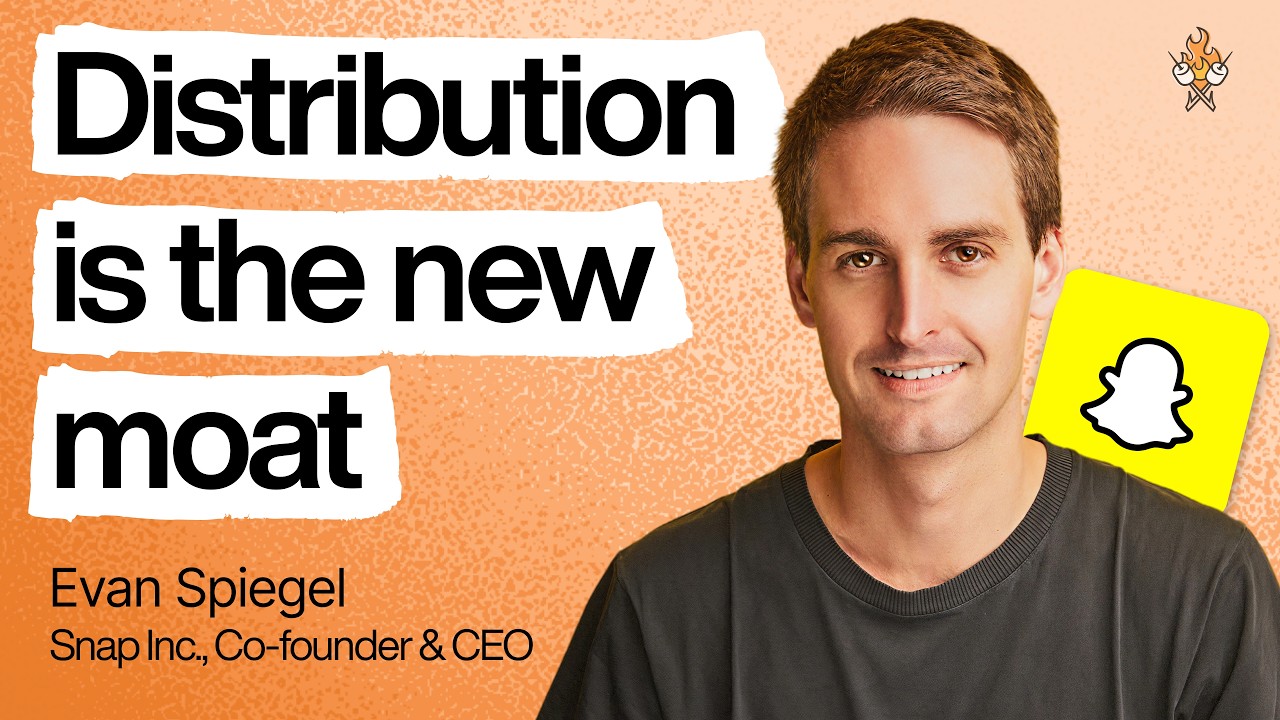
- Evan Spiegel, CEO and co-founder of Snap, joins the podcast to explain why building a lasting consumer social product is extraordinarily difficult, how Snap has survived and innovated for 15 years, and why he believes this year is a “crucible moment” for the company.
- Snapchat has over 1 billion monthly active users, generates over $6 billion in annual revenue, and has invented foundational social features—Stories, AR lenses, swipe-based navigation, face filters—that the entire industry has copied.
- Despite this track record, Snap’s stock has underperformed, the company is not yet net income profitable, and Evan frames the coming year as a turning point where Snap must prove it can be a strong, profitable business while launching its next-generation AR glasses product, Specs.
Why consumer social products are so hard to build
-
The core challenge is distribution, not product-market fit.
- Most consumer tech founders focus on building the right product, but the real differentiator is figuring out how to get people to actually use it.
- When Snapchat launched 15 years ago, the app store was new and people were actively downloading new apps. Today, that organic discovery channel has largely disappeared.
- TikTok succeeded by spending billions to subsidize both creators and viewers. Threads succeeded by leveraging Instagram’s existing user base. Both solved distribution first.
-
Snapchat’s early distribution insight was that connecting people to their closest friends matters more than connecting them to the largest network.
- The prevailing belief at the time was that network effects made the biggest social network unbeatable.
- Snapchat found that value came from connecting someone to their best friend or partner, not to everyone they knew—allowing it to grow despite much larger competitors.
Software is not a moat
-
Snap learned 15 years ago that software features are trivially easy to copy, a lesson the AI era is now teaching everyone else.
- Stories, AR lenses, swipe navigation—every major Snap innovation has been cloned by larger competitors, often at great benefit to those competitors.
- Evan’s response has been to invest in things that are hard to copy: ecosystems (creator and developer platforms), hardware (Spectacles/Specs), and vertically integrated technology stacks.
- The AR lens platform, where developers have built millions of lenses, is an example of an ecosystem moat that is far harder to replicate than any single software feature.
-
Network effects alone are insufficient defensibility.
- Even with a billion users and strong network effects, Snap’s software innovations get cloned quickly.
- Building platforms that support relationships between creators, developers, and the community creates a compounding advantage that pure network effects cannot provide.
Why Snap invests in hardware
-
Evan’s motivation is fundamentally about making computing more human and less isolating.
- He observed that phones pull people out of real-world social interactions—even when friends are physically together, they’re often looking at their screens.
- Snap’s hardware journey started with getting the camera off the phone (early Spectacles), then added depth sensing, displays for overlaying digital objects, and finally a full operating system for developers.
- The upcoming Specs product represents 12 years of investment in a new computing platform designed to keep people grounded in the real world while enhancing social interaction through AR.
-
Specs use cases center on shared, multiplayer AR experiences rather than notifications or heads-up displays.
- Unlike heads-up display glasses that show notifications in a corner of the lens (which Evan finds unappealing and socially awkward), Specs anchors digital content in the real world within the user’s field of view.
- The goal is enabling new ways for friends to hang out together—learning to be an airbender, placing virtual plants around a room, drawing in shared space—rather than replicating phone notifications on your face.
How Snap innovates: organizational structure
-
Snap’s innovation model is informed by Safi Bahcall’s “Loonshots,” which describes the tension between structured organizations (good for scaling) and flat organizations (good for innovation).
- Large, hierarchical organizations are operationally excellent but risk-averse—people focus on promotions and hitting targets rather than trying new things.
- Small, flat organizations generate ideas quickly but lack the structure to deliver them at scale.
- The key leadership challenge is maintaining a constructive dialogue between these two types of organizations so they don’t become adversarial.
-
Snap operationalizes this through a very small design team (9–12 people) with a flat, non-hierarchical structure.
- The design team has no titles or seniority distinctions, and new members present work on their very first day.
- Evan meets with designers for a couple of hours every week to review hundreds of ideas, creating a high-velocity feedback loop modeled on art school critique culture.
- The design team serves as an intentional bottleneck—everything that ships must be approved by design, which slows things down but ensures a cohesive customer experience.
-
New ideas come from everywhere, but the design-engineer dialogue is the primary engine.
- Snap’s culture was modeled on Evan’s co-founding relationship with Bobby Murphy—Evan with a design background, Bobby with computer science and stats—where mutual respect between disciplines drove innovation.
- Engineers working on reliability and customer-facing features generate ideas alongside designers, and the ongoing dialogue between these groups produces the best outcomes.
Talking to customers: Snap’s approach
-
Evan strongly disagrees with the “don’t talk to customers” school of thought.
- He advocates going deep—spending an hour or two understanding how people use technology, how it fits in their lives, and how they feel about existing products.
- The key is listening for underlying needs rather than building exactly what people ask for.
-
The invention of Stories illustrates this approach.
- Customers kept asking for a “send all” button to blast snaps to everyone, and they complained about the pressure of permanent, metrics-driven social media posts.
- Snap didn’t build a send-all button. Instead, they created Stories: chronological, ephemeral, without public likes or comments, solving the underlying problems customers described without literally following their requests.
-
Screenshot detection was another foundational early innovation.
- When Snapchat launched, people said “disappearing photos” was impossible because you can always take a screenshot.
- Evan and Bobby figured out that taking a screenshot while pressing and holding to view a snap triggered a touch-event change that could be detected, even without an Apple API. They used this to notify senders when a screenshot was taken—a core mechanic that helped establish trust in the platform’s ephemerality.
Product managers at Snap
- Snap waited until it had roughly 200 employees before hiring its first product manager.
- Evan’s concern was that traditional tech org structures reduce designers to visual executors responding to PM direction, rather than active contributors to product strategy and vision.
- He wanted designers to own product direction themselves, modeled on the designer-engineer partnership he had with Bobby.
- At Snap’s current scale, PMs play an important coordination role—synthesizing data science, managing legal/trust-and-safety requirements, and bringing cross-functional teams together to ship products.
AI’s impact on the designer-PM-engineer triad
-
Designers at Snap are now shipping code, which Evan sees as validating the creative discipline.
- Many designers were told growing up that studying design instead of computer science was impractical. AI tools now let them go from idea to shipped product at scale.
- There is no requirement to ship code—designers are self-motivated to learn and adopt new tools.
-
AI also requires new guardrails at scale.
- With more people able to submit code, Snap has built automated code review systems that have caught nearly 10,000 bugs.
- An internal system lets users shake their phone to report problems, and AI agents can now debug issues and suggest fixes.
-
Snap is organizing its AI transformation around “jobs to be done” for users and advertisers.
- Rather than letting AI experimentation happen chaotically, Snap mapped out core jobs (get people to download the app, add friends, use lenses; for advertisers, configure campaigns, etc.) and is building agent-supported cross-functional teams around each one.
- This provides a clear mechanism for tracking progress against business outcomes.
-
Snap is building end-to-end agent workflows.
- Example: a go-to-market agent that takes a product idea, writes the spec, identifies stakeholders, performs risk analysis from legal/trust-and-safety perspectives, and drafts blog posts and marketing materials in one shot.
- These agents are primarily built using Claude and live within Glean, which provides secure access to all of Snap’s internal documents and dashboards.
Evan’s evolution as a CEO over 15 years
-
The CEO role has changed dramatically—from doing everything (design, customer support, legal filings, fundraising) to focusing on leadership, culture, strategy, and communication.
- Evan’s biggest area of personal growth has been learning to communicate effectively—to his team, to shareholders, and publicly.
- He was initially reluctant to do all-hands meetings and Q&A sessions, preferring to send emails, but a board member pushed him to embrace it. He now genuinely enjoys the dialogue and learns a lot from the questions his team asks.
- He cites President Clinton’s description of the presidency as “explainer-in-chief” as a framework he returns to often.
-
Evan still stays deeply involved in product details and pixel-level decisions.
- He describes being “in the weeds” as what drives him and gets him out of bed in the morning—it’s not work to him.
- He believes staying close to the product and customers is the most important thing any leader can do, regardless of company type or role.
Hiring and developing design talent
-
Snap hires designers based solely on portfolio—not experience, pedigree, or where they went to school. Most join right out of school.
- Evan looks for two things in a portfolio: range (can they build things that look very different from each other, showing empathy for different audiences rather than a single artistic style) and the story behind their work (how they approach problems and what they learned).
- He values diverse backgrounds on the design team—3D animation, electrical engineering, etc.—because different perspectives strengthen the team.
-
Young designers are developed through high-volume making and rapid feedback.
- New designers present work on day one, establishing a culture of constant creation and critique from the start.
- The goal is to eliminate preciousness around ideas—when you’re generating thousands of ideas, it’s fine that most aren’t great.
- Designers are rotated across different products (chat, maps, AR, games) to keep them fresh and bring cross-pollinating perspectives.
Snap as the “middle child” of tech
- Evan describes Snap as the middle child: much larger than Pinterest or Reddit, but far smaller than Meta and Google.
- This position brings both advantages (enough scale to do interesting things) and challenges (being overshadowed by bigger competitors and getting less attention from the market).
- The “middle child” framing connects to the crucible moment—Snap needs to define itself on its own terms, and launching Specs to consumers is a key part of that self-definition.
Screen-time philosophy for Evan’s four kids
- Evan and his wife take an age-appropriate approach: zero screen time for their 2-year-old (except Bobcat tractor YouTube videos during haircuts), occasional movies for their 6- and 7-year-olds (who also play with the Mod Retro, a screen-limited device from Palmer Luckey’s startup), and full technology access for their 15-year-old.
- His eldest son is the most fluent with AI tools and serves as a beta tester for Specs.
- Evan sees AI as especially empowering for kids because it lets them turn any idea into something tangible almost instantly, and he believes it needs to be deeply integrated into education.
Contrarian view: humanity over technology
- Evan’s contrarian belief is that humanity matters more than technology in determining outcomes.
- The tech industry focuses heavily on technological advancement, but human adoption and comfort dictate how technology actually gets deployed.
- He believes society will push back significantly against many AI-driven changes, and that the industry needs to put humanity first—ensuring tools advance human goals, not just business goals.
Lightning round
- Recommended books: The First 50 Years of Apple by David Pogue (first half, featuring interviews with 150 early Apple team members) and The End of the World Is Just the Beginning by Peter Zeihan (about vulnerabilities in global shipping).
- Recent entertainment: Marty Supreme, which he describes as an intense, edge-of-your-seat movie experience.
- Recently discovered product: Rediscovering Pokémon through his kids—he sees enormous untapped potential in the franchise.
- Life motto: “You have two ears and one mouth. Use them in that proportion.”
- Favorite lens: The Vomiting Rainbow, for the joy it brought to people. Least favorite: Face swap or the old lens, which were intense and unsettling.