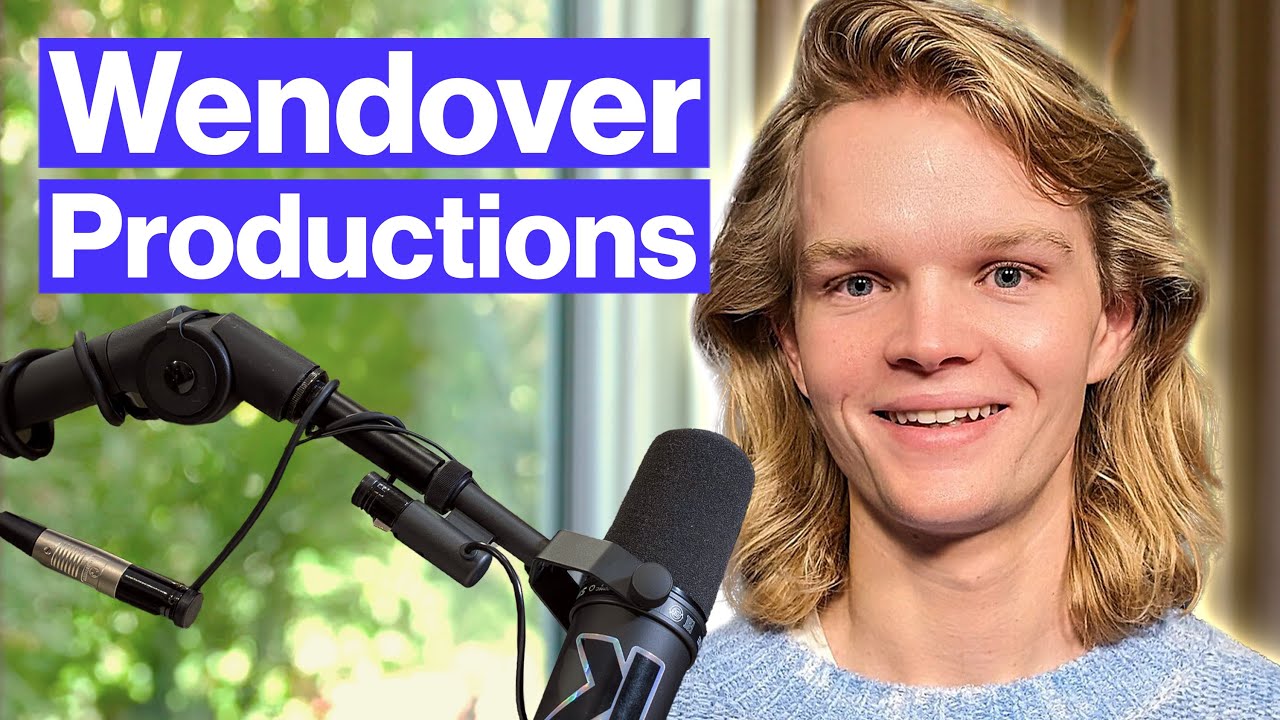
Sam from Wendover Productions and Eric from Carrot sit down for a structured, question-based conversation that reveals both personal histories and professional philosophies, covering Sam’s evolution from teenage YouTuber to co-owner of Standard/Nebula (a creator-owned streaming and tools company supporting 150+ creators), Eric’s path from Facebook/McKinsey to founding Carrot, the origins of the travel competition show Jet Lag, and deeper reflections on risk, identity, and building meaningful work.
How Sam Got Here: From Teenage YouTuber to Company Co-Owner
Sam started YouTube at 17–18, during his final semester of high school in the UK, initially just because he liked making videos—he didn’t tell anyone at first.
His first videos got tens of thousands of views quickly, and by the time he started college, it was already a full-time-equivalent income.
He describes this as the “Holy sh** this is cool” era—suddenly having disposable income and creative freedom as a college student.
Throughout college, he wasn’t sure he wanted to scale it; he was more in a “figuring out how to be an adult” phase, partly because he worried YouTube’s business model was too good to last.
His family background is steeped in consulting (father at McKinsey, brother in the same world), and he could easily have followed that path.
He also launched a second channel, Half as Interesting, during this time.
He graduated in spring 2020, right as COVID hit—his college experience ended by pressing “submit” on an online portal, with no ceremony.
He moved to Colorado in May 2020 and began hiring writers and building an office, entering the “figuring out how to run a company” era.
This was a tough period of trial and error: learning how to manage people, train writers from academic/journalism backgrounds for YouTube, and structure workflows.
About a year and a half before this conversation, things started to click. He told his team that 2022 would be their growth year—and it was, largely because of Jet Lag’s launch in March 2022.
Jet Lag grew so fast that Sam’s current challenge is not creating growth but regulating it—making sure it doesn’t consume or destabilize their other channels.
He describes the current era as the “growth era,” both professionally and personally.
The Responsibility of Running a Creator-Owned Business
Sam is co-owner of Standard/Nebula, which supports 150+ creators and is likely the largest independently owned creator-run streaming platform (aside from partner Curiosity Stream).
He’s not deeply involved in day-to-day operational decisions but is responsible for big-picture direction.
The company is creator-run, which means decisions are made with creators’ actual needs in mind—but it also means they agonize over small changes because those changes are amplified across 150–200 clients.
Sam feels a genuine fear about making the wrong call, not just for the business but for the livelihoods and well-being of the seven people directly on his payroll and the broader creator community they serve.
He draws a parallel to Eric’s Uncle Ben moment: with great freedom comes great responsibility—the work has to keep going and keep getting better so that clients want to stay.
Eric’s Path: From Facebook and Depression to Founding Carrot
Eric’s life chapters, as he frames them:
Tryhard era: Chasing external validation—Harvard, Blackstone, McKinsey, Facebook—because he thought that was the only way to justify his parents’ sacrifices. He was miserable.
Depressed era: After leaving Facebook, he went through a serious depressive period, including an outpatient program at El Camino Hospital. He describes this as the structurally inevitable follow-up to the tryhard era.
Trying things era: Emerging from that, he decided to give himself a shot at building something he actually cared about—which became Carrot.
Trying really hard not fail era (current): He has the opportunity and the responsibility, and he’s fully committed to making it work.
Eric cold-emailed Sam’s agent Dave in early 2020 to pitch Carrot. Dave’s first response was essentially “this is a terrible idea, but I’ll take the call to tell you why.”
Eric was honest on that call: he wasn’t sure Carrot would work, but he believed in the vision of financial services built for creators.
Sam was cardholder #12 or #13—one of the very first people to join Carrot, not because he was convinced by the product specifics but because he understood the long-term vision and trusted Eric’s intentions.
First Impressions and the Vegas Poker Trip
Their first phone call was in May 2020, during deep quarantine. Sam was in a hammock in DC; Eric was pitching Carrot.
Sam’s initial impression of the concept was that it sounded dystopian (social stats determining credit), but the conversation evolved into a genuine riff on how broken the financial system is and why there was a real opportunity.
Their first in-person meeting was a trip to Vegas with MrBeast, TierZoo, and Real Engineering to gamble.
Sam lent Eric money to play poker when Eric realized he’d forgotten his debit card—a small act that Eric remembers as a sign of Sam’s decency.
Eric folded early on a hand that turned into a full house because MrBeast, with his effectively unlimited bankroll, bullied everyone at the table—illustrating how someone with no attachment to money can dominate a game everyone else takes seriously.
The Origin of Jet Lag
Jet Lag emerged from a convergence of factors:
Sam loves travel and has always felt The Amazing Race could be better—specifically, that the show treats travel as a backdrop rather than the actual game.
The core insight: travel itself can be optimized. Flight schedules, airport navigation, route planning—these are skills you can be good or bad at.
In summer 2021, Standard/Nebula needed a new original. Their original slate of big-budget on-location documentaries was impossible because of COVID.
They developed a bare-bones concept: make travel the game. This became a Nebula original called Half as Interesting’s Crime Spree, where Sam tried to break weird laws across America while Ben and Adam chased him.
The format worked—not because of the weird laws, but because of the underlying game mechanics. They realized the chase-and-travel structure was inherently engaging.
They then developed it further into Jet Lag, which launched on YouTube in March 2022 and almost immediately took over Sam’s professional life.
Sam describes it as achieving product-market fit: the concept itself drives growth, and his role is more about directing and regulating than creating from scratch.
On Identity, Risk, and the Freedom to Fail
Sam is 24 and deeply grateful for the freedom that comes with youth and financial security—he can fail tremendously and have time to recover.
This allows him to take what he perceives as high-risk decisions (though he acknowledges they may actually be relatively low-risk given his safety net).
He contrasts this with someone starting a company at 40, 50, or 60, who has to think about the next two decades in a much more constrained way.
Eric took a different path to the same psychological safety: he spent years at prestigious companies (McKinsey, Facebook) specifically so that, when he left, he knew he could always go back.
McKinsey’s “alumni return” policy—a written offer to come back if you leave in good standing—was both empowering and a trap for him. It kept him there longer than he wanted because it reduced the perceived risk of leaving.
He eventually realized the policy was preventing him from taking the risks he actually wanted to take, and he left anyway.
Both agree that having a form of psychological safety—whether from youth, savings, or a prestigious resume—is what enables people to take meaningful swings.
Admiration and Connection
What Sam admires most about Eric: his ability to take what are perceived as higher-risk decisions, built on a foundation of psychological safety. Each step—leaving Facebook, starting Carrot, launching a new kind of financial product—was a departure from the previous path, and Eric kept choosing the new thing.
Sam also notes that Eric is obviously smart and genuinely enjoys learning and sharing knowledge.
What Eric admires most about Sam: the human touch in how he builds business. Despite being in LA and operating at scale, Eric has built Carrot around genuine relationships and community. Sam sees this as a real skill and the key factor in Carrot’s growth.
The moment they both felt most connected: sharing the human stories behind their resumes—Eric’s depression and recovery, Sam’s uncertainty in the early days of YouTube. Both related to the gap between how successful someone appears from the outside and the doubt they felt along the way.
Sam notes that every big YouTube channel started with someone just uploading a video and seeing what happened—there’s no grand origin story, just a decision to start and keep going.
Sam’s Philosophy on Goals and Content
Sam’s stated goal is to be the best content creator in existence—a goal he knows is impossible to fully achieve, but that’s the point. An impossible goal keeps you on the path indefinitely.
He references the phenomenon of climbers who summit the Seven Summits and then fall into depression because they have no next goal. A moving target prevents that.
He extends this beyond YouTube: his team’s core competency is making the absolute best content possible, period. If you do that, there will always be a way to monetize it—since the beginning of civilization, people have found ways to pay for content others want to consume.
He references Nietzsche’s three metamorphoses (camel, lion, child): most people start bound by others’ expectations, then fight against them, and ideally reach a state of pure flow where they just do what they want. Sam feels he was in that third state almost from the start—he made videos because he liked it, and everything followed from that.