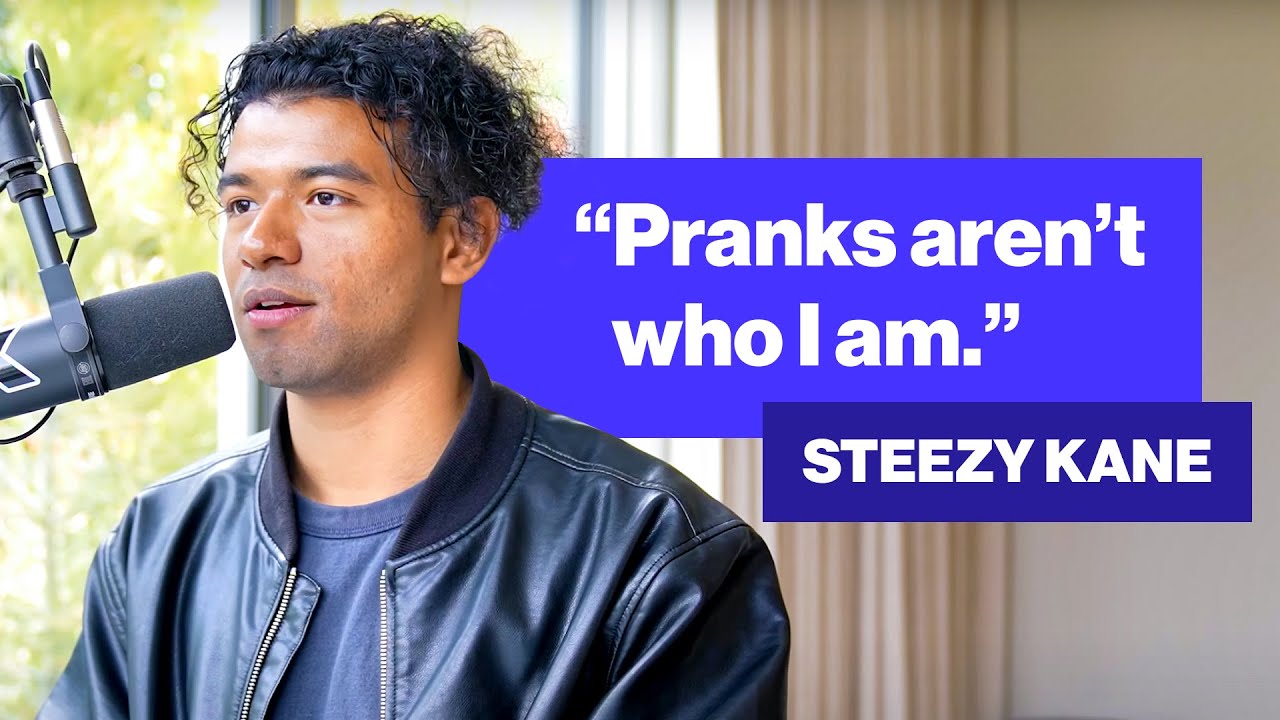
- Steezy Kane is a creator who rose to fame through prank videos on YouTube but is now transitioning toward filmmaking and more thoughtful, documentary-style content. He reflects on his journey from viral prank videos to pursuing serious creative work, the financial struggles that came with early fame, and his evolving philosophy on art, meaning, and the pressures of algorithms and audience expectations.
From Viral Pranks to Creative Filmmaking
-
Kane’s career began with a viral prank video—jumping off a pier—which was posted by WorldStarHipHop and garnered around 20 million views on Facebook, roughly 10% of the U.S. population at the time.
- This led to rapid channel growth, his first significant income, and moving out of his parents’ house.
- However, his entire channel was eventually hit with copyright strikes due to using copyrighted music, causing his income to drop dramatically to as little as $500–$1,000 per month despite having a million subscribers.
- He describes this period as “broke famous”—being publicly recognized while financially struggling, which made the experience of poverty more humiliating because of the perceived expectations that came with fame.
- It took about two years to stabilize financially; even after hiring employees and scaling up, he was still breaking even because expenses matched income.
- He emphasizes that financial success is not about how much you make but how much you keep.
-
Kane always had a deeper interest in filmmaking, sparked in high school when he auditioned for a short film and observed the director, DP, and crew working together.
- He started with pranks because they were accessible and aligned with content he grew up watching (Jackass, Angry Video Game Nerd, etc.), but always intended to transition into film.
- He sees pranks and film as closely related, making the shift more natural than, say, moving from YouTube to music.
Blending Algorithm Appeal with Authentic Content
-
Kane experiments with packaging his more thoughtful, cinematic content using clickbait-style thumbnails and titles reminiscent of Mr. Beast, then delivering laid-back, narrative-driven videos.
- This approach is risky because YouTube’s algorithm tends to favor high-energy, consistent content, but Kane prioritizes creating work he’s personally proud of.
- He believes constraints—whether from algorithms, executives, or audience expectations—can actually improve art by forcing discipline and focus.
- He compares algorithm pressure to executive producers tightening a script: it’s collaborative refinement, not creative suppression.
- However, he acknowledges the algorithm is “scarier” because it’s a rigid machine, unlike human collaborators.
-
Kane identifies a tension between two creator archetypes: Emma Chamberlain, who treats YouTube as a creative canvas, and Mr. Beast, who treats it as a business.
- He sees himself in the middle—passionate about storytelling but also aware of the need to “dance on the stage” of the algorithm to build a sustainable career.
- He uses the metaphor of wrapping the algorithm around your spine like a support structure rather than letting it dictate your every move.
Philosophy, Meaning, and the Role of Art
-
Kane has recently become deeply interested in existential questions, particularly whether life has inherent meaning or if humanity is essentially an accident.
- He shares a personal analogy: Earth might be like a glass of milk left on the counter, with humans as the mold that grew unintentionally—neither good nor bad, just existing.
- He finds beauty in both possibilities: if we don’t matter, that’s freeing; if we do, that’s meaningful.
- He references the philosophical concept of the “clockmaker God”—a creator who sets the universe in motion and walks away—and contrasts it with his milk mold analogy, which emphasizes neglect rather than design.
- He shares a personal analogy: Earth might be like a glass of milk left on the counter, with humans as the mold that grew unintentionally—neither good nor bad, just existing.
-
Kane believes art is humanity’s most important tool for expression precisely because we lack clear answers about our purpose.
- He tells a parable about a dancing crowd where everyone stops to ask the DJ where they’re going, only to discover the DJ is unknowingly steering a ship—symbolizing how no one truly knows the direction of life, and that uncertainty is what frees us to create and express ourselves.
- He connects this to the Gauguin painting Where Do We Come From? What Are We? Where Are We Going? and the film Everything Everywhere All at Once, both of which explore similar existential themes.
Personal Growth and Self-Reflection
-
Kane reflects on how his self-perception has changed over time:
- At 18, he felt like the center of the universe; by 19–20, he realized life was harder than he thought and others seemed more successful.
- Around age 21–22, he began seriously contemplating existential questions and reevaluating his identity beyond the “Steezy Kane” persona.
- He created the Steezy Kane alter ego in high school as a path to success, but now recognizes it doesn’t reflect his true self—he’s more introverted and earnest than the high-energy prankster image suggests.
-
He wrote a letter to himself at age 17 predicting his future: a million subscribers, living in Hollywood, waking up each day choosing what to do. When he received the letter years later, nearly all of it had come true—except he hadn’t yet bought his mom a house, which remains a goal.
- His younger self wouldn’t believe how mature and calm he’s become; he used to think you had to stay a “kid” forever, but now values balance between fun and seriousness.
- He admires Bryan Cranston as someone who is both deeply thoughtful and a goofball, showing that maturity and playfulness can coexist.
Building Capabilities and Embracing Failure
- Kane received advice at Creator Camp (run by Max Reisinger and Ryan Ing) that resonated deeply: even if a project fails, the skills and knowledge gained will eventually be useful in unexpected ways.
- He’s currently developing a TV show called Views, which he’s pitching to FX Networks, and has spent a year and a half on it.
- Even if it doesn’t get picked up, he values the experience of learning to write scripts, treatments, and pitch to executives.
- He believes every endeavor builds capabilities that serve as “dominoes” for future opportunities—even seemingly wasted time (like laziness or heartbreak) can provide rest or motivation that fuels later success.
- He’s currently developing a TV show called Views, which he’s pitching to FX Networks, and has spent a year and a half on it.
Transcending the “YouTuber” Label
- Kane is actively trying to move beyond being labeled a “YouTuber,” which he feels is reductive and diminishing.
- He aspires to be seen the way Donald Glover, Bo Burnham, and Issa Rae are viewed—not defined by their YouTube origins but recognized for their broader creative work.
- He wants to reach a point where “YouTube happens to be where I post my work” rather than being defined by the platform.
- He admires independent filmmakers like Spike Lee, who made impactful films with minimal resources, and believes modern technology (drones, affordable cameras) makes high-quality independent filmmaking more accessible than ever.
Family, Creativity, and Early Influences
- Kane grew up in Canada near a nuclear power plant where his father worked as a nuclear physicist; the family moved to Indiana and then New Jersey when he was five due to his mother’s concerns about radiation exposure.
- His father was creatively inclined—teaching him Photoshop and video editing using Pinnacle Studio 14—and his mother eventually bought him a computer and a Flip camera.
- His first film, made at age eight, was called The Unbeatable, a high-concept short about his brother becoming an unbeatable monster—showing early signs of his storytelling ambitions.
- He has three younger brothers, none of whom are currently involved in media, though their interests are still developing.
Living an Interesting Life as Content
- Kane discusses the concept of “imploding content”—when creators start vlogging about being a YouTuber, causing the content to collapse in on itself.
- He praises creators like Kelly Stamps, who is vlogging her journey to becoming a commercial pilot, as examples of how living an inherently interesting life creates compelling content naturally.
- He notes that many successful older-generation creators (Mickey Rye, Genie Weenie, Stevioe, Rich BFF) started by documenting their existing careers (nursing, flight attendant, EMT, finance), which gave them authentic material before the content itself became the focus.
The Beauty of Endings and Cherishing Moments
- Kane and the host discuss how everything—relationships, life, podcasts—eventually ends, and how that inevitability is what makes moments precious.
- Kane used to avoid getting pets because he didn’t want to deal with their eventual death, but his ex-partner helped him realize that endings are what give experiences meaning.
- He connects this to the idea that rare moments (like playing kickball with his dad and brother, or playing football with his father three times in childhood) become more cherished precisely because they happened infrequently.
- The host shares a similar experience with his military father, and both agree that these brief, self-contained memories function like little stories within the larger narrative of life.
Final Reflections
- Kane describes feeling most connected during the conversation when discussing rare, meaningful moments with family—highlighting how scarcity deepens emotional resonance.
- He reflects on the dual nature of human expressions (smiling can be genuine or forced; crying can be joy or sorrow) and references the “Stepford Smiler” trope as a real phenomenon.
- The conversation ends on the theme of balance—yin and yang—as the answer to life’s tensions: happiness and sadness, pressure and freedom, endings and meaning.