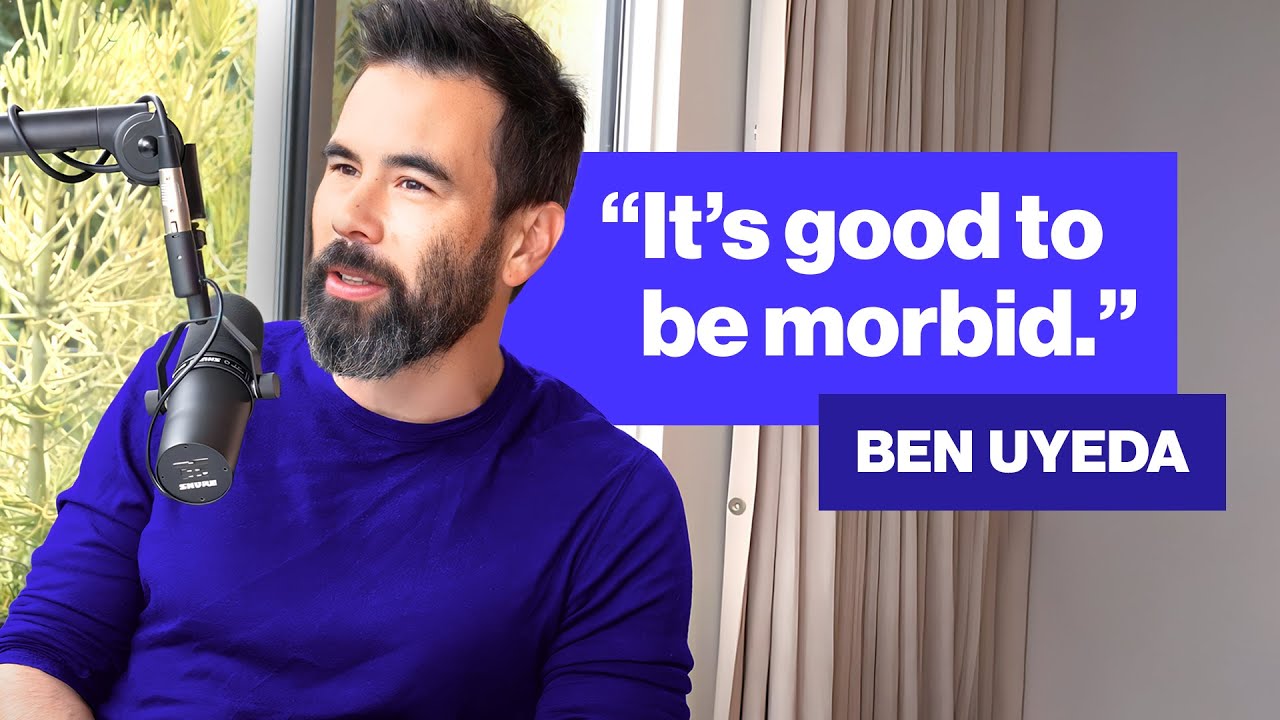
Ben Uyeda is a designer, maker, and YouTuber who runs the channel Home Made Modern, where he creates design and DIY content. He studied architecture but shifted focus from designing for wealthy clients to making design accessible to more people through YouTube and the internet. This conversation explores his philosophy on design, life, optimization, failure, friendship, and how to live deliberately rather than efficiently.
Designing Life Like a Video Game
Ben’s core philosophy: don’t try to live life as if it’s a video game you need to win, but as if you’re designing your own video game — focusing on setting up boundaries and incentives that make the experience consistently enjoyable rather than racing toward optimization.
He first encountered the concept of diminishing returns as a teenager playing video games, noticing that the most fun came midway through — when you understand the rules but still have discovery ahead — not at the end when everything becomes predictable.
Once you “beat the game,” further play becomes about optimization (speed runs, high scores), which can strip away joy and turn play into work.
Applied to career and life: the goal is to structure things so the process itself remains rewarding, not to squeeze out maximum efficiency at the expense of enjoyment.
The Compromised Designer
Ben grew up in suburban California with no remarkable architecture around him, which made architecture school feel exotic and exciting. But he noticed his parents lived happy, fulfilled lives without ever engaging with design discourse.
This led him to reconcile his passion for design with the reality that it’s not essential to a good life — and to focus on making the common good and making the good more common, rather than chasing masterpieces.
He describes himself as a “compromised designer” — not in a negative sense, but in the sense that he’s oriented toward practical, accessible outcomes rather than pure artistic ambition.
His design philosophy crystallized around a simple idea: take something you already enjoy and make it easier or more accessible. His favorite example: the ultimate luxury would be an avocado tree growing inside his kitchen, so he could pick a perfectly ripened avocado without stepping outside.
From Architecture to YouTube
After starting an architecture firm and gaining recognition (magazine covers, etc.), Ben noticed that the more successful a designer becomes, the wealthier and narrower their client base gets — designing a $200K house takes as much effort as a $2M house but pays far less.
He shifted to YouTube and internet-based design because it allowed him to design things that reach many people rather than a few wealthy ones, comparing it to the difference between Titanic and Moonlight — both excellent, but one reaches far more people.
He describes his approach as “vertically integrated” — designing, making, and sharing the process himself.
On Optimization, Justification, and Indulgence
Ben thinks deeply about when justification for expenses hits diminishing returns. He naturally justifies most purchases through utility (acting classes help him podcast better, a house has business value), but he most appreciates gifts from others that are completely useless and sentimental — because he’d never buy those for himself.
He allows himself “quirky indulgence” in his workshop — buying materials and tools on impulse for future projects, even if they sit unused for a year. This isn’t efficient, but it enables spontaneous creative moments.
The danger of justification: you can post-rationalize any purchase, but you’re not accounting for the counterfactual (something else would have inspired you anyway). The key is having trusted people who can check you if self-justification drifts into entitlement.
He references stories of celebrities (Ellen, JLo, James Corden) who may have developed plausible justifications for bad behavior because of their sense of importance — a warning about the path from reasonable self-care to entitlement.
On Death and Failing Gloriously
Ben enjoys contemplating mortality, influenced by Stoic philosophy (memento mori). He finds it makes him kinder and less anxious about worst-case scenarios.
He mentioned an app called “Deathbook” — a journaling tool that lets you plan your funeral like a wedding registry — which he found intriguing.
On how he’d like to die: free to death while doing something adventurous, like ice climbing or diving off a glacier. From what he understands, you simply feel heavy and sleepy as your circulation slows.
The “glorious” part: you’re failing (dying) in pursuit of something magnificent, and there’s even a slim chance someone finds your frozen body centuries later and revives you.
Contrast with dying from a drug overdose — high dopamine, but someone has to find you in an unglamorous state, which imposes a burden on others.
The conversation crystallized into a shared mantra: “Sally forth and succeed or fail nobly — and don’t leave a mess.”
Transactional Relationships and Longevity
Ben observes that all human relationships have transactional elements — even between parents and children, siblings, or spouses. This can lead entrepreneurs toward cynicism and a tendency to “bottom-line” human interaction.
But he argues that long-term transactional relationships are where the deepest bonds form. He compares long-running TV shows like Friends or The Office to critically acclaimed but shorter series like Breaking Bad:
Friends isn’t considered a masterpiece, but the sheer longevity and familiarity created profound emotional connections between viewers and characters.
Similarly, working with a freelance graphic designer for nine years — a transactional relationship — produced a genuine friendship because the longevity itself has meaning and virtue.
Longevity smooths over the transactional nature of relationships and turns something ordinary into something profound.
On Fear of Failure vs. Fear of Success
Ben distinguishes between glorious failure and humiliating failure. He’s less afraid of failing itself and more afraid of the appearance of failure — what people he went to high school with would think.
On the surface, success seems scary because of the hedonic treadmill: each achievement raises the bar, and satisfaction diminishes relative to the difficulty increase.
His experience bears this out: hitting 100K YouTube subscribers was one of his happiest years (it meant financial security and proof the venture wouldn’t fail), while hitting 1 million was one of his least fun (overextension, too many projects, stress).
His conclusion: success isn’t scary when you remove the thorns of stress and anxiety. The velocity of progress matters less than the existence of progress and security. Success becomes scary only when you’re willing to endure traumatic, exhausting things to achieve it faster.
What He’s Afraid Of Now
Ben’s current fear is responsibility — specifically fiduciary responsibility to investors and partners in real estate development projects.
YouTube videos have low stakes (if it flops, no big deal), but real estate involves other people’s money and requires presenting an optimistic, exciting vision of the future.
This creates anxiety and sleepless nights — the feeling of having bitten off more than he can chew.
When pitching to creator-investors, Ben tries to be honest about the risks (“most likely this won’t work”), but he’s found this doesn’t land well — people hear either confidence or doubt, not both simultaneously.
He’s found a better framing: present the odds honestly (e.g., “startups have a 10% success rate, but we’re better than that, and the returns justify the risk”) — similar to how sports betting communicates risk and reward.
Earliest Memory of Happiness
Ben’s earliest memory: sitting on his grandfather’s porch at around age two, playing with a plastic typewriter. He remembers the haptic feedback of the keys and the smell of his grandfather’s cigarettes (who smoked for 80 years and lived to 104).
He acknowledges memory is malleable — he’s seen a photo of this scene, so the “memory” may be partly reconstructed from the photo. But the sensory impression of the typewriter keys feels real and encoded.
An important early memory (not the happiest but empowering): receiving a real band saw for Christmas at age nine or ten. His parents gave them dangerous tools with proper instruction, which gave him and his brother huge social status in the neighborhood — they could build better forts, wooden swords, and crossbows than kids with plastic toys. This taught him that adult capabilities are more fun than toys.
Most Important Similarity Between Them
Ben identifies temperament as the most important similarity: both have an even, calm demeanor and don’t yell or scream at people.
He notes a potential downside: even temperaments can result from internalizing too much stress rather than sharing it, becoming a “point of absorption” for scary things.
The other person adds that Ben has a considering mind — he thinks deeply and deliberately about how and why he lives the way he does, which the other person admires and tries to cultivate in himself.
Deliberate Non-Optimality in Design
Ben designs his life and home around deliberate non-optimality — choosing things that aren’t efficient but bring him joy.
Example: his new house has two dishwashers. He only uses the second one every two weeks when hosting dinner parties for 6-8 people, but it stores his complete set of entertaining dishes — they go from the dishwasher to the table and back, so he never has to unload it. The extra cost was ~$2,000 over a cabinet, but the convenience and joy of hosting justify it.
He wouldn’t prescribe this for everyone — it’s not an optimal use of money in general — but it’s justifiable enough for his life, and the deliberateness is what makes it special.
How He’d Describe Ben to a Stranger (e.g., an Investor)
Rather than listing generic admirable traits, Ben would focus on what’s rare in the context of startup founders:
Calm in the face of adversity — reframing “even temperament” as a quality that’s especially valuable because every startup inevitably faces crisis.
Renaissance man — someone with genuine versatility across many domains (design, making, building, content) who actually creates and makes things, not just manages.
He’d avoid observations that took years to notice and instead highlight things an investor would immediately recognize and that would prompt a call to action.
What the Conversation Taught Each of Them
Ben realized he’s comfortable in conversational settings even though he rarely seeks them out — like a third-favorite cuisine that’s especially enjoyable precisely because you don’t have it often. He also reflected on the value of internet friendships transitioning to in-person relationships.
The other person took away several philosophical mantras: die gloriously, make comfortable plans, move directionally. He also questioned the cultural obsession with discipline and hustle, noting that his most disciplined periods weren’t his most joyful or fulfilling, and that over-discipline in one area can create problems in another.
He reflected on Ben being one of his first “internet friends” — someone he met online during COVID (2020) and only later met in person — and how this represents an underrated model for forming meaningful friendships later in life.