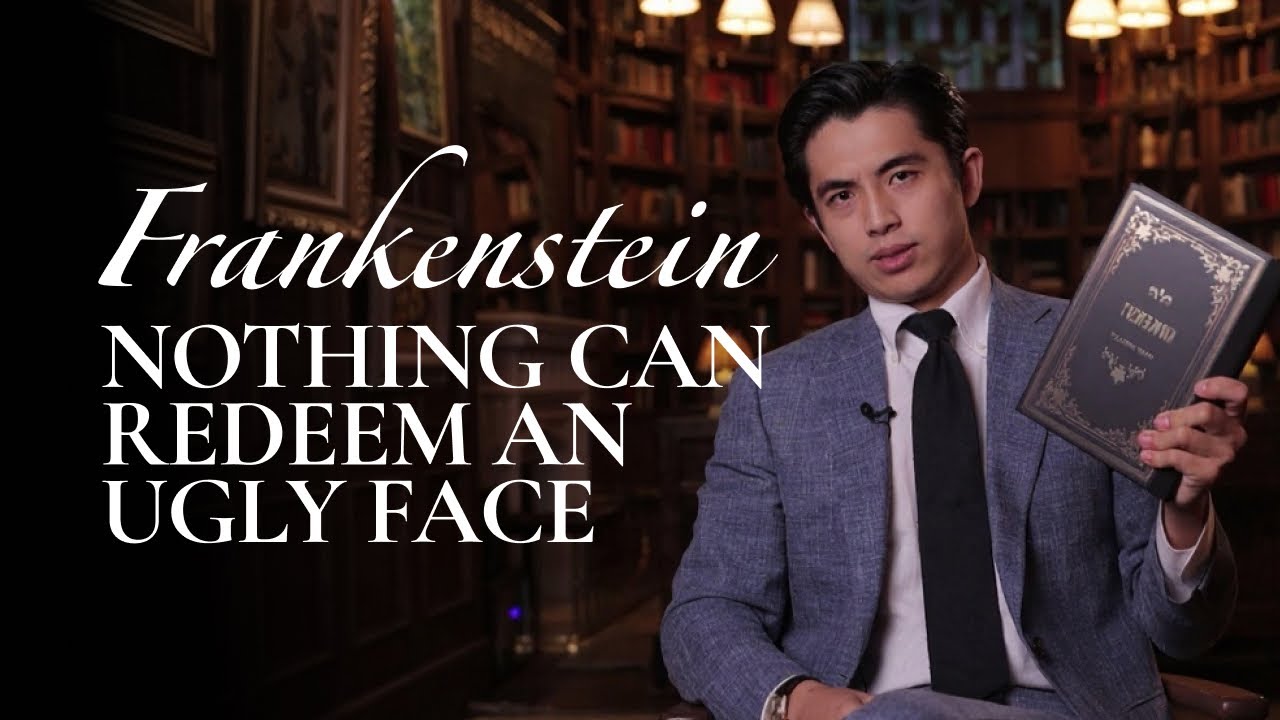
Mary Shelley’s Frankenstein is often read as a social commentary — that the monster becomes evil only because society rejects it for its ugliness — but the novel also supports a deeper, more unsettling reading rooted in the forgotten discipline of physiognomy, the idea that outer appearance reveals inner character. The episode explores both readings, examines their strengths and weaknesses, and argues that modern society’s refusal to take appearances seriously may cause us to lose insight into the soul.
The Monster’s Character and the Central Question
Victor Frankenstein assembles his creature from carefully chosen beautiful corpse parts, but the result is an eight-foot-tall hideous being with yellow, translucent skin, watery eyes, and a grotesque appearance — so repulsive that Victor abandons it immediately upon animation.
Despite being the defining figure of horror, the monster is portrayed as gentle, rational, and even ethical in the early part of the novel: it rescues a drowning girl (and is shot by her guardian for its appearance), secretly helps a family by performing chores, and attempts to befriend the family’s blind father — only to be violently driven away when the sighted children return.
The monster only turns to murderous vengeance after repeated rejection, and even then it feels genuine remorse — unlike classical villains such as Satan in Paradise Lost or Iago in Othello, who feel none.
This raises the episode’s central question: how does ugliness — the monster’s defining feature — turn an otherwise ethical soul wicked?
The Social Reading: Rejection Breeds Resentment
The most common interpretation is that the monster’s wickedness is caused entirely by social prejudice — that society’s lookism creates a self-fulfilling cycle of resentment and violence.
This reading resonates with the modern incel community: men who, unable to find romantic partners largely due to their looks, develop deep resentment that sometimes erupts in violence. Like the monster, incels do not merely want sex — they want romantic recognition, a social good.
The monster demands a female companion who is equally deformed, so she cannot abandon him for being ugly — mirroring the incel concept of “looks matching,” where people of similar attractiveness pair off to ensure security in recognition.
Mary Shelley was part of the Romantic movement, and her mother Mary Wollstonecraft was a leading feminist — both movements locate the origin of evil in changeable social habits and prejudices, not in immutable human nature.
Under this reading, society itself is to blame: had people treated the monster as the blind father nearly did, it would not have become evil.
Problems with the Social-Only Reading
First problem: the social reaction against ugliness may itself be innate and immutable. The monster itself tries a Romantic experiment — approaching a child it assumes has not yet been corrupted by society — but the child screams “ugly wretch” and “ogre” on sight, suggesting the human aversion to ugliness is hardwired, not learned.
Second and stronger problem: what if the connection between ugliness and wickedness is not merely social but intrinsic — if ugliness actually indicates an already-corrupt inner character? This is where physiognomy enters.
Physiognomy: The Forgotten Discipline
Physiognomy is the discipline of reading inner character from outer form, especially the face — for example, a straight nose indicating nobility, a hooked nose indicating cunning. Though dismissed today as pseudoscience, it was considered a serious science from antiquity through the 19th century.
There is a kernel of empirical truth: experiments show that even forced smiling makes people feel happier, suggesting a real connection between facial expression and inner states.
Physiognomy was practiced by Plato, attributed to Aristotle’s school, and peaked in the 18th century with Johann Lavater, whose Essays on Physiognomy was an international bestseller. Mary Shelley’s father read it, and she almost certainly did too — its influence is clearly visible in Frankenstein.
Under the physiognomic reading, the monster’s ugliness does not cause wickedness through social rejection — it reveals a latent wicked essence that eventually blooms over the course of the novel.
This reading requires us to be suspicious of the monster’s own account of its purity and remorse, since Victor warns us the monster is highly eloquent and deceitful.
Evidence for Physiognomy in the Novel
Elizabeth, Victor’s adopted sister, is described with all the classical Lavater markers — bright golden hair, clear brow, blue eyes, expressive lips — and she is correspondingly noble, gentle, and virtuous throughout. She is later revealed to be the abandoned daughter of a Milan nobleman, echoing the Shakespearean trope (as in The Winter’s Tale) that noble appearance signals noble birth and character.
Justine, the beautiful maidservant, is gentle and ethical even when wrongfully sentenced to death — providing a counterpoint to the social reading, since she too suffers injustice and exile but never turns evil.
Victor Frankenstein himself is handsome but cowardly and selfish — but this is not a refutation of physiognomy, because Lavater did not claim strict moral determinism. He held that appearance reveals one’s essence, which can rarely be overcome through nurture.
The classic example is Socrates, who was famously ugly but had a beautiful soul — because, as Nietzsche entertainingly recounts, Socrates acknowledged that his face truly revealed his vicious youthful appetites, but he overcame that essence through philosophical practice.
What This Means for the Modern World
The episode argues that modern society is an outlier in Western intellectual history for treating appearances as disconnected from inner reality. The Greeks, Christians, and early moderns all took beauty as a meaningful indicator of proper functioning and goodness.
The speaker is not claiming physiognomy is correct, but that dismissing appearances entirely causes society to lose pathways to the soul that earlier traditions understood.
Frankenstein serves as a reminder of the multiple mechanisms — social and intrinsic — that can connect ugliness and wickedness, and that taking appearances more seriously might yield deeper insight into human character.