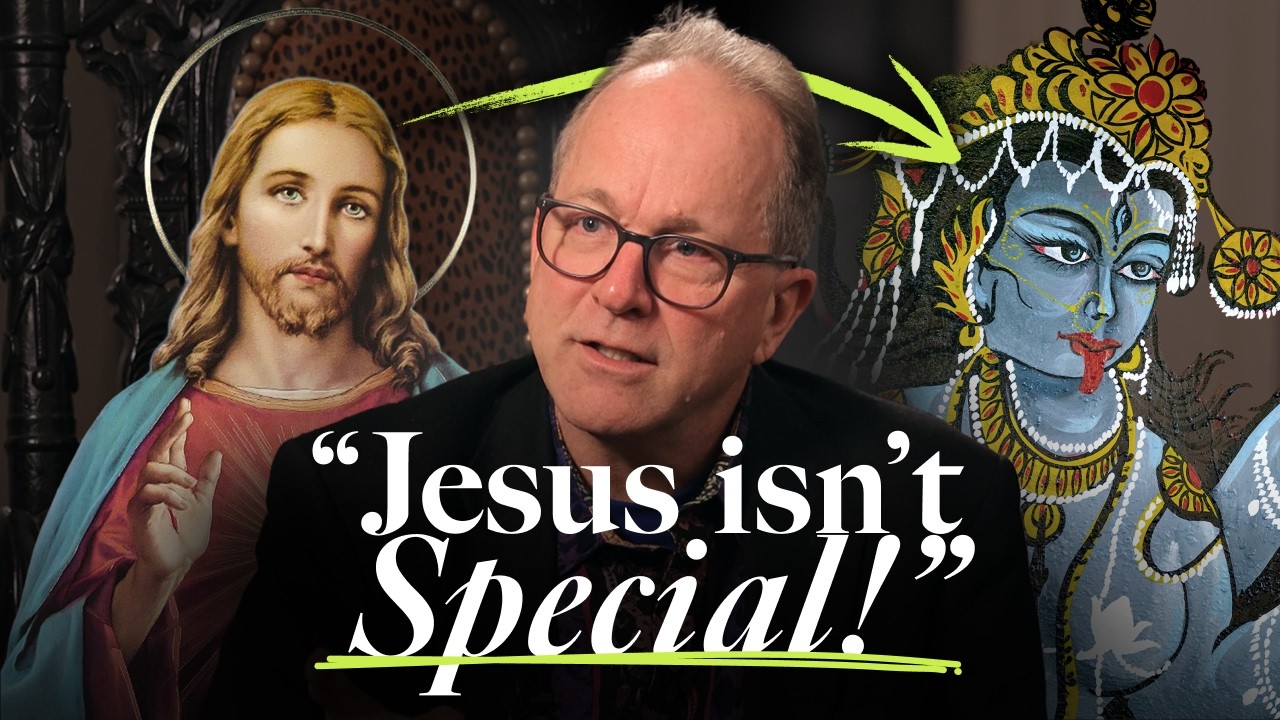
Jeff Kripal, a Rice University professor of religious studies, spent his career studying extraordinary experiences across religious traditions—levitation, near-death experiences, reincarnation memories, precognition, miracles—and arrived at a position that rejects both orthodox religious exclusivism and materialist scientism. He calls his approach “new comparativism” and his metaphysics “dual aspect monism.” The conversation explores why he left Catholicism, why he finds all orthodox traditions simultaneously compelling and insufficient, and how he navigates the ethical and existential implications of taking paranormal phenomena seriously.
Against Orthodox Exclusivism
Kripal was raised Roman Catholic and was taught that miracles only happen in the Catholic faith, but comparative study revealed miracles everywhere—levitating Christian saints, rainbow bodies in Tibetan Buddhism, Hindu mystics who claim identity with God, weeping icons, reincarnation memories in children. Once you see this global pattern, the claim that any one tradition has a monopoly on truth becomes empirically untenable.
He frames the problem as “believing too much, not too little.” The issue isn’t that nothing supernatural happens—it’s that too many mutually exclusive supernatural claims exist, and no single tradition can account for all the data without special pleading.
His method is to put every tradition’s experiences on the table and refuse to privilege one community’s interpretation over another’s. This is what he means by “new comparativism”—comparing traditions not to rank them but to see what patterns emerge when all the data is kept in play.
He is particularly critical of how traditions explain away each other: Christians calling Buddhists “demons” or “lesser revelations,” Buddhists returning the favor. He finds these moves intellectually unpersuasive because he has heard them all and they all follow the same self-serving logic.
He does not think any tradition is simply “wrong”—each gives something real to its communities—but all are partial, and their ethical systems have histories and political economies that insiders often cannot see.
Who Were the Founders?
Kripal treats figures like Jesus, Muhammad, and Moses as real historical individuals who likely had genuine experiences of divinity, but whose identities were co-constructed by their followers using the cultural categories available to them—Greek philosophical language for Jesus, Arabic prophetic categories for Muhammad.
He points to the Gospel of John’s passage where Jesus asks his disciples, “Who do you say that I am?” and argues that Jesus himself may not have had a fixed, clear answer—that the question was genuine, not rhetorical, and that identity was being negotiated in real time.
He extends this to all religious experience: even experiencers themselves often cannot fully explain what happened to them. The ego or social self is only one part of the person, and the part having the experience may not be accessible to the part trying to narrate it.
He is skeptical of scriptural literalism in every tradition, noting that historical criticism has made fundamentalism untenable in Christianity and Judaism, and that Islam has not yet undergone the same rigorous internal critique of the Quran—though he acknowledges it could and should.
Against Materialist Scientism
Kripal does not reject science or materialism outright but considers them inadequate. Newton wasn’t wrong; he was incomplete. The same is true of Einstein. Present-day science should not be treated as the final word.
He argues that the scientific method begins with a subject-object split that is itself a metaphysical assumption, not a proven fact. The method is excellent for studying objects but poorly suited to studying phenomena that are minded, intentional, or alive.
He points to the deep mystery of why mathematics—something that goes on in the human brain—corresponds so precisely to physical reality. This Pythagorean-Platonic correspondence between inner and outer is itself a kind of miracle that materialism cannot explain.
He is critical of how science dismisses anomalous experiences by labeling them “fraud,” “hallucination,” or “anecdote”—rhetorical moves that take data off the table rather than engaging with it. Calling something an anecdote doesn’t mean it didn’t happen; it means the listener has decided not to think about it.
The Empirical Evidence
Kripal finds the strongest empirical evidence in precognition—human beings experiencing future events in vivid detail before they happen. He cites the case of Barry Windsor-Smith, a young comic book artist in the early 1970s who had a detailed vision of a New York office, a traffic jam, and specific conversations, which then played out exactly three years later.
He also cites Elizabeth Cone (from the book Changed in the Flash), who sent herself timestamped emails predicting plane crashes, tsunamis, and earthquakes. A forensic computer scientist examined her computer and could not prove the emails were fabricated, though he also could not definitively prove they weren’t—the data was lost through normal computer transfers.
He is convinced that people levitate, that near-death experiences are real, and that children’s reincarnation memories (studied at UVA by Ian Stevenson and Jim Tucker) are genuine. But he insists that none of these phenomena require a single, simple explanation, and that the academy currently has no adequate model for any of them.
He notes that paranormal phenomena seem to resist controlled laboratory study. The Duke card-guessing experiments and the Stargate remote viewing program produced statistically significant but modest results. The most dramatic phenomena—a mother dreaming of a chandelier falling on her baby’s crib and rescuing the child—occur in real-world, high-stakes situations, not in labs. He speculates that trauma, survival urgency, and genuine life-or-death stakes may be necessary conditions for the most robust manifestations.
The Nature of the Phenomena
Kripal proposes that paranormal phenomena are not random or mechanical but minded, intentional, and communicative. They are “semantic over physical”—they carry meaning, not just energy. They are “organic rather than mechanical”—they have purpose and will.
He suggests that the phenomena may actively resist being studied by the scientific method—not out of malice but because the method treats them as dead objects, which is a kind of category error. It’s as if the phenomena are offended by being studied that way.
He also suggests that the phenomena camouflage themselves in culturally available forms—a Christian sees the Virgin Mary, a Buddhist sees a Buddha, a UFO enthusiast sees an alien. The form is shaped by the perceiver’s cultural framework, but the underlying reality is something else.
He is deeply suspicious of the word “fraud” as commonly used. He argues for a three-level defense: (1) fraud in some cases doesn’t invalidate all cases; (2) fraud by a person in one instance doesn’t invalidate their other experiences; (3) the practice of fraud can sometimes lead to genuine phenomena—the placebo effect is a fraud that works 25-30% of the time, and shamans who start with tricks sometimes find that real healing occurs. The boundary between trickery and genuine magic is fuzzier than people assume.
Dual Aspect Monism
Kripal’s metaphysical position is “dual aspect monism”—the idea that the mental world and the material world both emerge from a common source that is neither mental nor material. He draws on Jung’s concept of the unus mundus (one world).
This explains synchronicity—meaningful coincidences between inner mental states and outer physical events that have no causal connection. If both emerge from the same source, their correspondence is natural, not miraculous.
He prefers this to Cartesian dualism (which cannot explain how mind and matter interact) and to pure idealism (which cannot adequately account for the stubborn reality of the physical world). Dual aspect monism keeps both on the table while pointing to something deeper beneath both.
He acknowledges this commits him to a form of panpsychism, but a qualified one: the chair is not conscious in any ordinary sense, but at a deeper level the distinction between mental and material dissolves. Human beings in mystical states sometimes access this deeper level, where subject-object duality breaks down entirely.
He cites the example of a woman named Dina, dying of cancer, who after taking a psychoactive substance reported: “I am the universe. I am it. There is no death.” This is a non-dual experience in which the subject-object distinction completely collapses—and it is these experiences that Kripal takes as ontologically revealing, not because he lives in them (he doesn’t) but because the people who have them consistently report that this is what reality really is.
The Humanist Too
Kripal’s central concept is the “humanist too”—the idea that human beings are both the social ego (the constructed self, the cultural identity, the person named Jeff Kripal) and something else, something superhuman, that the ego does not control and cannot fully access. Both are true simultaneously.
This is not a dualism of two substances but an affirmation of contradiction and complexity. He does not believe in a permanent self or soul—he is convinced by Buddhist no-self philosophy and neuroscience—but he also does not believe the social ego is all there is.
He uses this to explain paranormal phenomena: it’s “us” doing it, but not the egoic us. It’s the other aspect of the humanist too—the superhuman dimension—that levitates, precognizes, and appears as Jesus, Buddha, or an alien. We are responsible for God, not the other way around.
He acknowledges this sounds like a Gnostic position—direct experiential knowledge of one’s own divinity—and he embraces that. He quotes Alan Moore approvingly: “Faith is for sissies who dared not go and look for themselves.”
Ethics and Practice
Kripal does not have a traditional spiritual practice. He cannot meditate, has failed at monastic-style retreats, and does not have devotional relationships with gurus or teachers. His practice is writing, which he understands as a paranormal activity—a form of inspiration from the future, a way of accessing the superhuman dimension of the humanist too.
He describes his famous 1989 “Khali experience” as a moment when all his future books somehow downloaded into him. It was definitive for his life but not something he has been able to recreate, and he does not think it should be recreated.
He is skeptical of spiritual direction and guardrails because they tend to keep people inside traditions. His only ethical rule is “don’t hurt anyone.” Beyond that, he thinks people should explore freely, though he acknowledges that not everyone is set up for these experiences—some people are “thick” to them, and that’s fine.
He believes the universe is essentially benevolent, though he acknowledges this is a faith claim. He has never met a “demon” that didn’t look like a suffering human being. He thinks even negative experiences—alien abductions, hellish near-death experiences—may be the human ego’s response to ego dissolution, not evidence of an actually evil realm.
He is transmoral rather than immoral: he does not think the ultimate is good or evil in any social or ethical sense. Moral categories apply at the conventional level of the “two” but not at the level of the “one.” The one is life itself, the universe, the cosmos—affirming in a deep ontological sense but not moral in any human sense.
Politics and the Future
Kripal’s politics flow from his study of marginality. He believes that profound religious experience disproportionately comes from marginalized people—those on the edges of society in terms of gender, sexuality, class, race. His early work was on queering religion; his later work is on “weering” religion. Both are about taking seriously what mainstream culture dismisses.
He is critical of over-politicization in the academy, not because political concerns are unimportant but because they are not ultimate. Even a perfect moral utopia would not answer the fundamental religious questions: Who are we? Where did we come from? What happens after death?
He sees himself and people like the host as being on the vanguard of a new era—one that looks toward the future for answers rather than toward the past. He thinks the old religious answers are no longer tenable, but he does not think the answer is secularism either. Something new is coming that does not yet exist.
He is not troubled by political withdrawal or monastic-style communities dedicated to investigating these questions. He wanted to be a monk himself and sees nothing wrong with that choice. His own “Epicurean community” is the academy and the small network of scholars and seekers with whom he works.