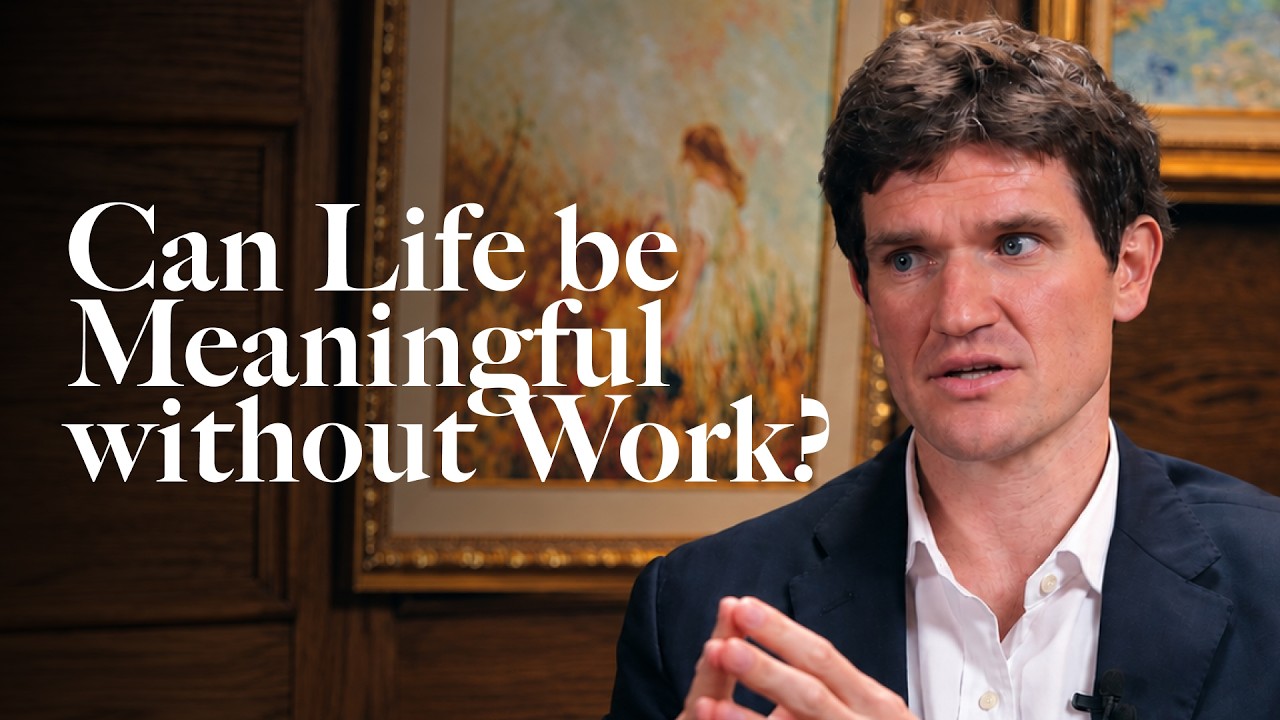
This episode features NYU philosopher Harvey Lederman in conversation about the existential threat and promise of AI automating human work, exploring the grief of losing meaningful labor, the historical elevation of work from Aristotle to modern “workism,” whether democracy can survive mass unemployment, and how philosophy itself might transform when AI can produce knowledge faster than humans.
The core tension: grief and optimism about AI replacing beloved work
Lederman’s dominant emotion toward AI is grief for the loss of work that gives life meaning — philosophical discovery, scientific research, medical practice, legal work — even while recognizing AI could bring enormous benefits.
Grief and optimism are compatible: like graduating school or the decline of an Italian dialect, one can mourn what’s lost while acknowledging life improves overall.
Many pessimists confuse personal grief for lost ways of life with genuine pessimism about future welfare; the loss of work feels terrible personally but may not make the world worse.
Even people who hate their jobs fear losing them, projecting personal anxiety onto civilizational decline.
Lederman’s own grief centers on discovery: the romantic ideal of being first to a truth (like polar explorers) may vanish when AI makes discovery trivial, yet he remains optimistic about post-work goods like family, leisure, and atelic activities.
Historical arc: how work became a religion (workism)
In classical thought (Aristotle, Plato), commercial work was low-status; “leisure” (scholē) included philosophy, learning, and politics — activities we now call work.
Aristotle’s leisure was not amusement but soul-formation; his conception suggests an AI utopia where instrumentality ends and humans pursue intrinsically valuable activities.
The elevation of work began in medieval commercial Europe, accelerated by the Protestant Reformation (Weber’s Protestant ethic), and was legitimized in the American founding where commerce replaced civic virtue as the cultural center.
Franklin’s push for practical math education (for merchants) replaced Plato’s geometry (for philosophy), marking a shift from contemplation to production.
Post-WWII universities shifted from training aristocrats to mass professional training, making higher education an instrument for commercial success.
Early Marx was surprisingly Aristotelian: he saw material production meeting others’ needs as essential to human flourishing (species-being), not something to escape; capitalism’s crime was distorting this, not imposing work.
Hegel viewed market participation as a mechanism of mutual recognition and freedom, superior to feudal hierarchy.
Modern “workism” (Derek Thompson) makes work the primary source of identity, meaning, and prestige — a recent cultural invention to incentivize labor when society needed it.
Can democracy work without work?
A prevailing fear: democracy depends on elites needing ordinary citizens as workers, soldiers, and bureaucrats; if automation makes citizens economically superfluous, elites lose incentive to maintain democratic power-sharing.
Game-theoretic counterargument: even robot-owning elites need a Leviathan to protect them from each other; a distributed political system with hard-to-manipulate citizens may be the most stable equilibrium for elite self-preservation.
Historical test: post-Soviet Russia’s oligarchs were gradually picked off until one dominated — a cautionary tale for elites considering disempowering the populace.
Civic virtue argument (Tocqueville): work, especially independent farming, once cultivated responsibility and self-governance; corporate wage labor already eroded this, and universal unemployment would accelerate the decay.
Counterpoint: retirees (non-workers) are politically hyperactive and vote at higher rates; the work-civic virtue link may be overblown, but new institutions must deliberately inculcate democratic culture without work.
Institutional fragility: the real threat to human capabilities
Lederman worries less about AI “frying brains” directly (humans adapt, learn to focus) and more about short-termist institutions destroying the pipeline that rewards deep skill acquisition.
Hiring pipelines optimize for immediate needs; if entry-level jobs vanish (Meta laying off juniors, coding agents replacing analysts), people who could develop expertise never get the chance.
Analogy: literacy killed the economic incentive for epic poetry; the tradition died not because people lost the capacity but because institutions stopped rewarding it.
Prescription: over-endow universities and similar institutions to support lifelong retraining, making them resilient to short-term market pressures so humans can maintain capabilities AI hasn’t replaced.
The nature of philosophy: knowledge production vs. character formation
Lederman sees professional philosophy as primarily knowledge production (understanding the world), with character formation a personal byproduct, not the university’s systematic job — attempting the latter risks cultishness.
The host argues philosophy’s primary aim is wisdom for flourishing (Socratic/Aristotelian/Eastern traditions); theoretical questions matter only insofar as they bear on ethical life.
Lederman counters: apparently abstract metaphysics (mereology, properties) often proves essential to practical questions (persistence, causation, mental causation); the generality of philosophy is its miracle.
Both agree current institutions overemphasize “production” (papers, citations) as a proxy for understanding; AI may force a return to philosophy as acquisition of wisdom rather than output generation.
Lederman already uses AI for literature reviews and idea development; the field is shifting toward new urgent questions (AI welfare, democracy, meaning) while seminars on traditional topics continue unchanged for now.
Practical preparation for the transition
Lederman: shifted research to AI philosophy (welfare, democracy, meaning) — feels a “call” to address pressing practical questions where philosophers have unique contributions.
Host’s strategies: (1) invest in social capital as scarcity shifts from material to mimetic prestige; (2) pursue atelic activities (valuable in themselves, not for outcomes) — chose philosophy over a lucrative startup because the process was the win; (3) cultivate receptivity to “mystical downloads” (creative insight) as a uniquely human edge.
Both emphasize the transition period is the danger zone: mass unemployment, shame cultures, potential revolution, and institutional collapse before any utopia arrives.
Urgent cultural task: destigmatize non-work, build new visions of flourishing detached from productivity, and revive thick civic values among elites and citizens alike.