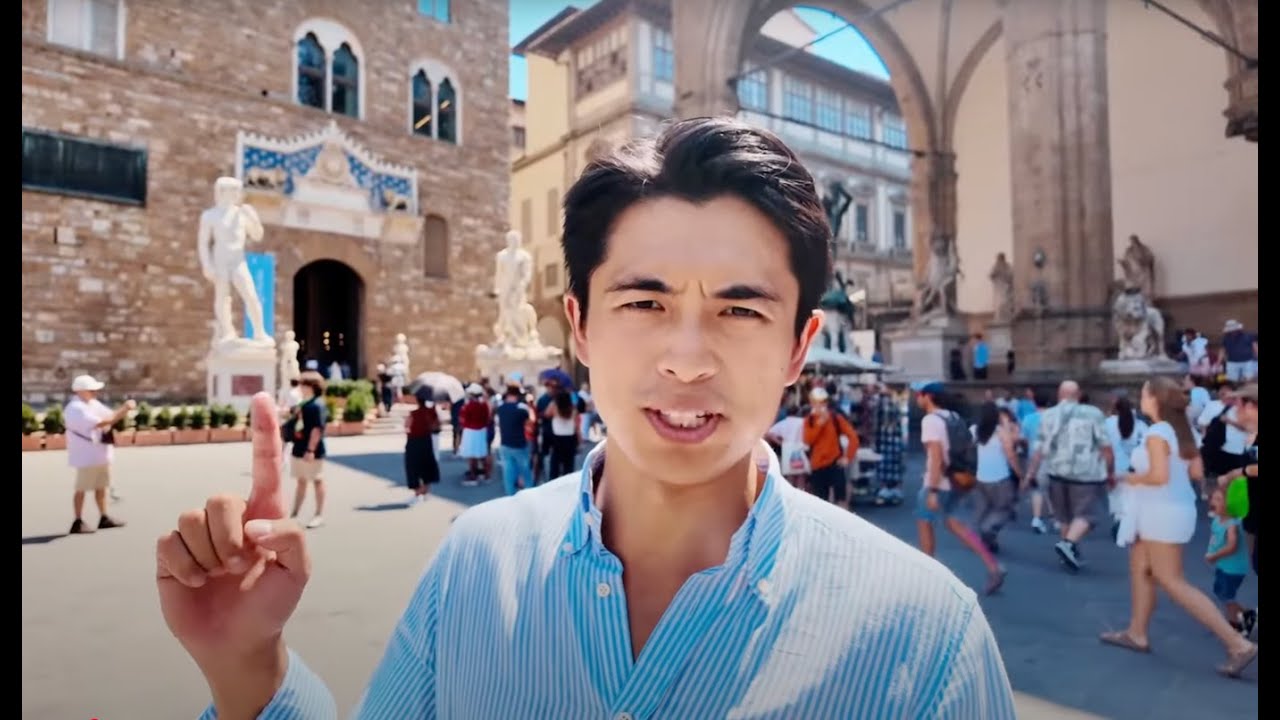
The episode explores the relationship between political exile and philosophical greatness, using Machiavelli’s life as a central case study and Plato’s Republic as the theoretical framework. The core argument is that alienation from political life—whether through exile, failure, or social estrangement—has historically been a necessary condition for producing the deepest works of political philosophy, because it frees the thinker from the corrupting demands of public life and forces ambition into the contemplative channel of writing.
Machiavelli’s Florence: the commute that frames a life
The host walks the same route Machiavelli took every morning from his apartment in Florence to the Palazzo Vecchio, the city’s main governmental building, where he served as second chancellor and secretary of the republic.
The walk crosses the Ponte Vecchio, still lined with shops and bustling activity, much as it was in Machiavelli’s time, when leather tanning was the dominant trade.
The Palazzo Vecchio still stands, and Machiavelli would have passed Michelangelo’s David (now a replica; the original is in a museum) staring defiantly toward Rome, where the exiled Medici family lived.
The point of the tour is to convey the energy of Renaissance Florence—a center of commerce, art, and political intrigue—and to contrast it sharply with what came next for Machiavelli.
Exile as punishment and paradox
When the Medici returned to power, Machiavelli was charged with treason, imprisoned for a year, and sentenced to death; his sentence was commuted to exile during a papal jubilee.
He was sent to his family’s small farm estate just outside Florence, where he wrote The Prince and other major works.
From his garden, he could see Florence in the distance—a constant, painful reminder of the city he loved and had served.
Machiavelli was a genuine patriot: he never took a bribe during his entire political career, which is why he died poor.
The host argues that being exiled within sight of Florence was arguably crueler than being sent somewhere remote, because the longing was inescapable every day.
The pattern across thinkers
Machiavelli is not an isolated case. The host identifies a recurring pattern in the history of political thought: thinkers produce their best work only after being forced out of political life.
Cicero wrote most of his philosophical works after the civil war, when he was exiled and his friends were killed.
Boethius wrote The Consolation of Philosophy while imprisoned and awaiting execution.
Confucius spent years in political estrangement, wandering between states after being rejected by his own.
The common thread is that political alienation—exile, imprisonment, or failure—forces the thinker to redirect ambition from the active life to the contemplative life of writing.
Plato’s argument: why society corrupts the philosopher
In Republic Book 6 (around 494a), Plato lays out a systematic argument for why exile is a necessary condition for producing true philosophers.
The philosophical soul has a specific nature: quick learning, good memory, courage, moderation, and magnificence. Philosophy is not just an intellectual exercise for Plato—it is a way of life, so the philosopher needs both intellectual and character virtues.
The beautiful is the good: Plato claims that a soul with these qualities will also tend to be tall and handsome, because outward appearance reflects inner character. (Socrates and Alcibiades are the famous counter-examples that complicate this.)
Such a person will come from a good city and a good family: Plato’s republic assumes a kind of genetic inheritance—gold-souled parents produce gold-souled children, and so on, with limited mobility between classes.
Society will not let this person do philosophy: A rich, handsome, brilliant person from a good family will be pulled into public life by friends, family, and the city itself. Even if he develops a taste for philosophy, those around him will not allow it because they benefit from his worldly success.
Plato uses a courtship metaphor: philosophy is the bride, the true philosopher is the rightful suitor, but he leaves her unwed. Illegitimate figures—sophists with second-rate souls—then defile her by seizing philosophy without being worthy of it.
Alcibiades is the tragic case: a man with every advantage and even a philosophical disposition, so corrupted by society that he ends up harming it more than anyone of lesser ability could.
Exile as the escape from corruption
Plato’s solution is that the truly philosophical soul must be saved by some form of alienation from society.
Plato lists several such conditions: being born in a small, insignificant town with no political opportunities; having a sickly body that prevents political involvement (Theages); or having a divine inner sign that forbids political action (Socrates’ daimonion).
These are all forms of exile or misfortune, and they are what protect the philosopher from the corruption that would otherwise destroy his capacity for genuine thought.
The fundamental tension Plato identifies is that to think deeply, one must be alienated from the society that would otherwise consume the philosopher’s talents for its own purposes.
Two positive lessons from the argument
First, reframe personal tragedy as a gift. The host draws on his own experience: his first tech startup failed, which led him to philosophy; his second was successful enough to leave but not so successful (not “a Facebook”) that leaving would be irresponsible. In both cases, a form of exile opened the door to contemplation.
The same logic applies to Machiavelli and Cicero: their political failures forced them into the channel of writing, which is why we remember them at all. Machiavelli wanted glory; exile gave him the only kind of glory available to someone shut out of political action—the glory of the philosopher.
Second, even Plato’s ideal state preserves the intuition of alternation. In the Republic’s Callipolis, philosopher-kings are not educated by doing philosophy and ruling simultaneously. They alternate in long periods—study, then rule, then study, then rule. Even in the best possible city, you cannot fully combine the active and the contemplative at the same moment. The silver lining is that both modes can be lived sequentially, even if not at once.