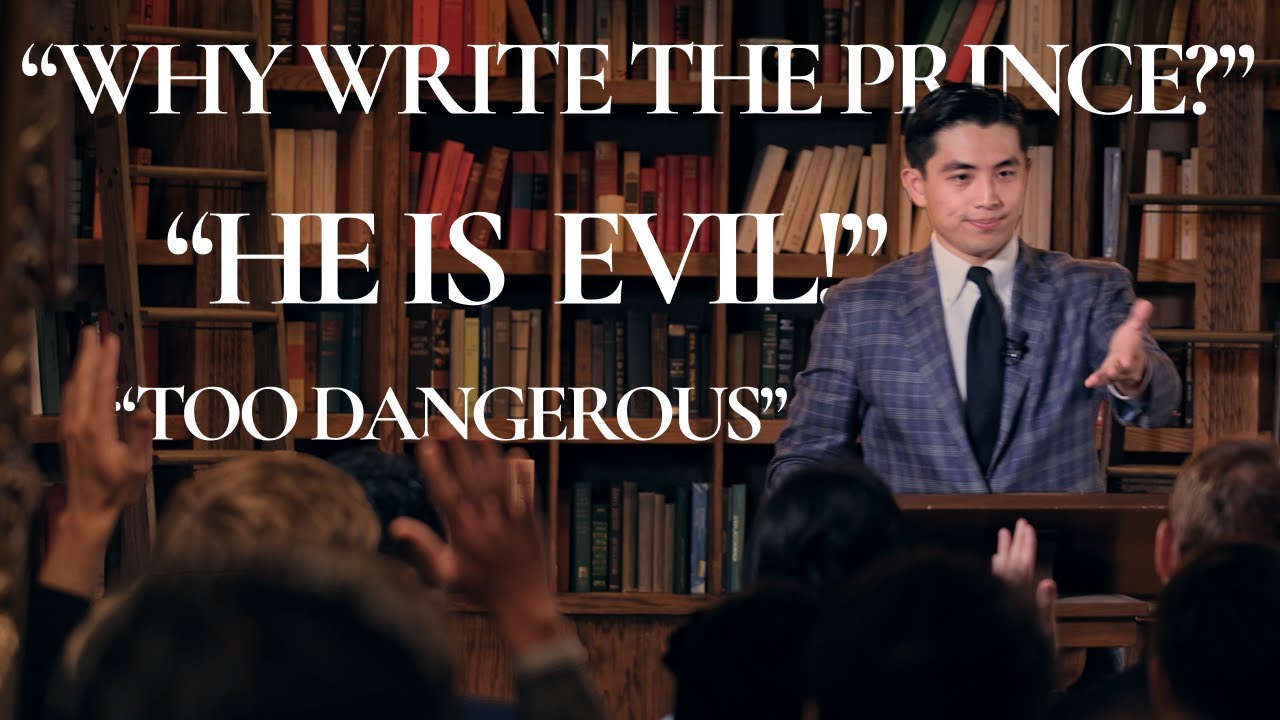
This is a Q&A session following a lecture on Machiavelli’s ethics, where the speaker (Jonathan) fields audience questions about Machiavelli’s intentions, moral philosophy, and the practical implications of his ideas for modern leadership, rebellion, and political order. The discussion ranges across Machiavelli’s sincerity in writing The Prince, the tension between selfish glory and altruistic sacrifice, his intellectual predecessors, the paradox of order producing docile populations, when to break rules, and whether Machiavelli would endorse manufactured crises.
Why Did Machiavelli Write The Prince?
Machiavelli is notoriously difficult to pin down because he oscillates between contradictory positions, often exploring an idea and then its opposite, which reflects a scientific intuition that extreme cases reveal more about power than ordinary ones.
Scholars are deeply divided on his intentions: Harvey Mansfield reads him as the Antichrist and a teacher of evil, while Maurizio Viroli sees him as a genuine patriot and Christian.
Possible readings of The Prince include:
A sarcastic, ironic critique of princely power (Rousseau’s view), though this is hard to sustain given that Machiavelli also wrote the Discourses, which is clearly a republican work, and the two are complementary rather than contradictory.
A desperate employment plea to the Medici, supported by his private correspondence where he explicitly says he wants to be hired.
A genuine theoretical revolution intended to break from classical tradition and lay the groundwork for modern political science and modernity itself (Mansfield’s reading).
Jonathan’s own reading sits between the last two: Machiavelli was both a genuine intellectual innovator and someone seeking a job, a patriot who wanted to teach effective ruling.
On whether it was reckless to publish these tactics: Jonathan argues that in Machiavelli’s time, the greater danger was a lack of manly virtue, and that in peacetime people tend to underappreciate the violent foundations that peace actually requires.
Is Glory Selfish or Selfless?
Machiavelli distinguishes between mere fame (which Caesar had, and which Machiavelli disapproves of because Caesar destroyed the Republic) and genuine glory, which combines a deeply altruistic desire to found or refound a state with a selfish desire for immortal recognition.
A glorious leader would not choose between the deed and the reputation; both are inseparable and equally necessary.
The phrase “I love my fatherland more than my soul” captures this duality: the willingness to be a morally bad person for a genuinely great cause, partly for the reward it brings.
Machiavelli’s famous dream—seeing peasants in heaven and great thinkers and captains in hell, then declaring he’d rather go to hell because that’s where the interesting people are—illustrates his embrace of this morally complex pursuit.
Recognition is both selfish and selfless; as Adam Smith noted, humans want not only to be sympathized with but to be sympathizable—to both be good and appear good.
Which Ancient Thinkers Inspired Machiavelli?
Machiavelli saw himself as doing something unprecedented: theorizing classical action for the first time, extracting the actual principles of how figures like Theseus and Cyrus acted, rather than the idealized virtue-talk of Plato, Aristotle, or Cicero.
His reading of Rome is that Rome betrayed its stated values in practice, and his works are the first to capture how politics actually worked.
Intellectual predecessors who shared his realpolitik sensibility include Callicles in Plato’s Republic and Thucydides, whose histories are unflinching about how power actually operates. Nietzsche, who is deeply similar to Machiavelli, also elevated Thucydides.
Did Machiavelli Have a Shadow?
The questioner asks whether Machiavelli, despite his willingness to look at darkness, might still have an unintegrated shadow he doesn’t acknowledge.
Jonathan’s answer is that Machiavelli likely made peace with whatever shadow he had, citing the dream of choosing hell as evidence of his willingness to let his darker side out openly.
What makes Machiavelli unusual among great thinkers is his joyfulness: even during exile and torture, he wrote The Mandrake (considered by some the greatest Italian comedy) for a Medici wedding, played cards with friends, and maintained a love of food, women, and humor. He is the thinker Jonathan would most want to hang out with.
Stability or War: What Does Machiavelli Want for Humanity?
Classical political philosophy generally valued stability and was suspicious of change; modernity has flipped this, calling stability “stagnation” and celebrating innovation and disruption.
Machiavelli is a key link in this flip: he is one of the few classical-era thinkers for whom innovation has a positive connotation, and he envisions an ideal state that is ever-changing and responsive to fortune.
He uses disorder to gain order—impetuousness over caution, constant movement—but modernity has gone further, using change not to achieve stability but to perpetually escape stagnation.
Machiavelli’s ideal vision for humanity is not a one-world state (he criticizes Rome for becoming too big and comfortable, which caused its collapse) but a world of multiple states led by vivacious, virtuous leaders who compete and even fight occasionally, keeping the spiritual life of each state healthy through this friction.
Does Too Much Order Make Citizens Weak?
There is a paradox: effective leaders create order, but order makes populations docile and less capable of the violence that sustains freedom.
Jonathan argues this is not irresolvable. Machiavelli believes virtuous leaders can halt and even reverse corruption through refounding—not just founding like Moses, but periodically renewing the state.
Machiavelli distinguishes between violence that strengthens institutions and spirits (like 9/11, which united people) and violence that destroys them (like civil war). The difference may be quantitative rather than qualitative.
He also distinguishes between tumults (class conflict or factional struggle, which kept Rome free) and division (which destroys states)—again, the line may be one of degree.
The political leader’s task is to know what kind and how much violence is needed for the best outcome.
When Should We Ignore the Rules?
The questioner asks when Americans should stop following regulations (e.g., building in Manhattan) and when nations should stop obeying international accords.
Machiavelli actually says explicitly, more than once, to always try the legal route first, because even one extra-legal act destroys the institution that required so much violence to establish.
The public, legal mode resolves tensions; the private mode inflames them and leads to blood feuds. Rule of law allows even the most powerful people to settle disputes without violence.
The general principle is mushy and requires trained intuition from studying history: using extraordinary methods in ordinary political life destroys what’s left of ordinary life, but refusing to use extraordinary methods in already-messed-up political life means staying messed up forever.
Machiavelli cannot give a formula; he trains judgment through historical examples and the biographies of great men.
Would Machiavelli Endorse Manufactured Crises?
The questioner references Michael Dell’s strategy of injecting necessity by creating crises when none exist naturally, and asks whether Machiavelli would endorse things like staging massacres or hiding attacks to manufacture political necessity.
Jonathan’s answer is yes: if a leader knew Pearl Harbor was coming and allowed it to happen because it was the only way to unite the country for war, Machiavelli would be fine with that. This is analogous to Moses lying about his intentions.
However, Machiavelli’s preferred method of injecting artificial necessity is through tough laws (like Lycurgus) or reducing inequality, not through raw violence against one’s own people.
Even when doing extraordinary action, Machiavelli prefers legal means: Brutus killed his sons legally at the founding of the Republic, because violating the law as a founder sets a dangerous precedent.
Machiavelli is deeply committed to rule of law, freedom, equality, and stability—he simply believes these foundations occasionally require extraordinary actions to establish or renew. In a business context, this translates not to abusing employees but to making performance reviews more brutal, for example.