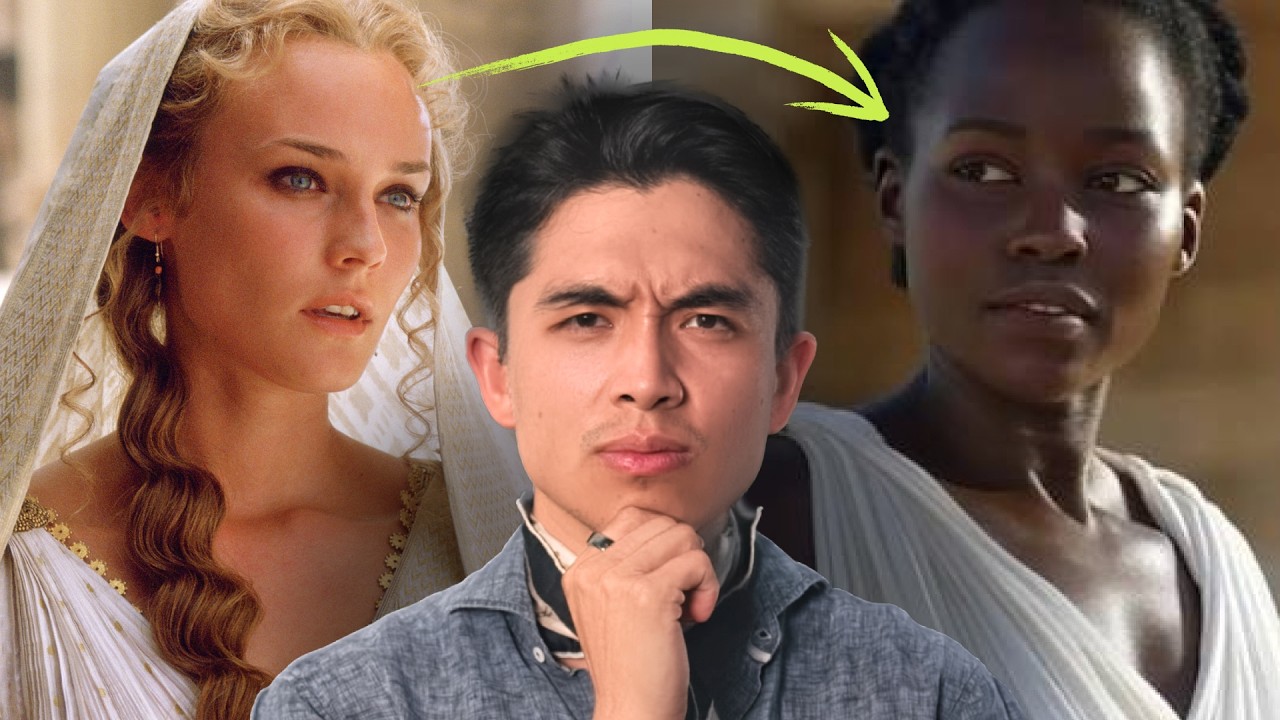
The reviewer has just seen Christopher Nolan’s 2026 film adaptation of The Odyssey after spending three weeks reading Homer’s epic in Ithaca, Greece; they judge it a very good but not great movie, identifying three systematic flaws that drain the world of its mystery: Odysseus is over-moralized into a modern family man, deception and identity-play (metis) are severely truncated, and the mixed-race casting of Odysseus’s Ithacan crew breaks the immersion that the film’s expensive practical effects otherwise build.
The Cyclops episode as a microcosm of what is lost
The Cyclops scene condenses the film’s two core failures: the crew’s visible racial diversity (Chinese, Indian, Black, white) shatters the ancient Mediterranean setting before any dialogue begins, and the omission of the “Outis / Metis” wordplay strips away Odysseus’s defining cunning.
In Homer, Odysseus tells the Cyclops his name is Outis (“Nobody”); after the blinding, the Cyclops screams “Nobody is killing me,” so his fellow Cyclopes dismiss it as divine will — but the Greek conditional mētis (“if cunning”) echoes Odysseus’s epithet, making the pun a philosophical statement: true cunning is not merely hiding one’s name but the potential to become anyone.
The film also cuts the aftermath: Odysseus’s hubristic self-revelation (“Odysseus, raider of cities, son of Laertes of Ithaca”) gives the Cyclops a target for his curse to Poseidon, making Odysseus responsible for his crew’s doom — a tragic tension between trickster anonymity and heroic kleos that the movie erases.
Homer also makes the crew’s presence in the cave Odysseus’s fault: they land on Goat Island, see the danger, beg to leave, but Odysseus insists on staying to satisfy his curiosity — another moral blemish the film removes.
Odysseus is over-moralized into a modern protagonist
Calypso and Circe: The film has Calypso drug Odysseus with lotus for seven years; in Homer the nymph was “no longer pleasing,” implying she once was, and Odysseus stays with Circe willingly for a year until his crew drags him away — both episodes show sober, chosen infidelity.
Slaughter of the suitors and serving women: Film Odysseus spares kneeling suitors and barely lets Telemachus fight; book Odysseus kills every suitor (even those clinging to his knees) and hangs the serving women who slept with them after forcing them to clean up the bodies.
Trojan War guilt: The movie gives Odysseus PTSD from witnessing war crimes; the Epic Cycle implies he commits them — killing Hector and Andromache’s son, Astyanax.
Pain inflicted on his own side: In the underworld his mother says “I died of grief waiting for you”; the omitted Phaeacian episode ends with Poseidon turning their ship and crew to stone for helping Odysseus, and Odysseus wishes to bury their city under a mountain — the classical hero is a “whirlwind of pain” to friends and foes alike.
Nietzschean frame: The Homeric hero is “beyond good and evil” — agathos means powerful, not morally good; Odysseus’s name derives from odussomai (“to hate”) and the non-Ionic Ulysses echoes oule (“scar”), just as Achilles sounds like akhos laos (“grief of the people”). The film’s regretful, PTSD Odysseus disavows the link between kleos and destructive power, delivering an anti-Greek moral frame.
Counter-example: The film Northmen (Nordic epic) proves a blockbuster can present genuinely alien, non-modern values without losing immersion.
Deception and identity-play (metis) are underutilized
The reviewer prefers the Ithaca half of the poem, where Odysseus tests identities, because deception creates charged emotional encounters the film truncates.
Swineherd / Telemachus reunion: Homer uses a reverse epic simile — Telemachus greets the swineherd as a long-lost son greets his father — while Odysseus watches, unseen, his own son treating another man that way.
Penelope and the beggar: Odysseus praises Penelope as “a just king whose reputation is renowned,” describing himself while disguised; he makes her weep with stories of himself but turns his suffering inward to maintain cover.
Structural truncation: Half the poem covers Ithaca testing scenes; the film only begins them in the third act, privileging adventure spectacle over revelation of character through deception.
Penelope’s recognition: The film implies she knows Odysseus before the slaughter; Homer suspends recognition until after, letting her beat him at his own game — she orders the marriage bed moved, Odysseus explodes because it is built into an olive trunk, proving she has tested and mastered him, establishing her as his equal in metis.
Further omissions: Odysseus tests his aged father Laertes (making him weep) even after victory; theoxeny (gods in human form testing hosts) is gone — Athena never inhabits a mortal, and it is unclear whether she is even external to Odysseus’s mind, removing the divine-human cunning duels that deepen the world’s mystery.
Race-swapping the Ithacan crew breaks the institution of xenia
The reviewer distinguishes minor race-swaps (Helen of Troy, Severus Snape) — ineffective for representation but harmless — from the mixed-race Ithacan crew (white, Black, Indian, East Asian), which actively destroys the narrative logic.
Xenia is the ritualized guest-host bond governing in-group/out-group relations, presiding over every encounter: Cyclops (violates xenia by eating guests), Calypso/Circe (defective xenia), Phaeacians (excessive xenia), Penelope/Telemachus (exemplary xenia toward beggars). Zeus Xenios enforces it; the only alternatives Odysseus considers for a new people are “do they observe xenia or are they uncivilized?” — xenia is civilization.
Boundary logic: Xenia exists precisely because the in-group has thick, particular mores not extended to humanity at large, and because the stranger (xenos = guest/host/stranger/friendly stranger/hostile stranger/god) is radically mysterious — could be a raider, a god, a lost father.
Homer’s Ethiopians: Placed at the world’s edge; the gods dine with them, preserving distance and mystery.
The crew’s diversity collapses the boundary: If an Indian or Chinese man is a born-and-raised Ithacan insider, the world has already been fully explored; the stranger is no longer mysterious, xenia loses its rationale, and the fundamental engine of the Odyssey’s adventure — “who are these people?” — evaporates. The film spends hundreds of millions on practical immersion (location shooting, 60-foot Cyclops) only to undo it every time the crew appears on screen.
Further material forthcoming
The reviewer recorded multiple lectures on the Odyssey in Ithaca and interviewed leading Homerists; these will be released and linked in the description.