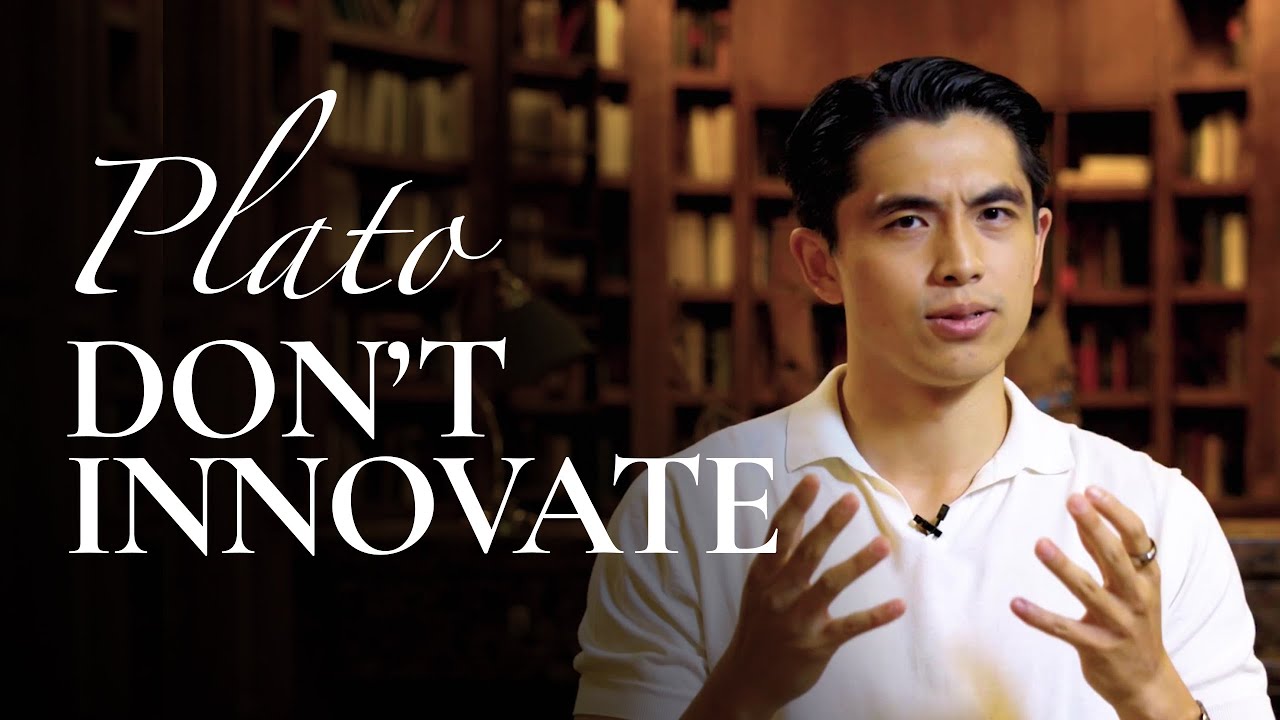
For most of Western history, “innovation” was a term of abuse — in the 17th century, one of the worst things you could call someone was an “innovator.” Today, every startup, social program, and video game conference brands itself as “innovative,” even when it is thoroughly derivative. This lecture traces the intellectual history of that reversal, drawing on Benoît Godin’s Innovation Contested and the philosophy of René Girard, to argue that our modern fetish for innovation is both a pathology that encourages unwanted change and a paradox that stifles the real, meaningful innovation it claims to celebrate.
What Innovation Means — and Why It Matters Beyond Technology
Innovation, across nearly all of its intellectual history, describes change that is artificial (not natural or divine), deliberate (not an unintended consequence), and novel (strange, disruptive of expectations — not necessarily “original” in the sense of being the first).
This makes innovation fundamentally a social and political concept: it describes a transgressive act by a minority against a status quo, not merely a technological one.
Innovation has always been entangled with deeper questions: the relationship between self and group, the “natural course” of human affairs, and whether a perfect or final good can be achieved.
Studying attitudes toward innovation is valuable because normative attitudes do not progress cumulatively like scientific knowledge; they shift like a flashlight in a dark room, illuminating one area while leaving others in shadow. Old perspectives can be valid even after they have been abandoned.
The Classical View: Innovation as a Corrective, Not a Virtue (Greek Antiquity–16th Century)
Plato wanted to freeze his ideal polis in time — 5,040 families, unchanging children’s games, fixed festivals and songs (the Egyptians were his exemplar). His suspicion of innovation operated on two levels:
Content: In a fully good society, any novel deviation from the good is necessarily bad. Innovation is only legitimate as a corrective — forced by calamity, or used to build toward a just state — never as something to pursue in an ideal state. One innovates only to stop having to innovate.
Form: Novelty inflames a natural human fetish for the new, leading people to seek difference for its own sake, despising the old and valuing the new regardless of whether it is good. This is worse than introducing badness, because it abandons the concern for goodness altogether.
Innovatio in Latin (4th century) had positive connotations but described something different from modern innovation: a renewal or return to a previous state (biblical examples: Job’s glory “innovated,” the Phoenix reborn). It was not necessarily artificial, deliberate, or original. This is consistent with Plato’s framework: the only time the new is loved is when it is a return to the truly old.
Machiavelli appears to break from Plato by prescribing innovation as a tool of princely virtue, but on closer inspection he belongs to the classical view:
He recommends innovation only in response to crisis (Fortuna) or when founding a republic from scratch — the same two circumstances Plato allows.
He warns rulers to avoid the appearance of innovation whenever possible, because being seen as an innovator is dangerous.
The key difference is social ontology: Plato wrote a utopian work; Machiavelli wrote for a world of constant crisis. Both agree that in a good, stable state, innovation is unnecessary and dangerous.
Core of the classical view: Innovation is done to achieve stability. The natural state of affairs is chaos; innovation is the corrective that jerks society toward order. The ideal state does not innovate.
The Reformation View: Innovation as Heresy (16th–17th Centuries)
The English Reformation produced not a love of innovation but a Puritan adherence to authority and disdain for novelty. Protestants did not see themselves as innovators — they saw themselves as restoring the original, pure teachings of Christ, and cast Catholics as the true innovators who had added pagan and artificial elements.
This religious framing injected innovation into everyday English with fully negative connotations:
Artificiality contrasted against the purity of divine works.
Deliberateness implied scheming, conspiracy, and runaway private opinion.
Novelty became specifically deviation from a right status quo toward the wrong direction — innovation became synonymous with heresy.
The religious domain assumes a different perfectability than the political: God prescribes the complete and timeless good, so there is even greater reluctance to change.
Innovation became politicized and demonized. Synonyms proliferated (renovation, reform) so people could describe the phenomenon without using the tainted word. Disciplinary language emerged: “invention” for crafts, “discovery” for science, “imagination” for the arts — all to avoid the word “innovation.”
Through the English Civil War and Interregnum, innovation became synonymous with revolution. By the 17th century, it was a completely untouchable word.
The Modern View: Innovation Deified (18th Century–Present)
The rehabilitation of innovation was a symptom of a deeper transformation: the bundle of ideas around time (future-oriented), progress, reason, and individualism all shifted together.
Jeremy Bentham was among the first to publicly defend innovation, responding to Adam Smith’s critique of entrepreneurial “projectors”: every useful thing we have was once an innovation, so surely more useful innovations can improve on what we have. This is the fallibilist argument: we are not at the full good, we don’t know what the full good is, so we should be open to innovation.
Three pathways enabled this fallibilist self-conception:
Utility: Innovation became tied to productive economic and technological activity, domains where it is natural to assume we have far to go.
Quantification: Once you measure things (GDP, demographics), the number scale is infinite — there is always room for marginal improvement. Quantitative epistemic modes carry the assumption that more is better, turning everything into a maximalist enterprise. (Plato wanted 5,0,40 families; modern politicians care about GDP growth.)
Increase of knowledge: The Scientific Revolution, printing press, and global travel unsettled previously settled answers, making fallibility feel obvious.
Through rehabilitation, each criterion of innovation took on new connotations:
Artificiality was celebrated — man shapes his own destiny.
Deliberateness created a cult of genius around innovators.
Novelty became more demanding: innovations had to be both novel and original, and novelty was redefined as bringing us closer to the good through utility and progress.
Innovation became tied to progress, initially associated only with the useful arts and invention, then after World War II expanding to encompass the full technology lifecycle (policy → discovery → invention → commercialization).
Innovation was deified rather than demonized: the linguistic set contracted (everything gets called “innovation”), and positive connotations from technology seeped back into politics and social life, where innovation had once been suspect.
What the Intellectual History Teaches Us Today
The radical shift in innovation’s connotations occurred because its primary domain shifted — from politics (conservative assumptions about the good) to religion (reactionary assumptions) to technology (progressive assumptions). Each domain’s assumptions about perfectability were carried by the word “innovation” into new domains where they do not belong.
Words are vessels by which normative attitudes traffic across domains. We assume that because we use “innovation” for both political reform and the iPhone, they share a common logic and normative status.
This is how normative attitudes change like a flashlight: a profitable insight in one domain (technology) is extended into others (politics, religion), obscuring previous modes of thought that were more fitting.
The Reformation view, applied today: We unduly demonize innovation even in religion, and project that negativity onto politics and utility where it doesn’t belong.
The modern view, critiqued: We unduly fetishize innovation — even technological innovation is exaggerated — and project this love of artificial change onto social life and religion where it doesn’t belong.
Social progress is now thought of in the mode of utility/GDP: more equality, more representation, more rights — a maximalist enterprise with no end state in view. Plato’s model suggests social justice is a balancing act around an optimal point, not a permanent revolution.
Religious innovation (new trends, combining religions, dismissing scripture) would seem absurd if one truly believed a being superior to us had prescribed the good.
Technological innovation should also be suspect:
It engenders social and religious change: the printing press enabled the Reformation; social media facilitated the Arab Spring; nuclear weapons shaped the Cold War. Genetically engineered babies, AI workforce displacement, and Mars colonization would transform social and religious life just as drastically. One cannot be both a conservative and a technologist.
Technology is leverage — it increases the volatility of human affairs, producing higher highs and lower lows. Our peaceful half century makes us think of innovation as iPhones and vaccines, but the previous generation experienced gas chambers, killing machines, 70,000 nuclear warheads, and multiple nuclear near-misses.
Nick Bostrom’s urn metaphor: Technological innovation is like drawing balls from an opaque urn — some white (penicillin), some gray (gunpowder), some black (apocalyptic). Innovators cannot know or control the impacts of their innovations. On a civilizational timescale, innovation is not a rational Hegelian unfolding but something closer to Russian roulette.
Competitive dynamics make innovation effectively mandatory: if you don’t innovate, your peers, competitors, or geopolitical opponents will. The only political structure that could stop it would be a totalitarian one-world state — a cure worse than the disease.
A third path — stagnation, or marginal improvements just enough to keep the growth-dependent economy from collapse without engendering foundational breakthroughs — becomes attractive if Bostrom is right. Peter Thiel lamented “we wanted flying cars but we got 140 characters”; perhaps democracies barely recovered from social media and are not ready for flying cars.
Girard: How the Fetish for Innovation Stifles Real Innovation
René Girard argues that the modern elevation of innovation is simultaneously a devaluation of imitation. In premodernity, imitation was valued (imitatio Christi, emulation of great figures); in modernity, we want to be “our own man,” to stand out, to be unique. Value comes not from proximity to distant ideals but from distance from proximate peers.
This flips the meaning of “self-made” (once an insult equivalent to “chair-buyer” in British Parliament) and tarnishes inherited achievement.
The modern view treats innovation and imitation as distinct and incompatible: innovators go from zero to one; imitators go from one to n. But Girard argues this is wrong — imitation is a necessary precondition of innovation, and the two seamlessly morph into each other without a clear boundary.
18th–19th century America is the canonical example: it was known for being a “mere copycat” — lacking intellectual property rights, running a systematic program of forced technology transfer, with citizens who were at best good technicians and at worst intellectual pirates copying, stealing, spying. These are the very practices America now condemns China for. America had to imitate Europe to become an innovator.
No innovation happens from a vacuum; all involve some degree of imitation. No imitation is adopted without adaptation, so all involve some degree of innovation. Steve Jobs took the GUI from Xerox PARC; SpaceX stands on the shoulders of the space program; PayPal wasn’t the first digital money transfer. “Only God goes from zero to one; the rest of us always go from one to n.”
Apparent acts of pure innovation are often fabricated histories created by fan bases, insecure posterity, or marketing departments.
Capitalism encourages imitation through the profit mechanism: profit is a reality check that determines winners and losers, and losers are already so thoroughly shamed by market failure that there is no additional shame in imitating. Capitalism is a sobering arena where imitation is forced by survival.
Domains without objective win/loss mechanisms (the humanities, arts, philosophy) have a weaker way of distinguishing masters from disciples. This allows disciples to pursue negative mimesis — systematically taking the opposite course of the master to demonstrate independence, even against their own self-interest.
Negative mimesis is still derivative: one is defined by the model one opposes. It often produces trends of contrarianism (late 20th-century Continental philosophy’s infatuation with Derrida drove everyone to write as incomprehensibly as possible, couched in the language of rebellion and originality).
Traditions like clarity and structure exist for good reasons. “The obligation always to rebel may be more destructive of real innovation than the obligation never to rebel.” The demand “write something original” may be the greatest blocker of meaningful originality.
Pursuing innovation directly produces fashions — innovations valuable only for their novelty, not for their substance. This is exactly what Plato feared: loving novelty makes us indifferent to the object and obsessed with the self.
“I want to change the world” often means “I want to be the one changing the world.” This narcissism constitutes a theology of self: the drive to be self-sufficient, the refusal to admit dependence on tradition, the insistence on ex nihilo creation, the arrogance of going from zero to one — these are attributes claimed only for God. The modern fetish for innovation is, at its core, the desire to be God. The Christian word for this is Satanism — deifying the self, pursuing godhood through pride.
When finite, dependent, social creatures pursue radical independence, they merely imitate the appearance of self-sufficiency, entangling themselves further in dependency: conforming to contrarianism, rallying under the banner of rebellion, apishly reproducing the appearance of genesis. Marlon Brando’s biker, asked what he’s rebelling against, sighs: “What do you got?”
The Prescription: Mastery, Not Innovation or Imitation
Real innovation requires minimal respect for the past and mastery of its achievements — not imitation for imitation’s sake, and not innovation for innovation’s sake.
Both pure innovation and pure imitation are motivated by the same pathology: radical concern for social signaling over substance (seeking distance from peers or proximity to idols).
Mastery is concerned with the object — improving the thing itself (beauty in art, profit in capitalism, wisdom in philosophy) — rather than with the social relation.
Real innovation is like an orgasm: it cannot be achieved by being aimed at directly. Focus on the thing, and it will creep up.
“Minimal respect” means: not treating the past as unsurpassable (avoiding the Scylla of idolatry) but seeing tradition as having something important to teach us (avoiding the Charybdis of rebellion).
The philosopher’s role shifts with the historical moment:
In the classical and Reformation eras, the danger was too much idolatry of the past; the philosopher’s role was to delegitimize tradition and license breaking free.
In the modern era, the danger is too little respect for the past; the philosopher’s role is to warn society off the fetish for innovation.
The lecture’s conclusion: the fetish for innovation threatens the future on all fronts — encouraging unwanted change and stifling needed change. If we cannot stop history (and competitive dynamics suggest we cannot), the suggestion is to resurrect the imitative features of the Roman innovatio: building the future not by cutting clean from the past but by being rooted in and sprouting from it. The lecture itself, as an exercise in intellectual history, is an act of innovatio — a return to rescue what has been unduly dimmed.