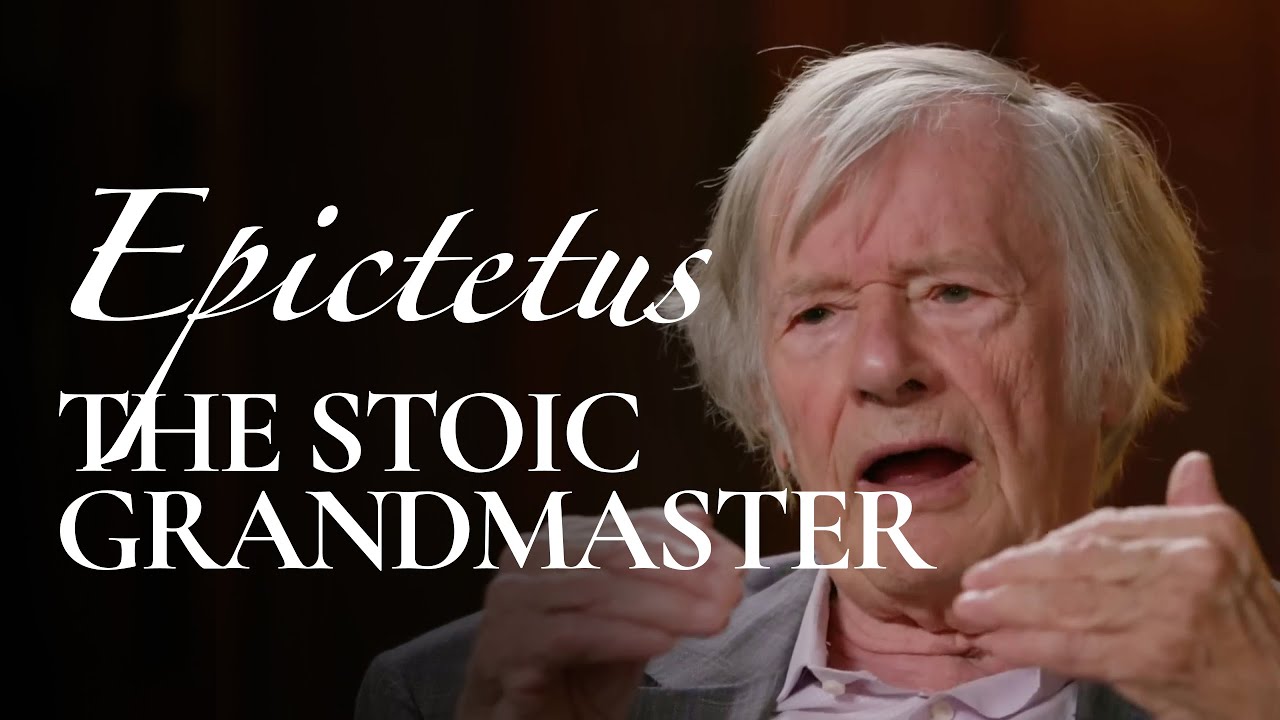
Epictetus was born a slave in first-century Anatolia, brought to Rome as a young man, studied under the Stoic philosopher Musonius Rufus, was eventually freed, and went on to found a highly influential school in Nicopolis — visited even by Emperor Hadrian. His life as a former slave gave his philosophy an experiential weight that distinguishes it from other Roman Stoics like Seneca, who was wealthy and powerful. The episode, featuring legendary Epictetus scholar Anthony Long, explores the core ideas of Epictetus’s Stoicism: the arguments for why virtue alone is sufficient for happiness, the role of divine providence, the famous dichotomy of control, and the therapeutic practices Epictetus used to train young men entering the upper echelons of Roman public life.
The Life of Epictetus
Born around the middle of the first century AD, probably into a slave household in what is now central Turkey; his mother was likely a slave.
Brought to Rome as a teenager and employed in the household of Epaphroditus, a prominent freedman and bureaucrat serving Emperor Nero.
Studied under Musonius Rufus, the most prominent Roman Stoic philosopher of the era.
When Emperor Domitian expelled Stoic philosophers from Rome near the end of the century, Epictetus was among them — a testament to his reputation and the political danger Stoicism posed to autocratic rule.
Settled in Nicopolis, a fine Greek city on the Adriatic coast, where he founded his own school.
Was almost certainly visited by Emperor Hadrian — remarkable for a former slave.
Was manumitted (freed), probably during his time with Epaphroditus; freedom and slavery as both literal and metaphorical categories are central to his thought.
Never married, but in old age adopted a young girl and had a woman help care for her, forming something like a family.
Lived simply and had a famously dry sense of humor: when his prized metal lamp was stolen, he said the thief must have needed it, but next time he’ll find one made of cheaper terracotta.
Our knowledge of his teachings comes from Arrian, a student who became a Roman consul and historian. Arrian recorded eight volumes of Epictetus’s discourses in colloquial Greek, capturing his spoken style — unique in ancient literature for its directness and challenge.
The Four Arguments for Virtue as Sufficient for Happiness
The central Stoic claim is that virtue is both necessary and sufficient for happiness — external circumstances cannot harm a truly virtuous person.
Anthony Long identifies four distinct arguments Epictetus uses to support this claim:
The ethical argument: Traces back to Plato’s dialogues (Gorgias, Euthydemus, Meno). It examines external goods one by one — wealth, power, health — and shows they are not always good, whereas virtue (wisdom) is always good and always chosen.
The argument from control: If happiness is to be fully in our control, we must limit our desires and aversions to what is in our control — namely, our own judgments, volitions, and rational agency. Everything else (body, property, reputation, even the welfare of loved ones) is “not ours.”
The argument from nature: We are rational animals by nature, and virtue is the perfection of that rational nature. Living according to nature means perfecting reason.
The theological argument: The cosmos is governed by Zeus (the divine rational principle), and the world is providentially ordered. Accepting this order — even its tragedies — is foundational to Stoic happiness.
The Theological Argument and Divine Providence
This is the most difficult argument for modern Stoics, since most today do not accept divine providence or the idea that this is the best of all possible worlds.
For Epictetus, theology is not separate from ethics — it is the foundation. He presents Stoic principles as “laws of nature” prescribed by Zeus.
He loves a quote from the early Stoic Cleanthes: “Guide me, Zeus, and I will follow without flinching; even if I do not wish to follow, I will go nonetheless.” This captures both determinism (the causal chain is closed and complete) and the normative claim (this is how things should be).
Epictetus imagines Zeus saying: “If I could have made your body invulnerable, I would have, but you are made of flesh and blood. What I have given you is a part of myself — your intellect and rational capacity.” Humans share the same basic mental nature as the divine.
He tells students: “Don’t you realize you are a Son of God?” — not in the Christian sense, but meaning that the rational faculty within us is literally a fragment of the divine.
One discourse imagines Epictetus going to bed, drawing the blinds, and saying to himself: “You are not alone” — because the divine is within him.
The Stoics derived the name “Zeus” from the Greek word for life (zên), seeing Zeus as the principle of plenitude who turns himself into all possible life forms — described with the phrase “spermatic logos,” a kind of precursor to DNA.
Long notes that without accepting both determinism and providential value, Stoicism doesn’t fully make sense — it becomes counterintuitive to say that facing execution or enslavement is the best state of the world.
Long himself does not accept the theology, but acknowledges it is structurally essential to Epictetus’s system.
The Ethical Argument and the Nature of Virtue
Virtue is the perfection or culmination of reason, instantiated in the four cardinal virtues: courage, justice, temperance, and wisdom. Each implies the others; none is sufficient alone.
Seneca’s example: a man who shows great courage in battle but cheats in the forum is not virtuous — virtue requires the composite of all admirable traits.
Virtue is a disposition of the mind, not something acquired from outside but grown into. It is an all-or-nothing state — the Stoics held that the sage, once achieved, cannot fall from virtue (except through madness or external catastrophe).
Cicero’s challenge: two equally virtuous Roman statesmen, one whose entire family dies and whose career is destroyed, the other whose children thrive and who dies peacefully — are they equally happy? The Stoics say yes, because the value of virtue is a different kind of value from external goods.
Long finds this the hardest claim in Stoic ethics. He does not accept the radical distinction between the goodness of an action and the goodness of a state of affairs — surely it is better if the child survives the burning house, regardless of the rescuer’s virtue.
The Stoics acknowledge the paradox: the transition to sagehood may be subjectively imperceptible, yet everything changes. Long compares it to the Buddhist idea of enlightenment — the phenomenology is so fundamentally different that a layperson cannot grasp it.
Epictetus, however, is less interested in the finished product (the sage) and more focused on progress. He says: “Don’t expect perfection. If you just manage to make only a few mistakes, you’re doing quite well.” This makes Stoicism attractive as a philosophy of ongoing effort rather than an unreachable ideal.
Orthodox Stoicism uses the metaphor of drowning: no matter how close you are to the surface, if you’re still underwater you can’t breathe. Only the full sage has happiness. Epictetus softens this — progress matters, and a life of progress is more worthy even if not yet fully happy.
Both lives in Cicero’s example may be equally happy, but one is “more preferable” — the Stoics can say that external circumstances can be preferred or dispreferred without affecting happiness.
Preferred Indifference
Unlike the Cynics, who rejected all external goods entirely, the Stoics introduced the category of “preferred indifferents” — things like health, wealth, and honor that are indifferent to happiness but should still be pursued.
The justification: virtue needs a basis for action. Moderation, for example, is relative to context — a sumo wrestler eating 5,000 calories is moderate; a ballerina eating 1,500 is moderate. Without some objective value in health and the body, virtue loses its grounding.
Chrysippus is quoted by Epictetus: “Where the future is uncertain, I always stick to what’s best calculated to secure the things in accordance with nature, because God has given me that power to select them. But if I knew I was fated to be sick, I would embrace sickness.”
This is not a paradox but a conditional: pursue preferred indifferents when the future is open, but accept whatever comes as part of the cosmic plan.
There are also circumstances where virtue requires choosing the dispreferred even without knowing fate — for example, wealthy parents who choose not to leave fortunes to their children because moderate wealth is better for character than extreme wealth.
Long suggests Epictetus gives the doctrine of preferred indifference much less emphasis than orthodox Stoicism. He doesn’t reject it, but he doesn’t build his teaching around it. He seems closer to Aristo, a heterodox Stoic who rejected the category entirely.
Epictetus is not interested in categorical imperatives or universal moral rules. Like Aristotle’s doctrine of the mean, what is appropriate depends on the individual — their propensities, weaknesses, strengths, and circumstances.
The Argument from Nature
“Living according to nature” for the Stoics refers primarily to our rational nature, not our physical biology.
Nature is gradated: infant behavior is different from mature behavior, and what is appropriate changes across life stages.
Nature is also individual: your nature includes your particular age, society, temperament, and circumstances. This requires deep introspection — “know yourself” in a more complicated way than Plato or Aristotle fully acknowledged.
Marcus Aurelius exemplifies this: his Meditations reveal his own strengths and weaknesses through honest self-examination.
Long argues that the Stoic conception of nature is not merely smuggling in Roman values. Property ownership, for instance, is “natural” in the sense that it is normal and socially necessary — Epictetus himself owned a lamp and was proud of it.
On the naturalistic fallacy: Long argues Stoic virtue is not vulnerable to G.E. Moore’s critique because virtue cannot be defined by listing ingredients or properties. It is a disposition of the rational faculty that has “clicked” into place — it is sui generis, known through its exercise in particular situations rather than through a formula.
The Argument from Control
Epictetus’s most famous teaching, from the opening of the Enchiridion (Manual): “Some things are up to us, and some things are not up to us.”
What is up to us: our use of impressions (phantasiai), our judgments, our volitions, our rational responses.
What is not up to us: our bodies, all external circumstances, property, reputation, and even the welfare of family and friends.
The argument: people naturally want their desires fulfilled, but desires directed at externals are frequently frustrated, causing distress. The remedy is to focus desire exclusively on what we can control — our own agency — where success is assured.
Long notes this argument is the most popular among modern Stoics but may not stand entirely on its own. It seems to require the ethical argument (that virtue is sufficient) to avoid the objection that happiness might require more than virtue.
The argument can sound merely prudential — “don’t wish for the moon” — but Epictetus’s point is deeper: without this distinction, a rational plan of life is impossible. You cannot build happiness on a foundation you cannot guarantee.
Aristotle acknowledges the same problem (Priam’s fate) but still requires some external goods for happiness — not because they have intrinsic value, but because you need resources to act virtuously (e.g., wealth to be generous).
Epictetus distinguishes between desires (full attachments that should be eliminated) and inclinations (reflex actions that are natural and not to be eliminated). He also distinguishes between passions (full-fledged value judgments like “this is terrible”) and pre-passions (involuntary reactions like blushing or flinching in an earthquake). The wise person cannot control pre-passions but can withhold assent from passions.
Long acknowledges a legitimate modern criticism: Epictetus may be too cavalier about how much is actually under our control, given what we now know about addiction, compulsion, and the social formation of desire.
Stoicism as Therapy and Practice
Epictetus’s teaching is deeply practical and therapeutic — not in the modern clinical sense, but as a training regimen for the soul.
Exercises include imagining challenging situations (e.g., sexual temptation, imprisonment, loss) and testing one’s response — either in imagination or by deliberately putting oneself in difficult circumstances to practice resilience.
Students learn about their own weaknesses and strengths through these challenges.
Beyond specific exercises, the broader therapeutic practice is cosmological: developing a perspective on the state of the world and one’s place in it, then focusing on what one can actually do.
Passions are disabling not because emotion is bad per se, but because they represent false value judgments that undermine agency.
Long argues that modern Stoics have largely extracted the therapeutic techniques while missing the larger framework — the challenge of achieving harmony with the world, which requires the theological and cosmological worldview.
Modern Stoicism tends toward maintaining equanimity in everyday situations (someone steals your towel at the bathhouse — let it go). This is valuable but misses the deeper existential challenge Epictetus posed.
Long finds Epictetus free of the melancholy that pervades Marcus Aurelius, who wrote his Meditations in military tents while losing many children. Epictetus conveys no resignation — his worldview is affirmative, even joyful. The famous Stoic “amor fati” (love of fate) is present without bitterness.
Long’s own assessment: he does not accept the theology or the radical ethics (virtue as the only good), but he finds Epictetus’s emphasis on progress, self-knowledge, and the challenge of living well deeply attractive and philosophically serious.