-
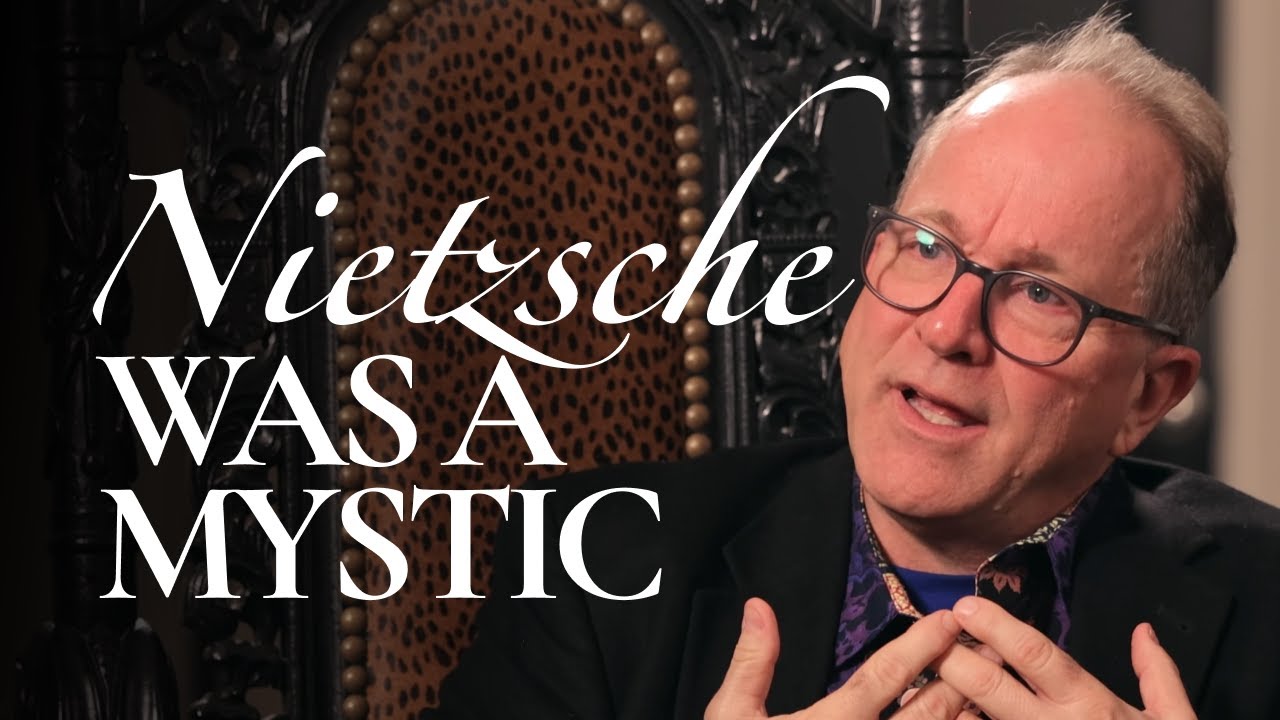
Jeff Krial is a scholar of mysticism who argues that Nietzsche—and indeed all great thinkers—must be read primarily as mystical and religious figures, not as political, philosophical, or literary ones. His central claim is that Nietzsche’s philosophy, especially the concept of the Übermensch, is rooted in genuine mystical experience and encodes a vision of human spiritual evolution that modernity has suppressed.
- Krial came to Nietzsche through stories of people whose lives were transformed by reading him—including a graduate student who was saved from suicide by a mystical encounter with Thus Spoke Zarathustra during a thunderstorm.
- Krial himself had a transformative mystical experience in Kolkata in 1989, where he encountered the erotic presence of the Hindu goddess Kali. After this event, his scholarship took on a “vertical” dimension—he continued historical analysis but also recognized a transcendent layer to religious phenomena that psychoanalysis alone could not capture.
- He sees Nietzsche’s famous 1881 experience at a boulder in Sils Maria—where he conceived the idea of eternal recurrence—as a genuine mystical awakening, and believes the books that followed in the 1880s were essentially channeled.
-
The Übermensch is not merely a value creator or political leader but a genuinely superhuman future being, pointing toward an ontological and epistemological transformation of humanity.
- The standard scholarly readings—that the Übermensch is a creator of new values, a yes-sayer, or an anti-egalitarian political figure—are what Krial calls “first floor” interpretations, missing the deeper mystical dimension.
- Nietzsche described humanity as a transitional species: “We are to apes what the Übermensch is to us.” This is not Darwinian randomness but involves the will—a deep spiritual force driving evolution toward a higher form.
- Krial draws on science fiction and comic books (especially the X-Men) as the most accurate popular expressions of Nietzsche’s ideas. Magneto embodies Nietzschean philosophy; Xavier represents the liberal professor trying to mediate between humans and superhumans.
- The Übermensch involves a radical shift in temporality—the ability to relate to time non-linearly, accessing future and past in ways that transcend ordinary causality.
-
Writing and mysticism are deeply intertwined: great texts encode and transmit altered states of consciousness across time, allowing readers to access the same inspirations that produced them.
- Krial argues that paranormal experiences—precognition, telepathy, mystical visions—express themselves through language and narrative. Therefore, texts can induce paranormal states in readers.
- He does not claim reading is the only path (meditation, psychedelics, and extreme ascetic practices are others), but as a writer and scholar, he privileges text because meaning is fundamentally semantic: “We ourselves are texts.”
- The self is a narrative construct—a story we tell ourselves from selected memories. Changing that story changes the self. Paranormal experiences often function as “critical theories” of one’s own narrative, urging the person to stop telling a destructive story.
- Krial’s own writing aims to engender mystical states in readers, just as Nietzsche’s books were written to transmit his altered states.
-
Precognition is real and well-attested, and it points toward a block cosmology where past, present, and future already exist.
- Krial cites numerous testimonies: a mother who dreamed her child would be in a car accident at a specific time and it happened exactly as envisioned; a woman who foresaw a chandelier falling on her baby at 4:32 a.m. and it did; precognitive dreams of Nietzsche himself predicting his brother’s death.
- These experiences only seem impossible if one assumes linear causality (past → present → future). In a block universe, the future already exists and can be accessed through altered states.
- Precognition often disguises itself as something else—clairvoyance, déjà vu, or creative inspiration—because the experiencer cannot yet process the circularity of time.
- Krial connects this to Nietzsche’s eternal recurrence: not a thought experiment but a real experience of temporal looping.
-
The filter thesis: consciousness is not produced by the brain but filtered through it. The brain is a receiver (like a radio), not a generator, of consciousness.
- This model explains why extreme states—madness, near-death experiences, psychedelics, ascetic practices—can “break open the ego” and allow cosmic consciousness to rush in.
- Krial’s dual-aspect monism holds that mind and material are two aspects of one deeper substance (the “one” or “unus mundus”). Neither is reducible to the other.
- He rejects both strict materialism and pluralistic idealism. The “one” is apophatic—it cannot be captured by language, math, or science as currently constituted.
- Madness and philosophical insight are linked not because madness causes genius, but because both involve the breakdown of the ordinary ego-filter. Plato’s “divine madness” is real but socially costly.
-
Nietzsche’s madness was philosophically meaningful, not merely pathological.
- The famous story of Nietzsche embracing a horse being beaten in Turin is, for Krial, an expression of cross-species compassion and identification with life itself—the same “one” that flows through all beings.
- Krial follows the philosopher Georges Devereux (The Psychodynamics of Psychopathology) in arguing that there is a “psychotic mystical way”—states that are both genuinely psychotic and genuinely revelatory.
- He tells his students he wants them “totally messed up” and “not to fit in,” because health and happiness often mean successful integration into a social system that suppresses superhuman potential.
- Nietzsche’s statements like “I am Dionysus” or “I am the Christ” are not megalomania but expressions of the same non-dual realization found in mystics like al-Bistami (“Glory be to me”) and Catherine of Genoa (“My me is God”). The ego, Nietzsche argued, is a function of language and not ultimately real.
-
The humanities have declined because they adopted materialism, reducing consciousness to matter and making the study of texts boring and irrelevant.
- Krial proposes the “superhumanities”: the study of consciousness as encoded in culture, foregrounding altered states as the true source of ideas.
- The sciences study the material aspect; the humanities study the mental/textual aspect; the superhumanities study the “one” that underlies both.
- He distinguishes signs (which work by Aristotle’s law of excluded middle—a thing is one thing or another) from symbols (which can be true and false simultaneously, referencing multiple realities at once). The humanities deal in symbols; the sciences deal in signs.
- Mathematics occupies a liminal space: it is mental (invented by human minds) yet corresponds uncannily to material reality. This correspondence has puzzled philosophers for 2,500 years and points toward the deeper “one.”
-
Psychedelics are a reliable but under-theorized means of accessing mystical states, and the culture lacks the sophistication to integrate them properly.
- Krial does not see a fundamental difference between psychedelic states and traditional mystical states—both involve the same kind of consciousness expansion.
- The problem is that psychedelics are treated as pharmaceuticals (for PTSD, depression) rather than as tools for metaphysical exploration. Without a philosophical framework, people cannot integrate what they experience.
- He cites the example of an anthropologist who took ayahuasca and saw dragon-like beings controlling space and time; the shaman’s response (“They’re always saying that”) illustrates the need for interpretive sophistication.
- Psychedelics were controversial in the 1960s not because they were illegal but because they threatened religious authority: they do not require correct belief, prayer, or years of meditation.
-
The Western canon has been misread by “muggle” scholars who strip it of its mystical content.
- Plato’s Republic ends with the myth of Er—a near-death experience describing reincarnation and the afterlife. This is the climax of the work, not a childish addendum, yet it is routinely dismissed.
- Socrates’ daimon (inner voice) is his muse—translated into Latin as “genius”—not mere intuition.
- Gnosticism (first–second century) taught direct knowledge of divinity (gnosis), the divinity of the human spark, and the sacralization of sexuality (the “bridal chamber”). It was crushed by Christian orthodoxy because it threatened hierarchical authority. The Gnostics read the Old Testament God as a lower, jealous demiurge—a reading that makes sense of the text’s troubling passages.
- Feuerbach’s projection theory (humans made God in their own image) is correct as far as it goes, but the deeper question is why humans project divinity at all—because there is something genuinely divine in human nature.
- William James, typically read as a pragmatist, spent his life studying psychics, mediums, and altered states. His later work (A Pluralistic Universe) is panpsychic and non-Aristotelian, not pragmatist.
-
Superhero comics and science fiction are the primary vehicles for mystical ideas in contemporary culture.
- Krial wrote Mutants and Mystics to show that many comic book creators had genuine paranormal experiences and encoded them in their stories. The X-Men’s Esalen Institute parallels the human potential movement of the 1960s.
- Superpowers are inversely proportional to sex appeal: Superman is infinitely powerful and celibate; Batman is hypersexual with no superpowers. This mirrors the religious logic of sublimation—repressed sexual energy manifests as spiritual power.
- Precognition often camouflages itself as creative writing. The writer Pierre Boulle wrote a scene in Planet of the Apes where a woman is kidnapped at gunpoint, then heard his actual wife being kidnapped in the exact same way moments later. He was unconsciously writing his own future.
-
Synchronicities and coincidences are real and meaningful, best understood through dual-aspect monism as the mental and material aspects of the “one” corresponding.
- Krial recounts seeing the letter X appear repeatedly at significant moments while writing Mutants and Mystics—on a parking lot, in unexpected places—and chose to follow these signs as guides.
- The host describes praying to God, then accidentally typing the Greek letter omega (the symbol of Kratos from God of War) next to the Greek section of his manuscript. Krial interprets this as the host’s larger self communicating with his ordinary self—not the Christian God but the superhuman within.
- The key is to listen playfully without taking it too literally: sometimes coincidences are just coincidences, but sometimes they are guidance from the deeper self.
-
Krial’s next project is a trilogy rereading the history of science through the lens of esotericism.
- Volume 1: The Physics of Mystics (on physics and mysticism)
- Volume 2: Biological Gods (on evolution and esotericism)
- Volume 3: The Soul is a UFO (on technology and the esoteric)
- The goal is to tell the story of how science, technology, and mystical experience have always been intertwined—and to show that we now have more knowledge than any previous generation to answer the religious questions that matter.
The Secret Religion of Nietzsche | On Mysticism
Johnathan Bi • • 3h13 → 7 min • #89