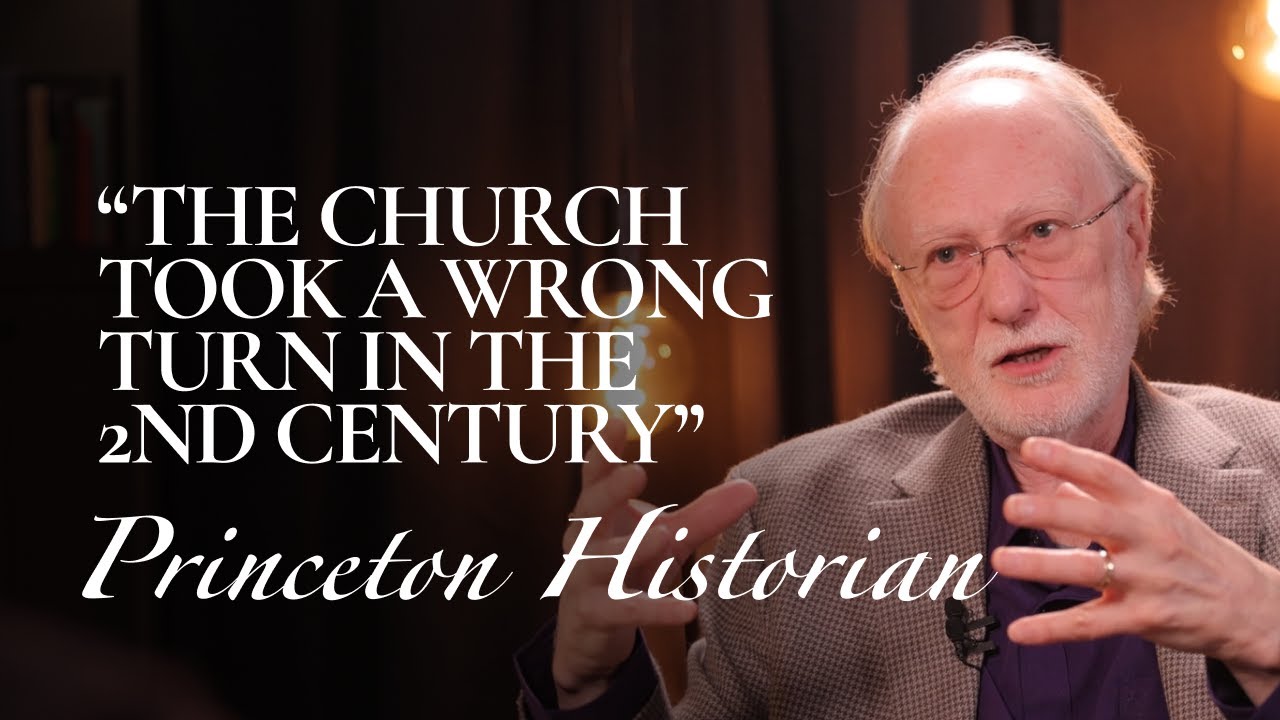
The episode features a conversation with a prominent Princeton historian of early Christianity who argues, on historical-critical grounds, that Jesus never explicitly claimed to be God, expected the imminent end of the world, and that the resurrection is historically inconclusive—yet he remains a practicing Christian. The interview explores how he reconciles rigorous historical scholarship with personal faith, and what his conclusions mean for Christian theology and practice.
Did Jesus Claim to Be God?
The Gospel of John is the only gospel where Jesus explicitly claims divinity, with statements like “Before Abraham was, I am” and clear affirmations of pre-existence. The synoptic gospels (Matthew, Mark, Luke) lack such explicit claims.
The professor argues John was written later than the synoptics, based on two independent lines of reasoning:
Textual dependence: John appears to use redactional material unique to Matthew and Luke—for example, language about Jesus going up on a mountain and sitting down to teach, which is a Matthean theme not found in Mark or Luke.
Development of ideas: Christology tends to develop upward over time (from lower to higher), while eschatology (expectation of the imminent end) tends to dissipate. Paul and the synoptics expect the end soon; John largely lacks this expectation, suggesting it was written later when the urgency had faded.
Early church tradition also supports John’s late date: Irenaeus in the second century already identified John as the latest gospel, possibly reflecting social memory of its actual later composition.
The “messianic secret” in the synoptics contrasts sharply with John: In Mark, Jesus tells people not to reveal his identity; in John, his divine claims are public. It is more natural to see the tradition moving from secrecy to openness than the reverse.
The synoptics contain statements difficult to reconcile with a divine Jesus: “The Father is greater than I,” “About that day or hour no one knows, not even the Son,” and Jesus praying to God in Gethsemane with a will distinct from the Father’s.
The professor’s view of early Christology has shifted: He now accepts “early high Christology”—the idea that pre-existence and exalted views of Jesus emerged very early, possibly in the 30s–40s CE, received by Paul from tradition rather than invented by him. But he stresses this was still conceptually messy and unsystematic.
Second Temple Judaism had fluid categories for divine or semi-divine figures: Texts like Pseudo-Ezekiel depict Moses sitting on God’s throne, holding the scepter of the universe, and receiving angelic worship. Daniel 7’s “one like a son of man” was read variously as an angel, a collective figure, or the Messiah. These precedents show that ancient Jews could hold expansive views of a figure’s status without necessarily equating that figure with God in a later Nicene sense.
Jesus’ own self-conception, in the professor’s judgment:
He saw himself as the Messiah-in-waiting, not yet reigning.
He identified with the “Son of Man” figure from Daniel 7—a central eschatological role in judgment.
He had a “high self-conception” but distinguished himself from Yahweh and did not think of himself as God.
“Son of God” was originally connected to Davidic tradition (2 Samuel 7), referring to the temple-building Messiah, and was not as exalted a title as “Son of Man.”
The professor does not defend or attack the Nicene Creed: He acknowledges the christological debates of the 4th century were genuinely difficult because the sources pull in different directions. He personally relates to Jesus through the Sermon on the Mount, the passion narrative, and the parables—not through creedal formulations. He calls himself a “garage theologian” who does theology as an amateur after spending the day as a historian.
Was Jesus a Failed Prophet?
Jesus expected the imminent end of the world: The professor argues that Jesus “hoped, expected, and even taught that the end was near,” based on explicit statements in the synoptics:
“Some standing here will not taste death until they see the kingdom of God come with power” (Mark 9:1).
“You will not have gone through all the towns of Israel before the Son of Man comes” (Matthew 10:23).
“This generation will certainly not pass away until all these things have happened.”
He clarifies that he avoids the phrase “failed prophet”: Jesus was wildly successful in founding a world religion. The point is simply that Jesus’ timeline was wrong—he did not envisage 2,000+ years of subsequent history.
He came to this conclusion reluctantly: It was a difficult, hard-won scholarly judgment that he is proud of reaching because he let the evidence dictate his view rather than his theology.
Arguments for the imminent reading:
The statements are, in a first-century context, not terribly ambiguous.
John the Baptist expected the end; Paul expected the end; Jesus stands between them chronologically, making it most likely he shared this expectation.
When statements with clear time references are cross-referenced with statements with clear content descriptions, the overall picture becomes quite specific.
Common harmonization strategies are unpersuasive to him:
“This generation” meaning “race” or “kind” is linguistically possible but contextually implausible—the word is used dozens of times in the synoptics to mean “this generation.”
Claims that these prophecies were fulfilled in the resurrection or the destruction of AD 70 do not fit the actual content of the predictions.
Jesus’ ethics are not primarily driven by eschatology: Against Albert Schweitzer’s “interim ethic” thesis, the professor argues that love your neighbor, love your enemies, and turning the other cheek are rooted in Jewish tradition, not in the expectation that the world will end next week. He acknowledges his earlier work overstated the connection between asceticism and eschatology, having written it partly in reaction to the Jesus Seminar’s attempt to strip all apocalyptic content from Jesus.
The Jesus Seminar’s method: Scholars went through the gospels cutting out everything apocalyptic as secondary, reconstructing a non-eschatological Jesus. The professor considers this unsustainable without doing violence to the text.
Jesus’ radical sayings had specific audiences: “Let the dead bury their own dead” and “hate your father and mother” were addressed to particular individuals being called to follow him, not to all Galilean peasants as general ethical instruction. The tradition later flattened these distinctions.
Failed prophecy in the Old Testament: The professor points to Daniel 7, where the prophecies about the Seleucid Empire (Antiochus Epiphanes) do not match what actually happened, and to the end of Daniel where a prophesied number of days was evidently wrong and a second, larger number was added—but the original was left in the text.
How religious movements cope with failed prophecy:
Members bond as a community and hold multiple beliefs, so the failure of one prophecy need not destroy the movement.
Strategies include: claiming the prophecy was contingent on human response, reinterpreting it, or admitting misinterpretation.
Early Christians interiorized eschatology: “You have been raised with Christ” (Colossians), “You have already passed through judgment” (John), eternal life as a present reality.
They also historicized it: the darkness at the crucifixion, the resurrection of saints in Matthew 27—end-time events were mapped onto past history.
Contingent eschatology is common in Jewish tradition: The rabbis said the Messiah would come when Israel repents; Acts 3 has Peter saying repentance will bring the Messiah. Jeremiah explicitly states that promised blessings or curses are conditional on behavior. Jesus may have held a similar view and been disappointed by Israel’s response.
Eschatological urgency recedes over time naturally: By the Gospel of John it has largely dissipated; by Chrysostom (4th century), eschatological passages are reinterpreted as referring to individual death. Every century has had Christians who thought the end was near.
The professor’s personal theological response: He sees the delay of the Parousia as “the problem of evil with a time stamp”—if God is all-powerful and loves the world, why not end it now? He has no neat solution, just as he has no neat solution to the problem of evil. But he shares Jesus’ faith that God must and will win in the end, and he is a universalist who believes everyone will ultimately be okay. If there is no eschatology at all and God does not win, he would be an atheist.
Did Jesus Rise from the Dead?
The professor’s historical assessment is agnostic: He considers the evidence inconclusive and does not affirm or deny the resurrection as a historical fact.
What he considers historically probable:
Jesus was crucified and buried, likely by a member of the Sanhedrin (an odd detail unlikely to be invented).
He was taken down quickly, not left on the cross for days as was typical Roman practice.
Multiple people had experiences they interpreted as encounters with the risen Jesus—Paul, Peter, the Twelve, the 500, the apostles, and others.
He takes visions seriously as a category: He does not dismiss all visions as hallucinations. He distinguishes between hallucinations and what he calls “veridical visions”—genuine encounters with something real. The phenomenology of visions in the New Testament matches patterns found in other visionary traditions.
Comparable visionary phenomena:
After a 1970s Eastern Airlines crash in the Florida Everglades, multiple crew members were reportedly seen alive afterward by multiple witnesses in different locations, including group sightings of two or more people simultaneously.
Tibetan Buddhist “rainbow body” traditions describe accomplished practitioners whose bodies shrink or dissolve at death, sometimes leaving only hair or fingernails. A Western Roman Catholic priest investigated a recent case (1998) and found strong local testimony. The professor does not claim to believe or disbelieve this but argues it deserves serious study.
He challenges Christian double standards: Apologists demand open-mindedness toward Christian evidence but immediately debunk comparable claims from other traditions. He sees no theological reason to debunk rainbow bodies—if some practitioners’ bodies really do dissipate, it does not threaten Christian faith.
Christianity’s resurrection accounts are phenomenologically distinctive but not unique in every feature: The combination of empty tomb + multiple individual encounters + collective experiences + an unbeliever’s conversion (Paul) is unusual, but the individual components appear in other traditions.
On religious pluralism and exclusivity: When Jesus says “I am the way, the truth, and the life,” the professor follows Justin Martyr’s Logos Christology—the Logos (divine reason) speaks to everyone through their own culture and language, so truth can be found in other traditions (Socrates, Heraclitus, etc.). He is sympathetic to the idea that other religions approximate or partially reflect the Logos, and he is open to the possibility that some traditions may have insights Christianity lacks. He firmly rejects the view that adherents of other religions are demonic or damned, finding it incompatible with knowing actual practitioners and their saints.
Historical Criticism and the Christian Tradition
The church took a wrong turn after Origen: Origen (3rd century) acknowledged real contradictions between the gospels and resolved them through allegory while still recognizing the historical differences. After him, the dominant tradition became harmonization—forcing the gospels into agreement.
Occasional voices of critical honesty persisted: Augustine admitted some passages couldn’t be harmonized and suggested the evangelists simply misremembered. Calvin recognized the Sermon on the Mount as a compilation of sayings from multiple occasions. Luther occasionally criticized Matthew and Mark for getting things wrong. But these were minority voices.
Harmonization led to absurdities: David Friedrich Strauss (19th century) devoted much of his critical work to lampooning harmonists who, for example, multiplied the number of blind men healed at Jericho to reconcile conflicting accounts.
Ancient historiography differed from modern standards: Ancient historians sometimes invented speeches to capture the “gist” of what was said, as Plato did with Socrates. The professor compares the Gospel of John’s discourses to Plato’s later dialogues—starting with genuine sayings but expanding and reinterpreting them. Still, the ancients were not oblivious to the difference between eyewitness testimony and rumor.
The professor’s method vs. the Jesus Seminar: The Jesus Seminar voted line-by-line on whether Jesus said particular things. The professor instead looks for patterns—recurring themes across multiple sources that are consistent and unlikely to have been invented (e.g., Jesus as exorcist, Jesus in conflict with Satan). He considers pattern-based arguments for historicity more secure than arguments for individual sayings, though he doesn’t rule out the latter.
On the canon: For historical purposes, the canon is irrelevant. The professor uses Josephus, the Gospel of Thomas, and any other source that is dateable and relevant. He currently views Thomas as a “rolling text” that grew over time, with some sayings possibly going back to the first century.
The relationship between history and theology: The professor keeps them separate. History asks what is probable; theology asks what things mean. He acknowledges the theologian’s task is impossible in one sense—to speak about God one would need to know everything: all religions, all history, all philosophy. He wants theologians to know modern biblical criticism, world religions, and philosophy, but recognizes no individual can master it all.
Faith and exploration: The professor’s faith rests on two convictions—God exists and God is good. With those, he feels free to explore, question, and doubt. He pictures Christianity as a citadel: most people live inside, apologists defend the walls, but he roams outside exploring other territories and occasionally brings back news. He is a universalist, believes God will win in the end, and finds historical criticism liberating rather than destructive—it frees one from false beliefs and opens up genuine knowledge.