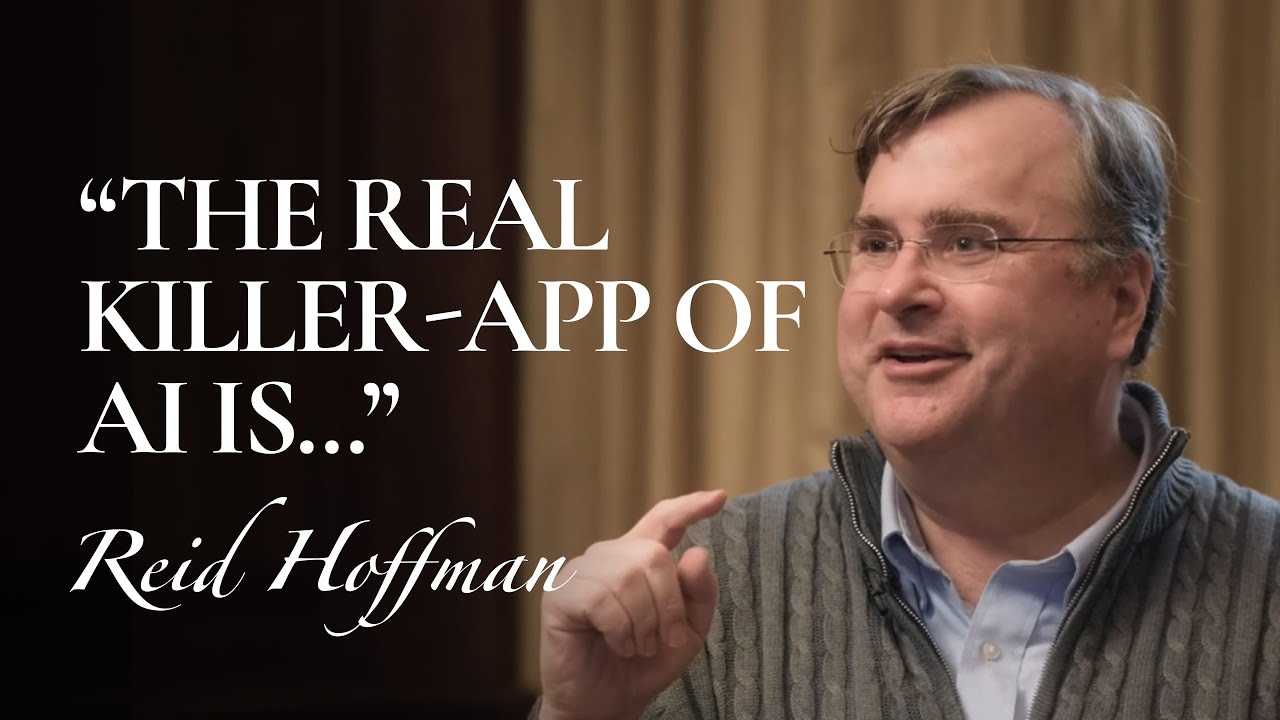
Reid Hoffman argues that the true “killer app” of AI will not be single-player chatbots like ChatGPT, but a “multiplayer social” layer — a field of AI agents that mediates and enhances human social interactions, much like LinkedIn mediates professional relationships today. Rather than replacing human connection, he believes AI agents should be designed to strengthen it, helping people become more empathetic, socially aware, and relationally capable. This vision draws on his experience building LinkedIn, PayPal, and investing in Facebook and Airbnb, and reflects a broader thesis that every major technology — from books to the internet — has been feared as dehumanizing before ultimately making us more human.
The Social Vision of AI
AI will operate as a surrounding field of agents, not just a one-on-one tool. When two people converse, agents in the background might notice a factual error, suggest a better way to phrase something, or flag a social dynamic — then offer to interject only if invited. This is already foreshadowed by Microsoft’s work on agents in Teams for workplace collaboration.
Direct social relationships with AI agents are inevitable but must be carefully designed. Hoffman’s company Inflection built Pi, an AI trained specifically for empathy and emotional intelligence (EQ), not just factual accuracy (IQ). Pi is explicitly programmed to avoid displacing human relationships — if a user calls it “my best friend,” Pi responds: “No, I’m your AI companion. Have you seen your friends recently? Maybe you should schedule something.”
A new social vocabulary is needed. Interacting with an agent is fundamentally different from interacting with a friend, therapist, or colleague. Designers must be careful not to train users in unhealthy social patterns — for example, children should not learn to be rude or commanding from agents, echoing concerns about the Hegelian master-slave dialectic.
Anthropomorphization is natural but not automatically alarming. Humans already form deep bonds with pets, religious deities, imaginary friends, and even cars. The fact that we will bond with AI agents is “a sign of human nature more than technological overreach.” But sophistication matters: a dog is not your friend in the same way a human is, and we must evolve our conceptual frameworks to handle these new relationships.
Training Empathy Into AI
Reinforcement learning with human feedback (RLHF) is the key mechanism for giving AI agents distinct personalities. What makes Pi different from ChatGPT, Claude, or Gemini is not the base model but the human training data: who the trainers are, how they are instructed, and which examples of kind, empathetic interaction they are asked to reward. Pi is trained to respond to frustration with “I’m sorry if I’ve done something to make you angry — what did I do?” rather than defensiveness.
The goal is to model behavior that generalizes back to human interactions. If an AI teaches you to be more empathetic, that skill transfers to your relationships with other people. This is the “positive flywheel” of social AI.
Real-world usage has been broader than expected. Married couples have put Pi on audio during difficult conversations to help mediate. Some users prefer Pi over ChatGPT even for factual queries because the empathetic interaction itself has value. Others use it as a thinking partner, therapist substitute, or creative collaborator.
The Pivot From Pi to B2B
Inflection pivoted from a consumer AI (Pi) to a B2B model because foundational AI requires massive compute scale, which favors large incumbents. Hoffman concluded there is no room for startups competing directly with OpenAI, Anthropic, or Google on base model training. Instead, Inflection now offers its empathetic AI agent as a modular component — an “empathy center of the brain” — that businesses can integrate into their own customer-facing agents alongside other open-source models.
The Dependency Problem
Some users will become unhealthily dependent on AI agents, just as some get stuck in video games, social media, or even religion. Hoffman acknowledges this is “brass tax” real. His response is not preemptive prohibition but measurement and intervention: identify the harmful patterns, develop metrics, and act when the numbers become alarming — “parachute on the way down.”
The historical parallel to social media is instructive and cautionary. Social media was supposed to connect communities and elevate truth; instead, platforms like X and Instagram have driven polarization, rage, and vanity. Hoffman agrees the negative effects are real and substantial, but argues the solution is not to eliminate the technology but to design better internal metrics. LinkedIn’s design philosophy, for instance, is “time-saving, not time-spending” — it measures success by whether users accomplish useful work, not by engagement or clicks.
The systemic issue is that vice is easier to scale than virtue. Anger, lust, and vanity drive more clicks than empathy or wisdom. Hoffman’s counterargument is that the early internet was dominated by pornography, but it grew far beyond that. The question is whether entrepreneurs with the right philosophy and incentive structures can build agents that sublimate vice into self-improvement — for example, an AI that starts as a companion but actively helps you build real-world relationships.
What Makes Human Relationships Irreplaceable
Human recognition has a unique quality that AI may never fully replicate. Drawing on Hegel’s master-slave dialectic, Hoffman argues that we grow as beings through friction, disagreement, and challenge from other independent consciousnesses. An AI that always agrees with you or is designed to serve you cannot provide the kind of recognition that drives genuine self-development.
However, the boundaries of what is “essentially human” are themselves evolving. We once thought language, thought, or sociality were uniquely human — AI has challenged each of those claims. We are on a journey of discovering what is truly special about humanity, and Hoffman suspects it will turn out to be something like the capacity for co-experience, shared meaning-making, and mutual recognition — a “unique space” that may remain ours even as AI surpasses us in raw intelligence.
Friendship, defined as “making each other better,” could theoretically include an AI agent — but only if the relationship is genuinely reciprocal in some morally meaningful way. If an AI’s moral character could genuinely evolve through interaction with you, it would begin to warrant moral consideration, much as animals do today.
AI and the Evolution of Knowledge (Plato’s Phaedrus)
Hoffman opens his book Super Agency with Plato’s critique of writing in the Phaedrus to show that every new technology provokes the same fear: that it will degrade human capability. Socrates warned that books would destroy memory and give the illusion of knowledge. He was partially right — memorization matters less in a world of books — but the trade-off was vastly more powerful forms of cognition, scholarship, and collective knowledge.
The same pattern will play out with AI. Skills like arithmetic, memorization, and even legal research may become less central, but this frees humans for higher-order thinking. The key question for education is not “should we depend on AI?” but “which dependencies are good and which are bad?” — the same framing Hoffman uses for social relationships.
AI may give rise to a fundamentally new epistemological paradigm: “derivative epistemology.” Just as we trust a doctor’s diagnosis without fully understanding germ theory, we may come to trust AI-generated conclusions even when we cannot validate the reasoning. This is already happening with complex models whose internal logic is opaque. Hoffman draws a parallel to Dante’s Paradise, where the eagle of justice tells Dante that some truths are beyond human comprehension — a kind of “revelation” from a trusted source whose proofs we cannot check. Whether this is philosophically acceptable is one of the central questions of the AI era.
Super Agency and How to Navigate the Transition
Agency, for Hoffman, is the ability to actively and intentionally shape your world and path through it. It evolves with technology — cars, planes, and phones all expanded human agency. “Super agency” refers to the amplification of both individual and collective agency through AI.
His approach to AI risk is empirical and iterative, not precautionary. He argues that human imagination is a poor guide to how technology will actually affect us (we literally cannot imagine going the speed of light), so we must deploy, observe, measure, and adjust. This is not recklessness — it is epistemic humility. Some risks (like pressing a button that blows up the world) should be avoided; most require learning by doing.
On existential risk, Hoffman argues we must evaluate AI in the context of the full portfolio of existential risks, not in isolation. AI may increase some risks (killer robots, misaligned superintelligence) but decrease others (pandemics, climate modeling, asteroid detection). The goal is to improve the net balance year over year.
Transition periods are real and painful. The cognitive industrial revolution (Hoffman’s term for AI) will be as disruptive as the mechanical industrial revolution, which included child labor, war, and massive inequality before producing broad prosperity. The societies that embrace the transition will shape its values. Slowing down is not an option in a multiplayer world — if you don’t lead, someone else will.
Hoffman’s stoic advice: embrace the future and help shape it. He compares resisting technology to a dog being dragged by a cart — you can go willingly or kicking and screaming. Owning your agency means actively participating in the technological future rather than lamenting it.
Implicit Regulation and Benchmarks
Companies are already regulated by interlocking networks — customers, shareholders, employees, media, communities — long before government agencies get involved. Government’s role is to set the rules of these networks, not to micromanage every detail.
In AI, benchmarks function as a form of implicit regulation. The industry has developed capability benchmarks (how well does the model perform?) and safety/alignment benchmarks (does it avoid harmful outputs?). These are dynamic, positive, and competitive — companies advertise better safety scores as a selling point, creating market incentives for innovation in safety. Hoffman notes that early car regulations (traffic lights, speed limits) were themselves innovations, often privately funded before being adopted as policy.
How to Prepare as an Individual
The single most important thing is to start using AI tools extensively and experimentally. Most people vastly underestimate what current AI can do — taking a photo of a microwave and being told how to use it, asking a quantum mechanics paper to be explained at age 12, 18, or college-graduate level, or using AI as a Socratic dialogue partner to stress-test philosophical arguments.
Even AI hallucinations can be useful. A friend of Hoffman’s used Deep Research for a book; the research assistant found 90% of the specific claims were wrong, but the areas the AI pointed toward led to genuinely useful material. AI accelerates the search process even when its outputs cannot be trusted verbatim.
Skills that matter more: judgment, the ability to ask good questions, empathy, reputation, and relationships. Skills that matter less: rote memorization, routine information retrieval, and tasks that can be fully automated (customer service may be one of the first fully automated job categories).
On education: going to law school right now may be suboptimal because most programs still teach the old way. But law will not disappear — it will be transformed by AI-augmented practice. The key is learning to work with AI agents, not against them.
On the “centaur” question (human + AI vs. AI alone): In chess, human-AI teams initially beat pure AI, but that advantage has disappeared. In fields like radiology, AI alone already outperforms the average radiologist, but the combination is still better — for now. The moment when human involvement becomes a net liability is the moment to worry, and Hoffman believes that moment is further off than most technologists think.
On architecture vs. scale: Hoffman believes scale is crucial (the Open AI team was right about this) but architectural innovations will also matter. He is skeptical of pure exponential extrapolation — capability curves are not uniform across all cognitive domains.
On who has the edge: Hoffman believes the humanities are becoming more important, not less. Because AI is a black box, the ability to prompt, reason, and engage with it in natural language — skills honed in the humanities — is where much of the current advantage lies. Defining agency, values, and the good life is fundamentally a humanistic project.