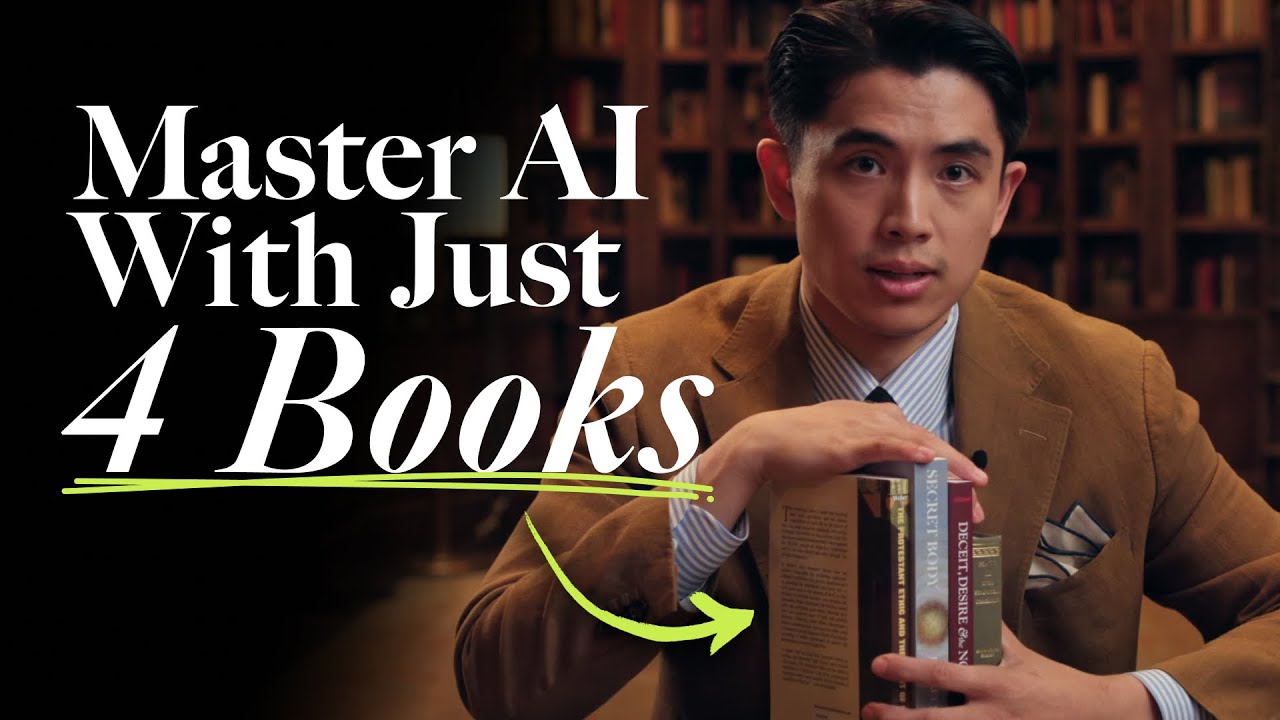
The host argues that AI is not merely an economic disruption but a religious-level threat to the dominant modern faith: capitalism, work, and achievement. Drawing on four key books—spanning sociology, ancient philosophy, literary theory, and the study of mysticism—he outlines how to reframe one’s relationship to work, value, and creativity in order to not just survive but thrive through the AI revolution. These are not technical or self-help books but works of philosophy, one thousands of years old, because the scale of change demands rethinking everything from first principles.
Weber’s The Protestant Ethic and the Spirit of Capitalism: AI as a Religious Crisis
Max Weber’s core argument is that certain Protestant sects, especially Calvinism, laid the cultural groundwork for modern capitalism. Calvinists believed in predestination—whether you are saved is predetermined—which created intense anxiety. People began looking for worldly signs of God’s favor, leading to habits like hard work, frugality, and valuing material gain.
Over time, capitalism retained these habits even after dissolving the religious framework. Today, most people treat work as a source of ultimate meaning and existential fulfillment, not just a way to earn money. This is what Weber calls the “Protestant ethic”—work has become a secular religion.
Once you see work as a religion, the fear of AI taking jobs becomes much deeper than an economic concern: it is an assault on people’s primary source of meaning and identity.
The host frames modernity as a series of humiliations for humanity:
Copernicus showed Earth is not the center of the universe.
Darwin showed humans are not biologically special, just “better apes.”
AI now threatens the last bastion of human pride: intelligence and productivity.
Historically, when a dominant religion collapses, competing ideologies fight to fill the vacuum. The death of classical Christianity, for example, set the stage for the ideological wars of the 20th century (communism, liberalism, fascism). The host predicts that once humans are no longer defined as homo economicus, there will be new ideological holy wars over what humanity is for.
This is why the host says the correct comparison for AI is not the dot-com bubble or 2008, but Darwin or the Industrial Revolution—events that required wars and upheaval to sort out.
Aristotle’s Nicomachean Ethics: The Case for Leisure Over Work
Aristotle draws a critical distinction between instrumental goods (things valued for what they provide, like money or work) and goods in themselves (things valuable for their own sake, like art, philosophy, and theater).
He criticizes people who confuse instrumental goods for final goods—for example, someone who hoards money for its own sake rather than for what it can do for their family. The host argues that the Protestant ethic has made this exact error with work: treating productivity and output as ends in themselves rather than as means to a good life.
Aristotle elevates leisure (schole) as the highest human activity. This does not mean laziness, rest, or amusement (like watching sports or playing video games). Leisure, for Aristotle, is activity done for its own sake that elevates and ennobles the soul—art, philosophy, deep conversation.
All work is instrumental; all leisure is intrinsic. This reframing makes the AI revolution something to be welcomed rather than feared: if AI and robots can handle all instrumental activity, humans are freed to pursue the activities that are truly worth doing for their own sake.
The host made a practical life decision based on this framework: he left a high-growth startup with enormous economic upside to pursue a project on the Great Books. His reasoning was that even if the startup became a $10 billion company, he would have failed in the Aristotelian sense—he would have spent his 20s on something he didn’t love for its own sake. The Great Books project, by contrast, was something he would do even if it made no money and no one watched it, because the joy was in the activity itself.
The practical question he urges viewers to ask: What do you do that is intrinsically good for its own sake? Because anything purely instrumental is likely to be replaced by AI and robotics.
Girard’s Deceit, Desire, and the Novel: Memetic Desire and the Future of Value
René Girard’s theory of memetic (mimetic) desire argues that humans do not desire objects directly. Instead, we desire what our models—people we admire or look up to—desire. Desire is triangular: subject → model → object.
This explains phenomena that pure use-value cannot: why a celebrity-endorsed t-shirt sells for hundreds of dollars when it costs five bucks to make, or why a romantic prospect seems more attractive when other suitors are competing for them. Value is socially constructed through imitation, not intrinsic to the object.
The host applies this to economics by ranking different assets on a spectrum of mimesis:
Treasury bills: almost zero mimesis, nearly pure underlying value.
Equity in a value company: some mimesis, some narrative.
Growth companies (Tesla, SpaceX): heavily driven by narrative and what others think.
Cryptocurrency: almost entirely mimesis, very little intrinsic value.
His prediction: as AI solves more and more physical scarcity, the economy will shift increasingly toward the memetic layer and away from the production layer. Value will be captured more by social narratives, status, and imitation than by raw economic output.
A practical implication: the host chose to build a YouTube channel over pursuing a PhD in philosophy partly because content creation builds a form of social capital that academia does not. In a world where more value is memetic, building social capital in any domain becomes a strategic advantage.
The practical question: How can you build more social capital in whatever domain you operate in?
Kripal’s The Secret Body: Human Genius as Received, Not Produced
Jeff Kripal’s (referred to as “Jeff” and “Carreira Paul” in the transcript) radical thesis is that human genius is not created by the genius but received—through mystical experiences, visions, or “downloads” from a source beyond the individual mind.
Historical examples he cites:
Nietzsche claimed his most famous work, Thus Spoke Zarathustra, was received in a mystical experience, more transcription than creation.
Tesla said he received nearly fully designed schematics of his inventions, rather than inventing them through conventional problem-solving.
Ramanujan, the Indian mathematician, claimed he received theorems from a Hindu goddess in his dreams. His notebooks contain conclusions with little or no proof shown, yet many have since been proven correct by other mathematicians.
Descartes, the father of rationalism and the scientific method, traced the origin of his entire philosophical system to three dreams in which he felt commissioned by a divine intelligence to find a unifying theory of knowledge.
Kripal extends this pattern to modern culture in his book Mutants and Mystics, documenting how much of pop culture (superheroes, the X-Men, etc.) was created by people who reported similar mystical experiences.
The host has personally angel-invested in two entrepreneurs who claim their business inspiration came through this kind of receptivity and download, suggesting the pattern extends to modern entrepreneurship.
The connection to AI: the host’s intuition is that AI cannot receive these downloads. If human intuition—even in its weaker forms like hunches—is connected to some kind of divine or transcendent source, that is an advantage humans will retain over AI.
Kripal’s conclusion about how to access these experiences: trauma of some kind seems to be a common trigger. Nietzsche, Tesla, and Ramanujan were all extremely sickly. Sexual trauma, near-death experiences, and physical trauma can open the “receptacle.” Alternative methods include psychedelics (which Kripal views as temporary chemical trauma) and meditation. The common thread is disrupting the normal functioning of the social ego, which opens the antenna for these experiences.
The host is actively researching how to become more open to these kinds of intuitions and downloads, viewing this as a practical edge that AI will never develop.