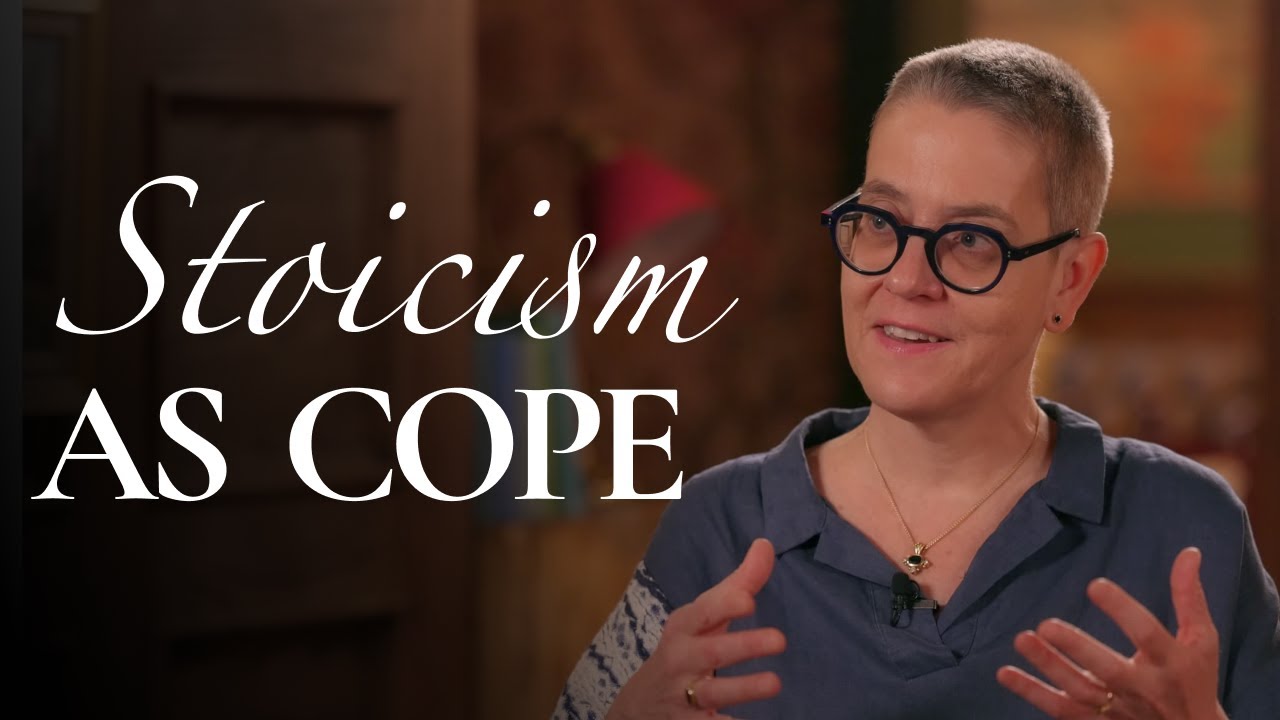
- Stoicism as a coping mechanism in the late Roman Republic: This episode examines stoicism not just as abstract philosophy but as a lived practice during one of Rome’s most turbulent periods—the collapse of the Republic and the rise of autocracy. Classicist Katharina Volk argues that stoicism often functions as a psychological tool for those who have lost control over their external circumstances, and its popularity surges precisely when people feel powerless. The episode uses the life of Cato the Younger as a central case study to test whether stoic ideals hold up under real political pressure, and finds that while stoicism can provide genuine consolation, its spread may reveal more about societal distress than about philosophical truth.
What Stoicism Teaches
-
Virtue is the only good and sufficient for happiness: Stoicism, founded in Athens in the late 4th century BCE, holds that virtue—knowing and doing what is morally right—is the summum bonum, the highest good. If you possess virtue, you have everything needed for happiness (eudaimonia), regardless of external outcomes.
- The Archer metaphor: A stoic archer does everything possible to hit the target, but whether the arrow actually hits depends on factors beyond their control (wind, the target falling). Virtue lies in the quality of the attempt, not the result.
- Virtue is within your control: Unlike health, wealth, or success, virtue depends entirely on your own reasoning and choices, making it the one reliable path to happiness.
-
Preferred and dispreferred indifferents: While only virtue is truly “good,” stoics acknowledge that some things are naturally preferable (health, wealth) and others naturally dispreferred (illness, poverty). These are called indifferents—they do not affect your happiness, but a wise person still pursues the preferred ones as circumstances demand.
- This creates a puzzle: if something is truly indifferent, why prefer it? The answer is that human nature naturally inclines toward health and wealth, so pursuing them is rational—but failing to obtain them does not diminish your virtue or happiness.
-
Political engagement is a stoic duty: Stoics believe humans are both rational and social by nature, so engaging in politics and serving the community is part of living virtuously. They also hold cosmopolitan ideals—seeing all humanity as fellow citizens of a universal polis—which extends moral concern beyond one’s own city or state.
Cato the Younger: Stoicism Embodied
-
Who was Cato?: Marcus Porcius Cato (the Younger) was a Roman senator in the late Republic, known as the uncompromising opponent of Julius Caesar and the defender of traditional senatorial rule. After Pompey’s defeat in the civil war, Cato continued fighting in Africa and ultimately committed suicide rather than accept Caesar’s pardon, becoming a martyr for the Republic.
-
Cato’s stubbornness as stoic practice: Cato’s political behavior closely mirrored stoic principles—he acted on principle regardless of outcome, even when it was politically disadvantageous.
- He filibustered in the Senate and was dragged off to prison.
- He brought a motion accusing Caesar of genocide in Gaul while others celebrated Caesar’s victories.
- He prosecuted a politically useful ally for electoral bribery simply because it was the right thing to do.
- He divorced his wife so an older, childless senator could marry her to produce an heir, then remarried her after the senator’s death—a move even Romans found strange.
-
Did stoicism cause Cato’s politics or merely shape their form?: Volk argues that stoicism provided the form of Cato’s politics—unyielding adherence to principle—but not necessarily the content of his hyper-conservatism. Stoicism prescribes acting virtuously for the community, but what counts as virtuous must be determined by each person in their specific circumstances.
- Stoic Persona Theory: What virtue requires depends not only on the situation but on the individual’s character. Cato’s stubborn, headstrong nature meant his stoicism manifested as rigid opposition, whereas Marcus Aurelius, a more melancholic and accommodating character, expressed stoicism through dutiful acceptance of imperial responsibilities.
-
Was Cato a true stoic or a performer?: Volk notes that Cato was a “spirited public performer” who relished the odd, admirable behavior people expected of him. His suicide was highly literary—he read Plato’s Phaedo (about Socrates’ death) before killing himself, clearly modeling himself on Socrates.
- This raises the question: was Cato genuinely virtuous, or was he building a political brand? Since Cato wrote nothing, we must infer his inner life from others’ accounts, especially Cicero’s. We ultimately cannot know whether he was sincere or vain.
- Volk suggests that even if Cato sought reputation, this is not necessarily unstoic—reputation is a preferred indifferent, and seeking it for the right reasons is acceptable. But if he acted only for reputation, that would violate the stoic principle that virtue, not consequences, matters.
-
Did Cato’s stoicism destroy the Republic?: Some argue that Cato’s uncompromising hardline stance pushed Pompey into conflict with Caesar, when negotiation might have preserved the Republic. Volk is cautious: Cato’s behavior didn’t help, but Caesar’s ambitions would likely have caused conflict regardless. Even if Cato is to blame politically, that does not mean stoicism as a philosophy is to blame.
Stoicism as Consolation for the Defeated
-
Stoicism surges after military defeat: After the defeat of the Pompeian side at the Battle of Pharsalus (48 BCE), stoic arguments became prominent in the letters and conversations of the defeated Romans, including Cicero (who was not a stoic but an Academic skeptic).
- The key argument: “The only evil is vice. Since our conduct has been blameless, no evil has befallen us.” This allowed the defeated to reframe their loss—they were morally victorious even though militarily crushed.
- Cicero and his friends used stoic reasoning to console each other: virtue is sufficient for happiness, and since they had acted virtuously, they could still be happy despite exile, loss of political power, and the death of the Republic.
-
The genre of philosophical consolation: Volk explains that there was an established genre of philosophical consolation in the ancient world, used to comfort people in distress—typically after death, exile, or disaster. Common arguments included: death is not an evil for the deceased, the person died at the right time, or excessive grief is unmanly and selfish.
- These arguments aim to reframe the situation intellectually so the sufferer stops being upset, rather than encouraging them to process grief emotionally (a more modern approach).
-
Is this Nietzschean slave morality?: The host raises the critique that stoicism looks like what Nietzsche called slave morality—the powerless flip the value hierarchy so that their weakness becomes virtue and their defeat becomes moral victory. Stoicism, on this reading, is “for people who can’t control the external world, so they cross their arms and say internal virtue is what matters.”
- Volk acknowledges this is a fair observation but notes that stoicism also has a deterministic and cosmological dimension: everything is fated and the universe is the best possible world. By accepting fate, you become part of a larger constructive whole rather than a marginalized loser. Marcus Aurelius especially emphasizes this—doing your duty means serving the cosmos.
- The host counters that this is still just another form of coping. Volk agrees that stoicism (and epicureanism, and Buddhism) are “largely or at least originally for coping”—they help people feel self-sufficient and in control when external circumstances are chaotic.
What the Spread of Stoicism Tells Us About Society
-
Stoicism as a signal of lost control: Volk and the host observe that stoicism was not widely popular during the Roman Republic, when citizens had real political power. It exploded in popularity during the Empire, when freedoms were curtailed. Similarly, Buddhism’s doctrine that “everything is suffering” made sense in a context of high infant mortality and limited control over life.
- The sociological pattern: When philosophies like stoicism spread widely, it tells us something about the society—specifically, that people feel a loss of control over their external world.
-
Stoicism’s contemporary resurgence: The host and Volk discuss the modern popularity of stoicism in the West, especially in Silicon Valley and the “manosphere.” They note that this modern stoicism is often a watered-down version that emphasizes self-sufficiency and emotional control while stripping away the ancient stoic commitment to community and political engagement.
- Modern stoicism often works alongside or replaces organized religion and psychotherapy. Some stoic techniques overlap with cognitive behavioral therapy and can be genuinely useful.
- The host asks whether stoicism’s rise today signals that people in the contemporary West feel increasingly powerless, much as Romans did during the transition from Republic to Empire. Volk finds this an interesting and plausible hypothesis.
Is Stoicism True or Just Useful?
-
The tension between truth and utility: The host expresses suspicion that stoicism spreads not because it is true but because it satisfies a psychological need—it makes people feel better. He gives the example of “preferred indifferents” as a metaphysical construction designed to preserve the claim that virtue alone guarantees happiness, even though common sense suggests you’d be happier healthy and virtuous rather than tortured and virtuous.
- Volk’s rescue: She points out that in ancient philosophy, truth and psychological benefit are not opposed—they are connected. The Socratic intellectualist view holds that knowledge itself transforms your psychological state. If you truly understand what is good, your emotions will align accordingly. So the fact that stoicism works as a coping mechanism could be evidence that it is true, not evidence that it is false.
- The host finds this a compelling response to his potential error in assuming that practical usefulness undermines truth.
-
Volk’s own assessment: Volk acknowledges that the stoic claim—that a wise person can be happy even while tortured—is “a tall order” and not entirely plausible by common-sense standards. The stoics themselves were not optimistic that anyone had ever fully achieved the ideal of the wise person (perhaps only Socrates came close).