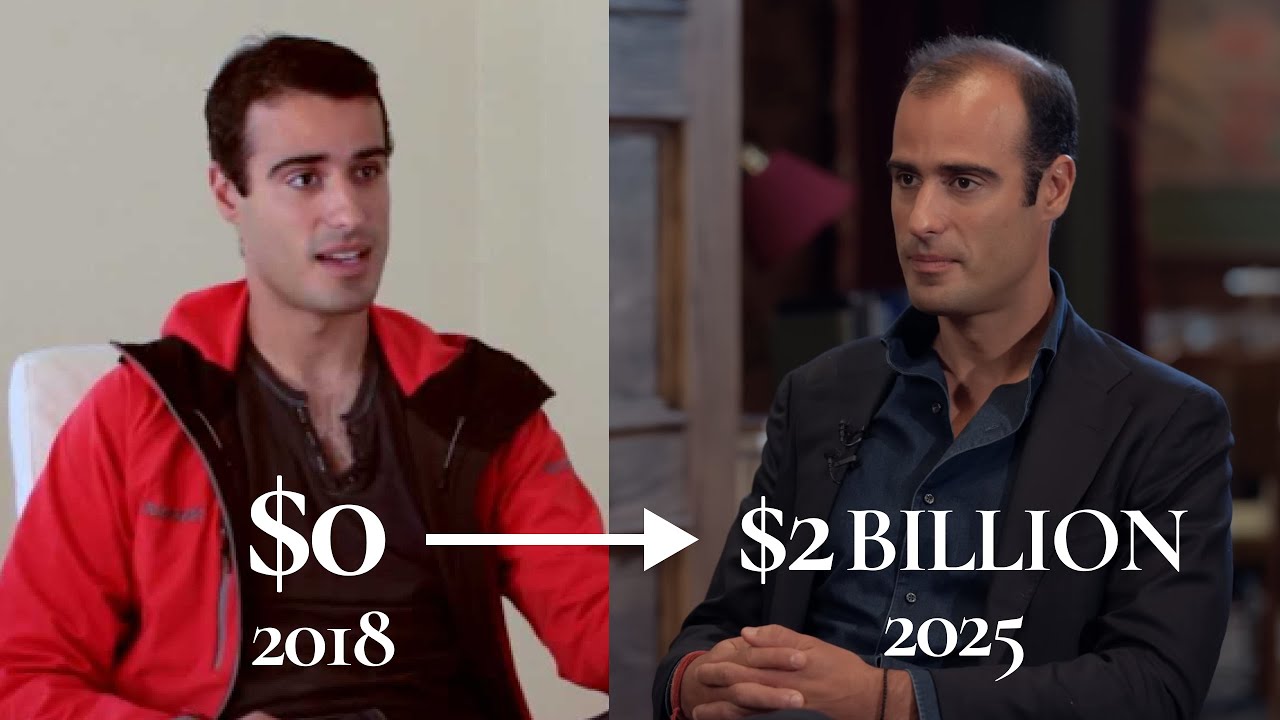
A decade after their first conversations, Francis Pedraza and Jonathan reunite to reflect on how Francis’s philosophical convictions shaped his journey from struggling founder to leader of Invisible, a multi-billion-dollar AI unicorn.
In 2018, Francis had just failed his first company, was barely surviving with Invisible, and was seen by many as delusional for his grandiose claims about saving the world.
By 2025, Invisible employs hundreds directly and 6,000 contractors globally, growing at 100% annually, potentially becoming the largest manpower organization on Earth.
The conversation explores how Francis’s deep study of philosophy, classics, and spiritual traditions wasn’t a hindrance but the very engine of his success—giving him unique ideas, resilience through near-failure, and a framework for using wealth meaningfully.
Entrepreneurship as Spiritual Practice
Francis frames company-building not as mere wealth creation but as a path of enlightenment and service, drawing on multiple spiritual traditions.
He references the Bodhisattva vow—to save all sentient beings—as his motivation: “To save myself is not enough. The true king makes others king.”
He distinguishes between Jana Yoga (yoga of knowledge) and Karma Yoga (yoga of action), arguing that his dharma is to be in the world applying wisdom, not retreating from it.
He sees Invisible as a “lightning vehicle for enlightenment”—a way to propagate an empowered entrepreneurial mindset globally, which he believes is the path to world peace.
The Vimalakirti Sutra’s teaching that the layman’s path is more difficult but more noble because one is constantly tempted resonates with him: building a company is his way of practicing in the world’s hardest conditions.
A Founder Who Rejects Progress
Francis holds the unusual position among Silicon Valley founders of rejecting the concept of absolute progress.
He argues that while technology improves material conditions—better plumbing, dentistry—the essential human experience hasn’t changed since the Epic of Gilgamesh: love, mortality, victory, defeat remain constant.
He critiques the “hockey stick” mentality of Silicon Valley, noting that every technological breakthrough eventually hits an S-curve plateau; deep learning is not the end of history but another cycle.
He identifies two Luciferian messages in modern media: longevity (you’ll live forever) and AI omnipotence (God as your slave), which he sees as modern versions of the curses from Genesis—mortality, labor, and coordination costs.
He challenges the assumption that literacy and learning have truly progressed, noting that most college graduates don’t read books and the sacredness of learning has been lost compared to earlier eras when the learned were treated as magicians.
His conclusion: technology can progress cumulatively, but the core questions of the good life are constant, and modernity may represent regress on the most important things.
How Invisible Will Save the World
Francis’s vision for Invisible has evolved from direct globalism to a philosophy of sovereignty and cultural renaissance.
He now believes Invisible’s primary impact is as a vanguard—an example of how one ought to live—and that the wealth it generates enables other transformative work.
He is launching two foundations: the Sovereignty Foundation, dedicated to empowering sovereign individuals, companies, and governments as an alternative to victim thinking and wokeness; and the Eternity Foundation, which uses AI to digitize, translate, and revive ancient texts, music, and traditions—a 21st-century Renaissance.
He envisions creating a global middle class through Invisible’s model: the best automation company should also be the best training company, continuously training humans to do what computers can’t, creating meritocratic paths to generational wealth.
He draws on the Arthurian legacy: building a just kingdom, which can be a corporation. He realized that a company has its own sphere of free will where you can write your own laws, and with people in over 100 countries, Invisible is already a global kingdom.
Reconciling Action, Contemplation, and Meditation
Francis navigates the tension between the active life, the contemplative life, and the meditative life by choosing entrepreneurship as the path that contains all others.
He chose company-building because capital has the “hermetic quality of being able to transform into everything else”—a house, a music production company, a university—allowing him to redeem all the forks in the road he left behind.
He relates to the Hegelian concept of sublation: building a company looks like the opposite of monastic poverty and chastity but actually contains the essence in a higher form.
He practices intense personal discipline: eight months of celibacy, vegetarianism, and fasting (one meal a day for three months, then two meals a day for three more) to test whether he could experience joy without attachment to success.
He manages the temptation of wealth by giving it away before it exists—structuring his estate to eventually distribute a third to the Eternity Foundation, a third to the Sovereignty Foundation, and a third to a family office that operates meritocratically, even adopting people in the Roman fashion.
Heroism in an Anti-Romantic Age
Francis and Jonathan explore the Arthurian archetype as a framework for understanding Francis’s journey and the role of the hero in modernity.
Francis was deeply moved as a child by the Arthurian legend—the knight who defeats the dragon, rescues the princess, saves the realm, and restores justice—and devastated to discover that knights no longer exist and the kingdom belongs to investment bankers.
He identifies with Don Quixote as the archetype of the last hero in a world that no longer believes in heroism, and argues that one must be willing to be a fool to produce a miracle.
He sees the entrepreneur as Napoleonic—deputizing themselves, giving themselves authority—and argues that this apparent delusion becomes a self-fulfilling prophecy: “You have to be crazy to be right there.”
He references the Abraham and Isaac story as a model of faith: the leap into the unknown where one acts on metaphysical convictions (truth, beauty, justice, love) that cannot be proven but must be assumed for life to have meaning.
Jonathan reflects that he initially saw Francis as Don Quixote but now sees him as more Ami of Gaul—the hero who actually succeeds—and that Francis’s philosophical obsession, which made him seem like a buffoon in 2018, was ultimately the cause of his success.
The Necessity of Faith in a Secular Age
Francis argues that even from a purely secular position, one must make an “Abrahamic leap of faith” in metaphysical concepts for life to have meaning.
He doesn’t claim to know God exists but asserts that belief in God is necessary: “If God does not exist, we must invent him.” Without this, he argues, we fall into Nietzsche’s abyss—the death of God destroys the foundation and we cannot replace it.
He extends this to true love, justice, beauty, and goodness: none can be proven, yet all must be assumed. Rejecting them leads to nihilism; embracing them enables the hero’s journey.
He critiques modern celebrity culture as idolatry—the mispricing of value that leads to societal weakness—and contrasts it with genuine heroism, which requires faith that may look like delusion to others.
He acknowledges the shadow of the hero: “You might be wrong.” The entrepreneur is either delusional or prophetic, and you never know which in your lifetime. The compensation for this uncertainty is fulfillment, but it’s built on a foundation of faith, not proof.
The Making of a Philosopher-Builder
Francis’s intellectual formation explains how he became the kind of founder who could persevere through near-failure and build something extraordinary.
He received what he considers a better education in high school than in college, studying the Great Books of Western civilization through a five-year program covering Homer, Plato, Aristotle, the Romans, medieval scholastics, and Renaissance-Enlightenment authors—reading full original texts, writing essays, and debating.
This education revealed “the great conversation”—2,000 years of authors responding to each other—and compelled him to ask: what does it mean for me, Francis, living now? What are the biggest problems in the world?
He lost respect for his Cornell professors for their jaded specialization—studying whether Thucydides said 300 or 400 ships at Salamis—and saw them as cowards hiding from the real message of their discipline.
He frames entrepreneurship as “an education for conquerors”: just as Aristotle taught Alexander the Great, the liberal arts should compel one to action. Ideas must become things.
During Invisible’s darkest period—when an angry employee deleted his email and Google Drive, when he was paying himself less than $1,000 a month, when he moved to his dying grandfather’s ranch—he sustained himself through what he calls “spiritual push-ups”: rereading the Stoics, Sufis, and ancient wisdom texts, practicing archery, and reading Hagakure’s Book of the Samurai, which taught him to “become insane and desperate to die”—to go down swinging rather than playing nice.