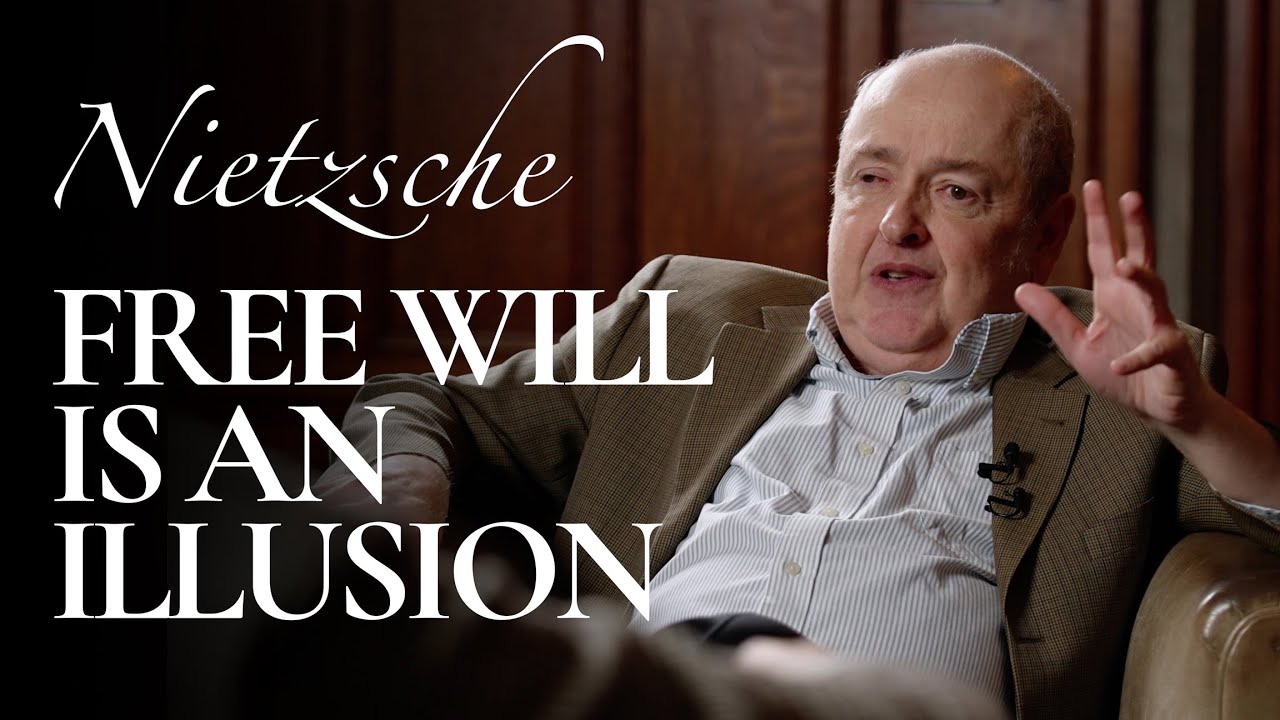
Nietzsche’s radical rejection of free will is central to his philosophy, not a peripheral curiosity. He denies both major philosophical camps—compatibilism (free will is compatible with determinism) and incompatibilism (free will requires the will to be causally undetermined)—and grounds his argument not in physics or theology but in physiology and unconscious drives. This makes his position uniquely threatening to free will even if classical determinism is false. The practical payoff is not passivity but a different kind of agency: stopping the futile struggle to be something you aren’t and instead discovering and becoming who you already are.
Nietzsche’s Core Position on Free Will
Nietzsche rejects both dominant philosophical frameworks for free will:
Compatibilism (Hume, Frankfurt): You act freely if you act on desires you endorse (second-order desires). Nietzsche’s objection: you don’t actually know which drive you’re acting on—the unconscious determines your desires, and you’re ignorant of the real causes. You can’t “identify” with a drive you can’t even identify.
Incompatibilism (Kant, libertarians): Free will requires the will to be self-caused, standing outside natural causation. Nietzsche’s objection: nothing can be self-caused except a supernatural being (God). We are embodied, natural creatures. The very idea of a self-caused will is incoherent.
His alternative: a “fatalism” grounded in physiology and unconscious drives, not Newtonian mechanics or divine foreknowledge. What we do is determined by unconscious drives, genetic inheritance, and environmental conditioning—not by conscious choice.
Conscious reasoning is largely epiphenomenal—it feels like it’s driving action, but it’s mostly a post-hoc story we tell ourselves. Nietzsche anticipates Freud here: the bulk of mental life is unconscious, and we discover who we are by observing our behavior, just as we learn about others by observing theirs.
Arguments Against Free Will
The “invention” argument (genealogical): We invented free will because it justifies punishment. The famous birds of prey and lambs parable: lambs call birds of prey “evil” for eating them, but birds of prey simply follow their nature. Punishing the bird for being a bird is absurd—yet we do the equivalent to humans by assuming free will. Free will is a fiction that lets the powerful feel justified in cruelty.
The same logic works in reverse: people also exaggerate their own agency to claim credit and praise (e.g., the modern cult of “innovation” that pretends creators build from nothing rather than standing on predecessors). Nietzsche’s own autobiography Ecce Homo has chapter titles like “Why I Am So Clever”—but his answer is that it was luck and fate, not willed achievement.
The grammar argument: In Indo-European languages, every active verb requires a subject (“I hit the ball”). This grammatical structure seduces us into thinking there must be a “will” or “I” that corresponds to the subject—a chooser behind the choice. Nietzsche thinks this is a cognitive illusion built into language.
The phenomenological deconstruction: When people say “I feel like I’m exercising free will,” Nietzsche asks: why do you identify with the commanding will rather than the commanded arm? His answer: because it produces a feeling of power. This is a debunking explanation—the phenomenology of free will is real but explained by a desire for power, not by actual freedom.
Moreover, the thoughts that precede actions are themselves unwilled. Thoughts come “when they want, not when I want.” If I didn’t will the thought into being, and the thought caused the action, I still wasn’t responsible for the action. Empirical psychology (e.g., Ouija board experiments) confirms that introspection about agency is highly unreliable.
The empirical/behavioral genetics evidence: Adoption and twin studies show that personality traits (extraversion, neuroticism, even criminality) are far more strongly predicted by biological parents than adoptive environments. This supports Nietzsche’s view that we arrive with a psychophysical core—a bundle of drives and dispositions—that unfolds largely independently of environment. You can shape expression but not fundamental type.
This doesn’t mean we’re fated to specific beliefs or actions (a conformist in Los Angeles expresses conformity differently than one in Tehran), but it does mean personality type is largely fixed at birth.
What Determines Us and How
We are determined by the interaction of genetics, environment, and unconscious drives—not by conscious free will. Nietzsche’s claim is not that every trivial action (sitting in a chair) requires a deep explanation, but that the most important things—moral decisions, life direction, character—are driven by unconscious forces.
Consciousness itself evolved not for truth but for social coordination. Language and consciousness co-developed because communities needed to share information to survive (e.g., “there’s a snake in the bush”). This means conscious mental life is a flattened, superficial representation of what’s actually happening in the mind—only the bits needed for coordination become conscious. It fundamentally falsifies the richness of inner life.
Nietzsche is not making a metaphysical claim about the nature of causality (Newtonian vs. quantum). His argument works with any ordinary notion of causal determination. The physics debate is irrelevant to his position.
Living Without Free Will: Nietzsche’s Prescriptions
The illusion of free will is practically irresistible. Nietzsche acknowledges that some illusions are necessary for life. From the first-person perspective, you must still act as if you have free will—you can’t think of yourself the way you think of your dog. But the belief should transform how you relate to others and to yourself.
Transforming our relationship with others: Giving up free will means giving up moral responsibility in the deep sense. No one is ultimately blameworthy or praiseworthy—they are products of nature. This doesn’t mean abandoning punishment (we still quarantine dangerous people), but it should make us less moralizing, less vindictive, less prone to calling people “evil.” Beethoven can be admired as a stroke of natural luck, not as someone who chose to be great.
“Become who you are” is Nietzsche’s central practical injunction. Since you can’t choose your fundamental nature, self-improvement is not about forcing yourself into an abstract ideal (patience, humility) but about discovering what type of creature you are—through observing your behavior, choices, and patterns—and then living a life suitable to that type.
This applies to parenting: understand the character your child arrived with rather than forcing them into a mold. Don’t limit their possibilities, but be alert to their proclivities.
It also means the past is strong evidence of who you really are. Someone who has cheated or committed crimes repeatedly is revealing their nature, not making isolated “choices.” Change has real limits on this picture.
The “higher men” (Caesar, Alexander, Nietzsche himself) don’t exaggerate their freedom—they feel fated. Their agency comes not from believing they can choose anything but from an absolute certainty of purpose: “this is what I must do.” Believing your greatness is inevitable can be more empowering than believing you freely chose it. The interviewee initially assumed that strong agency requires exaggerating freedom, but Nietzsche’s examples suggest the opposite: fate can be a more powerful motivator than choice.
The interviewee came into the conversation believing that rejecting free will meant passivity and powerlessness. Nietzsche’s actual message is the reverse: giving up the illusion that you can choose to be anything frees you to become what you already are—and that is the deepest form of agency.