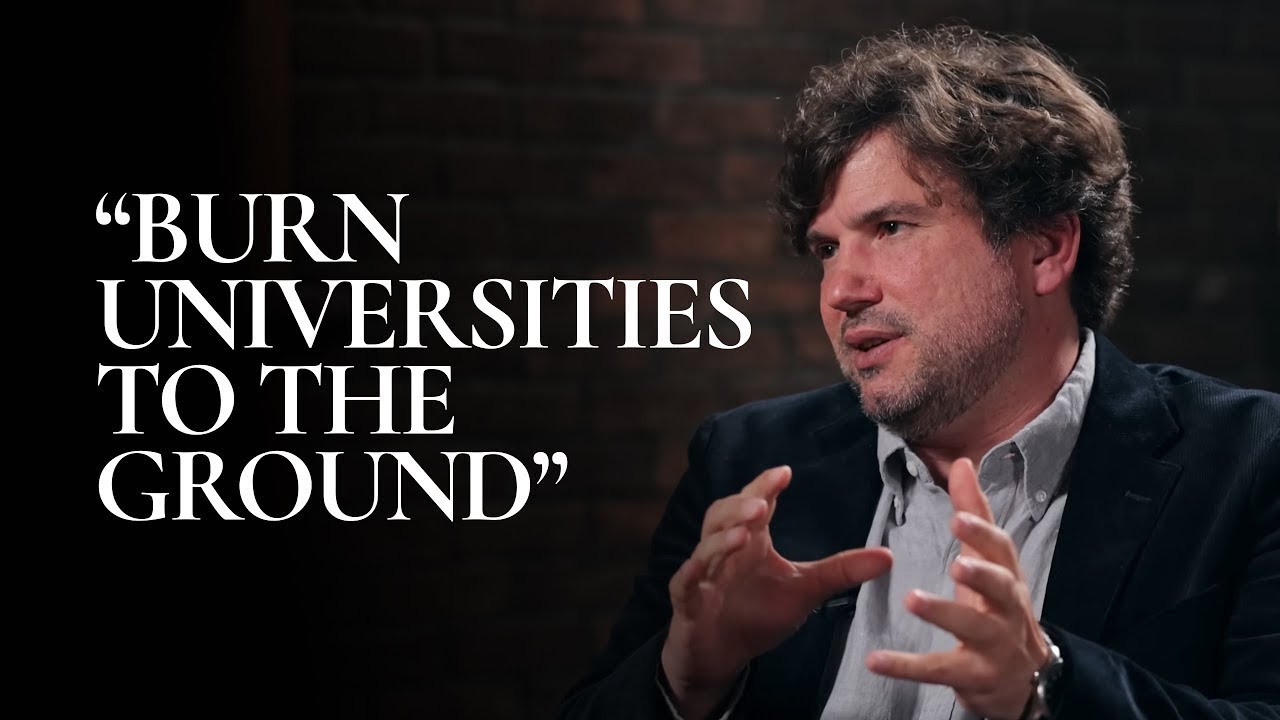
Michael Gibson is a venture capitalist and co-founder of the 1517 Fund who wants to dismantle the university system, which he calls part of the “paper belt” — a network of centralized bureaucracies (government, media, academia) whose power depends on printing paper. He argues universities stifle creativity, enforce conformity, and have become as corrupt as the medieval Catholic Church selling indulgences. Through the Teal Fellowship (which funded young people under 19 to work outside school) and his fund, he has systematically invested in dropouts and young founders as an alternative path to innovation. The interview covers his critique of higher education, the paradoxes of contrarian movements, what motivates creative individuals, his vision for education reform, and his political philosophy of “conservative anarchism.”
The Case Against Universities
The paper belt thesis: Gibson sees universities as one node in a corrupt system of centralized paper-printing institutions — government printing money, newspapers shaping narratives, universities issuing diplomas. He compares modern universities to the 16th-century Catholic Church selling indulgences: both sell pieces of paper that promise salvation (from “hell” in the labor market) in exchange for money and compliance.
Universities actively harm creativity: Drawing on René Girard’s theory of mimetic rivalry, Gibson argues that the more people compete for the same narrow credentials, the more alike they become, and the less original their thinking is. The mono-path to success in America — where not going to college marks you as a “permanent dunce” — forces the brightest into homogenizing competition.
Ideological conformity compounds the problem: Universities have become overwhelmingly left-wing, and the lack of intellectual diversity among faculty further stifles creative and original thought.
The Teal Fellowship as evidence: From 2010 to 2015, the Teal Fellowship gave grants to people under 19 who were not enrolled in school. Notable outcomes include Vitalik Buterin (Ethereum) and Dylan Field (Figma, which Adobe tried to acquire for $20 billion). Gibson takes this as proof that extraordinary innovation happens outside universities, not because of them.
The degree’s signal is weakening: The cost of college has skyrocketed while quality has declined — the “higher education bubble.” Gibson argues the diploma is losing value as a signal, and the Teal Fellowship results suggest the school itself adds little beyond selection.
The Selection vs. Education Debate
Universities may only be selecting, not cultivating: Gibson concedes that elite universities might be good at identifying talented people, but argues they add little in terms of actual skills or creativity. He cites a famous study showing that students who got into Ivy League schools but chose to attend state colleges had comparable long-term outcomes.
Counter-evidence from the 1517 ecosystem: The interviewer points out that many successful founders in the 1517 and Founders Fund networks (SpaceX, OpenAI, Airbnb, Flexport) are Ivy League graduates, not dropouts. Gibson responds that the ecosystem is in a transitional period, that many “success stories” are actually dropouts or attended non-elite schools (e.g., Palmer Luckey of Anduril went to community college), and that the cultural pressure to attend college is so strong it masks the institution’s lack of added value.
The output problem: Gibson’s broader argument is that society is stagnating — in science outside computing, in novels, philosophy, art, and sculpture. If universities truly imparted creativity and skills, the output would be better. He finds it damning that there are more poets alive today than ever, yet none seem relevant compared to the past.
The Paradox of Contrarian Movements
Dropout culture has become its own paper belt: The interviewer, who dropped out of Columbia in 2017 to build a startup, admits he did so purely out of mimetic desire — it was the “cool thing to do” in elite CS circles. He argues the Teal Fellowship and dropout culture have already developed their own rituals, prestige hierarchies, and mono-paths of competition, becoming the very thing they rebelled against.
Girard’s insight on negative movements: The interviewer draws on Girard’s observation that contrarian movements’ first generation is productive because its members have mastered the tradition before breaking from it (e.g., Rousseau in philosophy, Stravinsky in music, the Impressionists in art). But subsequent generations only inherit the desire to be different without the traditional education, producing empty radicalism — one break from the next with no positive substance.
Gibson’s partial agreement: Gibson acknowledges the problem. After he and co-founder Danielle Straman left the Teal Fellowship, it raised the age limit to 22, which opened the floodgates to more credentialed, further-along applicants. This shifted the fellowship toward metrics like seed funding and revenue, losing the original spirit of funding wild, early ideas from young people.
Creativity is perishable: Gibson’s deeper argument for funding younger people is that creativity has a prime — like chess players, mathematicians, or athletes, people tend to do their most original work in their 20s and 30s. Economist Benjamin Jones’s research shows that the age of first major scientific paper has risen from 23 (in 1900) to around 30 today, and peak achievement has shifted from early 30s to early 40s. Because people stay in school longer, society loses the window when imagination is most fertile. Gibson wants to channel resources toward younger people to take big bets before that window closes.
The Ideal Education System
Withdraw all government funding: Gibson would eliminate the roughly $1 trillion spent on K–12 and higher education (at least $400 billion on universities alone, plus federal loan backstops). He sees this as funding an arms race that hurts young minds.
The market test, not a blueprint: Gibson does not prescribe a specific alternative (app-based learning, AI tutors, etc.). His criterion is that education should survive the “market test” — meaning decentralized funding through voluntary donations, purchases, and earned income, not centralized government allocation. He believes people would voluntarily support arts, philosophy, and young learners if the funding were decentralized.
Invert the curriculum: Gibson wishes that incoming physics students, for example, would see a board listing the top 10 unsolved problems in the field on their first day — immediately understanding the frontiers of knowledge and what a Nobel Prize-worthy contribution would look like. Currently, education builds slowly from 101 to the frontier, reaching it only around age 33. He would start with the limits of knowledge to inspire and channel ambition toward solving real problems.
Channel rivalry productively: Drawing on Homer’s Iliad, Gibson sees the fundamental tension as one between hierarchies of prestige (legitimate authority, like Agamemnon) and hierarchies of greatness (proven ability, like Achilles). A dynamic society allows these hierarchies to compete. When yesterday’s innovators become today’s establishment and can block new entry through regulation, only the hierarchy of prestige remains, and society stagnates. The solution is to keep allowing new forms of greatness to arise and contest established power.
What Fosters Innovation
Macro conditions: Creative cultures throughout history — ancient Athens, Renaissance Florence, 1920s Paris, Elizabethan England, the Dutch Republic, 19th-century Britain, Silicon Valley — share some baseline features: freedom to raise new ideas, rule of law, and geographic clustering. Small policy differences may matter enormously; for example, California’s refusal to enforce non-compete clauses allowed the “Traitorous Eight” to leave Shockley Semiconductor for Fairchild, then Intel, creating Silicon Valley’s spinout culture.
Micro conditions — the psychology of creative founders: At the 1517 Fund, Gibson looks for character traits in founders since early-stage investments lack metrics. Key concepts include:
Hyperfluency: The phenomenal experience of hearing someone talk about something they love with such fluency and depth that it’s unmistakable — “like a fastball hitting a mitt.”
Insider-outside status: Drawing on Girard’s study of scapegoats, Gibson finds that creative individuals often occupy boundary positions — insiders who became outsiders (dropouts, immigrants, people who were kicked out). This gives them both understanding of the system and the motivation and fresh perspective to challenge it.
Immigrants as paradigmatic innovators: Immigrants have made tremendous advances in American science partly because they see things differently and carry a chip on their shoulder that drives them to prove themselves.
The limits of articulation: Gibson admits that identifying creative founders ultimately relies on intuitive, tacit knowledge — pattern recognition developed through years of working with founders. Any recipe or framework falls short.
Motivation and the Dark Side of Ambition
Sustaining motivation: Gibson writes that the best work is done for neither fame nor fortune. Money, thrills, and fame won’t carry someone through the “dark night of the soul at 2 a.m. when the doubts creep in.” He looks for what he calls “sustaining motivation” — something deeper that sustains commitment through failure.
Glory as a legitimate motivator: The interviewer pushes back, arguing that a desire for glory — historical recognition, standing among the greats in one’s field — is a powerful and perhaps necessary motivator for extraordinary achievement. Gibson agrees, noting that many people who deny wanting to be extraordinary are nonetheless drawn into “arenas of ambition” (Silicon Valley, philosophy, startups) by the sheer cultural force of examples around them.
Egoless ambition: Gibson endorses a paradox: you need the ego to believe you’re capable of extraordinary things, but you also need to be able to step away from identity attachment when things fail. Too strong an attachment to identity causes people to crack and never return after failure. He calls this “egoless ambition” — the drive to conquer the world combined with the adaptability to try something new when the first thing fails.
The dark side of great founders: The interviewer notes that the greatest entrepreneurs of previous generations — Musk, Jobs, Gates — had a darker, stronger hold on ego than more recent founders like Dylan Field or Vitalik Buterin. Their single-mindedness and low need for social approval translated into personal cruelty and difficult personal lives. Gibson agrees this is real and not the only path, but acknowledges that commitment and single-mindedness seem to correlate with the highest levels of achievement.
Credible commitment: Gibson values irrational commitment as a signal. Quoting game theory, he argues that credible commitments often require irrationality — like professing love “forever” in marriage. A founder who says “my grandma died and I’m getting revenge” or “this is my life’s mission” signals a deeper, more credible commitment than one who baldly states “I want to be famous.” The latter doesn’t convince others to join because it doesn’t signal staying power.
A tactical failure story: Gibson recounts investing in Loom (acquired by Atlassian for nearly $1 billion) and being told by the CEO on an investor call that he was using Robert Greene’s “50 Laws of Power” as a tactic to generate investor interest. Gibson found this transparent use of dark-side tactics off-putting — a tactical failure that undermined trust.
The Contemplative Life and the Future of Philosophy
Gibson’s secret identity as a writer: Despite being a successful VC, Gibson says in his “heart of hearts” he is a writer. He references Aeschylus, whose tombstone mentioned only that he fought at Marathon, not that he wrote legendary plays. Gibson sees himself as someone who stumbled into venture capital and would ultimately like to be remembered as a great thinker and writer.
His own fear of greatness: When he was 18 to 20, Gibson was too afraid to think he could be a great writer. Instead, he thought he could only comment on great writers — become a professor who wrote insightful essays about literature. He sees this fear as a product of the paper belt, and his work with young people is partly an attempt to free his 18-year-old self.
Academic philosophy is exhausted: Gibson argues that the marginal value of an academic philosophical paper is very low. The field is characterized by meaningless differentiation among positions. He loves some 20th-century philosophers but finds the average paper in consciousness, morality, or epistemology to be empty.
Poet-philosophers over academic philosophers: Gibson admires thinkers who are poet-philosophers — Plato (possibly a failed playwright), Nietzsche, Dostoevsky. He believes there are truths inaccessible to discursive reason and argument that can only be reached through poetic expression and narrative. He sees his own writing style (in Paper Belt on Fire) as an attempt to interweave narrative and philosophical points, similar to Plato’s dialogues.
The interviewer’s discovery about Oxford philosophy: The interviewer reviewed books on Oxford philosophy (Anscombe, Foot, Parfit) and found that none of them had PhDs — the great contributors to the tradition never went through the credentialing process that academic philosophy now demands. This suggests the PhD may be making philosophy worse by its own standards.
Where has philosophy gone?: Gibson believes philosophy needs geographic density and a “scene” — people interacting, forming rivalries, being part of something. He points to Silicon Valley, where gifted people are drawn to philosophical questions through AI research (consciousness) or political experiments (pop-up cities). He encourages the interviewer to cultivate a circle and social events in New York, and to think about what output philosophers should be creating — books, lectures, videos — as this will shape the community.
Conservative Anarchism
The term explained: Gibson calls himself a “conservative anarchist” — a traditionalist who believes in the wisdom embedded in traditions that have survived the test of time (analogous to how prices aggregate information), combined with a hardcore libertarian who believes in capitalism, free markets, and minimal governance.
Political competition as market: Gibson’s ideal is a world where people can enter and exit political regimes according to their values — a market for governance. Just as Tim Cook’s power at Apple is constrained by people’s ability to leave for another product, political power would be constrained by the ability to move to a different regime. This is based on real social contract theory — actual consent, not hypothetical consent.
Anarchism for consenting adults: Gibson’s anarchism applies to people who opt into a regime, not those born into one. He envisions adjacent regimes with different philosophies (libertarian, communist, etc.) where people sort according to their values. He acknowledges this is ideal theory and that non-ideal theory (immigration, the status of nations) makes this difficult to realize.
Nakamoto consensus and political philosophy: Gibson draws on Bitcoin’s and Ethereum’s key innovation — trustlessness — as a framework for thinking about institutions. Just as Nakamoto created digital money that doesn’t require trusted third parties to authenticate it, Gibson asks whether institutions like universities (which centrally authenticate credentials) could be replaced by decentralized, trustless systems. He is a Bitcoin maximalist, believing the computational cost of decentralization is worth it for money but not yet for most other applications.
The limits of decentralization: The interviewer notes that Ethereum’s promise of decentralized applications (decentralized Uber, etc.) has largely failed, partly because scams flooded in and partly because many domains require trusted third parties somewhere in the chain. Gibson agrees that money may be uniquely suited to decentralization and that other domains may require some authority for dispute resolution — especially where violence is involved. He is not ready to argue for a fully anarcho-capitalist world with no state-provided dispute resolution, but believes in extending the power of contract (e.g., choosing which jurisdiction adjudicates disputes) as a step toward more political experimentation.