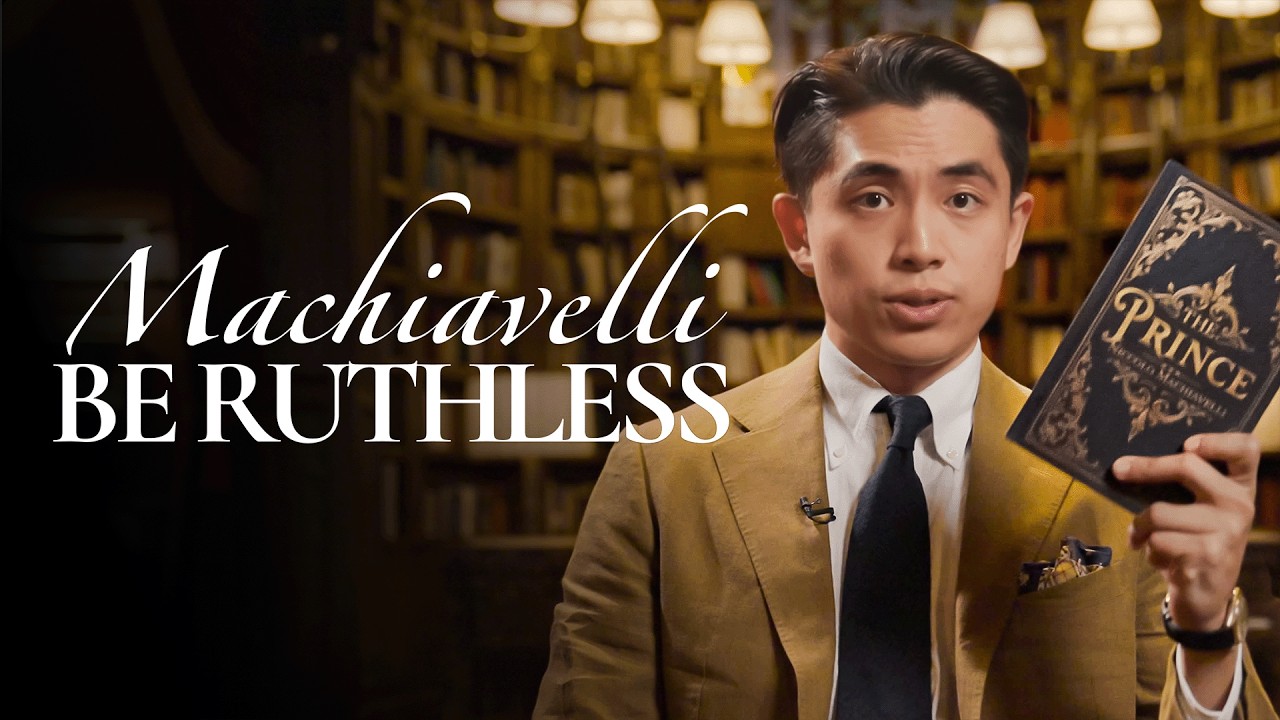
- This lecture presents Niccolò Machiavelli not as a simple “teacher of evil” but as a radical political thinker who argues that good people make terrible leaders, and that the rare, extraordinary individuals capable of founding or refounding states must be willing to commit terrible acts—lying, massacring, even genocide—when necessity demands it, while always maintaining the outward appearance of virtue. The central subject is Machiavelli’s concept of entering into evil, illustrated primarily through the biblical figure of Moses, whom Machiavelli holds up as the supreme model of political leadership precisely because Moses did what was necessary, not what was morally comfortable. The lecture builds through four parts: first, a deep reading of Moses’s “evil” acts (massacre, lying, genocide); second, three qualifications that soften Machiavelli’s teaching (evil for the sake of good, limited to extraordinary moments, and rooted in idealism as well as realism); third, the historical context showing how Machiavelli redefines virtue as force and prudence rather than Christian morality; and fourth, a personal critique engaging Plato’s challenge about whether doing injustice corrupts the soul, ultimately arguing that Machiavelli’s true teaching is directed not at good men but at “great men” driven by a lust for glory that bridges self-interest and public service.
1. Moses as Machiavelli’s Model of Entering into Evil
-
The massacre at Sinai (Exodus 32)
- After the Israelites worship the golden calf—just 40 days after God himself commanded “no idolatry”—God threatens to destroy them all and start fresh with Moses alone.
- Moses persuades God to relent, then descends and rallies the Levites with the command: “Thus saith the Lord God of Israel, put every man his sword by his side… and slay every man his brother, and every man his companion, and every man his neighbor.” Three thousand die in an indiscriminate massacre.
- Machiavelli’s reading: this was not about punishing the guilty but about teaching the entire people a memorable, public lesson through spectacular violence. The corruption was so deep that only an excessive, indiscriminate display could reset the community.
- Machiavelli’s principle: “In every decision of ours, we should consider where are the fewer inconveniences and take that for the best policy because nothing entirely clean and entirely without suspicion is ever found.”
-
Moses’s lie
- The command to massacre was never given by God. The text says “Moses said unto them, ‘Thus saith the Lord’“—one of the few places in Exodus where Moses attributes his own words to God rather than God speaking directly.
- The timeline confirms it: Moses descends immediately after God relents, with no time for a new divine command. After the massacre, God sends a plague on the people “because they made the calf”—inconsistent with the massacre being God’s will.
- Machiavelli hints at this explicitly: “One should not reason about Moses… as he was a mere executor of things that had been ordered for him by God.”
- The parallel to Roman augury: clever Roman generals would lie about omens (claiming chickens ate when they didn’t) to do what was politically necessary, then eliminate the priest who told the truth—preserving the appearance of piety while acting decisively. Moses did the same.
- The result: the ethical foundation of the Judeo-Christian worldview—the Ten Commandments—rests on a founding murder hidden by a lie. Yet Moses is not disowned; he remains embraced by God and tradition.
-
The genocide of the native inhabitants
- Before dying, Moses instructs the Israelites to kill all inhabitants of the Promised Land: “Kill them all… leave no one alive… everything that breathes.”
- Machiavelli distinguishes two kinds of war:
- Wars of command: you want obedience, not land. These can and should be bloodless—“crush them with the arts of peace.” Example: Pistoia willingly submitted to Florence because the Florentines treated them with mercy.
- Wars of habitation: you are displacing a people to take their land. Here, Machiav argues, you must eliminate them entirely—or face inevitable revenge.
- Machiavelli’s reasoning: “Men should either be caressed or eliminated because they avenge themselves for slight injuries but cannot do so for grave ones.” If you take their land and kill their fighters but leave the civilians, you have created a permanent enemy—fathers, mothers, sons who will burn hatred into the next generation.
- “Elimination” need not always mean killing: the Romans dispersed conquered peoples across the empire to prevent coordination; Americans forced assimilation. The goal is removing their capacity for revenge.
- The Samnite warning: when the Samnites trapped the entire Roman army and had total power over them, an elder advised two options—either befriend them fully or kill them all. The Samnite leader chose a middle way: disarmed the Romans, humiliated them under a yoke, and extracted a treaty. The Romans recovered and annihilated the Samnites. Machiavelli’s principle: “There is no such thing as halfway crooks.”
- Moses embodies the dual structure: Deuteronomy commands peace to distant cities (wars of command) but total destruction to nearby ones (wars of habitation). He always chooses the most humane option possible—but when forced into evil, he goes all the way.
2. Three Qualifications to Machiavelli’s “Invitation into Evil”
-
Evil for the sake of good
- Every evil act Machiavelli endorses must serve a greater good: Moses’s massacre prevented God from killing everyone; the Israelites’ policy of elimination prevented perpetual existential threat.
- Machiavelli’s conception of the good is not alien to moderns: he wants stability, rule of law, freedom, protection, and radical egalitarianism for his era. The disagreement is not about ends but about means.
- Machiavelli introduces the distinction between cruelty well-used and badly used:
- Well-used: done at a stroke, out of necessity, then converted into utility for subjects. Example: Cesare Borgia installed the brutal Remirro de Orco to pacify the Romagna, then had him publicly bisected in the town square—a spectacular act that satisfied the people’s hatred, eliminated a liability, and transitioned the region to democratic institutions.
- Badly used: cruelties that grow over time rather than being contained. Example: showing mercy to criminals repeatedly, which creates the very disorder that necessitates future violence.
- Machiavelli’s challenge to moderns: seemingly humane actions (leniency, civil discourse, human rights frameworks) can be deeply cruel in their consequences, while seemingly cruel actions can be profoundly humane in the long run.
-
Extraordinary moments only
- These teachings apply only to moments of founding (Moses) or refounding (Cesare Borgia)—not to ordinary political life.
- In an orderly state, in the absence of crisis, such acts would be inexcusable. Machiavelli’s advice is limited to extraordinary times, extraordinary people, in extraordinary positions of power.
- The Machiavelli paradox: Machiavelli himself, as a public servant in Florence, was by all accounts an extremely loyal, upstanding, incorruptible civil servant who refused bribes and lived in relative poverty. He wrote his books in exile, not as a manual for his own conduct, but as instruction for the rare redeemer who might one day unify Italy.
- He was not in an extraordinary position of power, so he engaged in ordinary politics in the ordinary mode.
-
Idealist as well as realist
- Contrary to the popular image of Machiavelli as a cynical realist, he is also an idealist who believes in the “great man theory of history”—that rare, marvelous individuals can rise up and completely transform the course of events.
- He is obsessed with founding and refounding because he wants to help princes achieve the most grandiose, seemingly imaginable political projects: the founding of states, civilizations, even religions.
- He is an idealist in ends but a realist in means. This tension is what makes his work so bloody—establishing a radically different order requires breaking many eggs.
- Even Plato, in the Republic, calls for a massacre at the founding of the ideal city (all adults over age 10 are “led into the fields”) because a radically new order requires malleable people—children. Machiavelli’s point: even the most idealistic philosopher concedes the necessity of entering into evil when pursuing grand projects.
3. Historical Context: Machiavelli’s Redefinition of Virtue
-
Virtue as force and prudence, not morality
- Machiavelli’s use of “virtù” would give a reader of Plato, Aristotle, or Christian moralists whiplash. It has almost nothing to do with conventional goodness.
- Two defining features:
- Force: an overwhelming, ordering, masculine energy that pushes back against the chaotic, feminine force of fortune. Machiavelli’s metaphors: fortune is a flood that must be held back by dikes and dams; fortune is a woman who must be beaten and struck down. “It is better to be impetuous than cautious… fortune is the friend of the young because they are less cautious, more ferocious and command her with more audacity.”
- Prudence: the classical virtue that survives most intact. It tells you when to use virtues and when to use vices, and—critically—how to appear virtuous while acting otherwise. “It is not necessary for a prince to have all the virtues, but it is indeed necessary to appear to have them… by having them and always observing them, they are harmful; by appearing to have them, they are useful.”
- The opposite of virtue in Machiavelli is no longer vice but effeminacy—being weak, passive, pushed around by fortune.
- The image of virtue: the centaur Chiron, half-man and half-beast, teacher of Achilles and Theseus. A prince must use both natures—law (man) and force (beast). Specifically, he must be both lion (raw power, force) and fox (cunning, prudence). “One needs to be a fox to recognize snares and a lion to frighten the wolves.”
-
Machiavelli’s relationship to the classical and Christian traditions
- Machiavelli despises the Christian era for making men weak and effeminate. He wants to return to the classical world—but not to classical theory (Plato and Aristotle, whom he considers as diluted as the Christians).
- He wants to return to classical political action: the world of Theseus, Moses, Cyrus—men who founded states through force, cunning, and decisive action.
- His project is simultaneously a complete return (“imitate Moses”) and a radical innovation (constructing a new theory of classical political action, introducing brand-new ideas like tumults and egalitarianism).
- “Do as the ancients do, not as they say.”
4. Critique: Is It Worth It?
-
Plato’s challenge from the Gorgias
- Plato asks: would you rather do injustice or suffer injustice? His answer: suffer injustice, because doing injustice harms your soul directly, while suffering it does not (if you respond virtuously).
- Applied to Machiavelli: what is the point of ruling a city of ashes with a stone-cold heart? Isn’t an alienated life worse than death? Isn’t there more to life than power, glory, and survival?
-
Machiavelli’s first response: political life is not all of life
- Machiavelli was a great lover of life—he wrote comedies, loved friends, fine clothes, wine, food, beautiful women, and the contemplative life. His private letters describe spending evenings in his study, dressed in regal robes, conversing with ancient writers for four hours, feeling no boredom, poverty, or fear of death.
- His point: there is far more to life than politics, but political life should be focused on securing the basics—stability, order, rule of law, freedom—so that the higher life becomes possible. When you try to combine higher ideals with political action, you destroy both.
-
Machiavelli’s second response: the soul question
- Machiavelli would argue that doing a necessary evil does not clearly harm the soul, because it was the right thing to do in the circumstances. Harry Truman never lost a night’s sleep over dropping two atomic bombs because, in his calculus, he was bringing the boys home.
- But Machiavelli ultimately concedes the difficulty: “The reordering of a city for a political way of life presupposes a good man, and becoming prince of a republic by violence presupposes a bad man. One will find that it very rarely happens that someone good wishes to become prince by bad ways, even though his end be good, and that someone wicked having become prince wishes to work well.”
-
The key insight: Machiavelli writes for the great man, not the good man
- The good man is altruistic, public-spirited, compassionate—but these drives are not brutal enough to sustain the necessary evils of political founding, and they dissolve once you enter into evil.
- The great man is driven by a lust for glory—a selfish, brutal, dependable force that can withstand the tumults of political action. “Good people always make bad leaders.”
- Machiavelli’s psychology: self-interest, avarice, insecurity, and especially the desire for glory are robust enough to motivate terrible acts while still aiming at publicly beneficial outcomes. Glory bridges the gap between self-interest and the common good.
- The great man views even the enslavement of the people he will eventually rescue as a precondition for his own glory: Moses needed the Israelites enslaved in Egypt so they would follow him; Cyrus needed the Persians malcontent so he could demonstrate his virtue.
-
The lecturer’s counter-critique: the contemplative path to glory
- If glory is the currency, why not retreat from politics entirely and win glory through writing? Machiavelli is more famous than any captain of his day; Plato has more glory now than Theseus.
- Machiavelli’s response: “It is not enough to say, I do not care for anything… For these excuses are heard and not accepted. Nor can men who have quality choose to abstain… because it is not believed of them. So if they wish to abstain, they are not allowed to.” You are already in the game.
- More deeply: Machiavelli wrote his books as a last resort, in exile, after exhausting every avenue to return to political service in Florence. He loved his fatherland more than his own glory. He ranks the glory of the political founder above that of the philosopher because founders actually help their people in their lifetimes.
-
Glory as the bridge between self-interest and public good
- Machiavelli distinguishes fame (Caesar destroyed the republic—eternal fame for a bad deed) from true glory (the recognition of having actually benefited your republic).
- Glory is dependable because it ties the great man’s self-interest intimately to his fatherland’s welfare. It is as robust as brute self-interest but often aims at the same publicly spirited ends as compassion.
- Machiavelli’s ultimate response to Plato: “I love my fatherland more than my soul. For the sake of my fatherland, I am willing to enter into evil, to risk corruption, dishonor, shame.” The Roman army, trapped by the Samnites, chose a shameful survival over an honorable death because “the fatherland is well defended in whatever mode one defends it, whether with ignominy or with glory.”
- The lecturer’s conclusion: studying Machiavelli radicalized him in the opposite direction—away from politics entirely. But he came to admire Machiavelli not despite his ruthlessness but because of his dedication to the good. The difference between the lecturer and Machiavelli was not an aversion to evil but a lack of dedication to the good. “If only I cared about the good as much as that teacher of evil, Niccolò Machiavelli.”