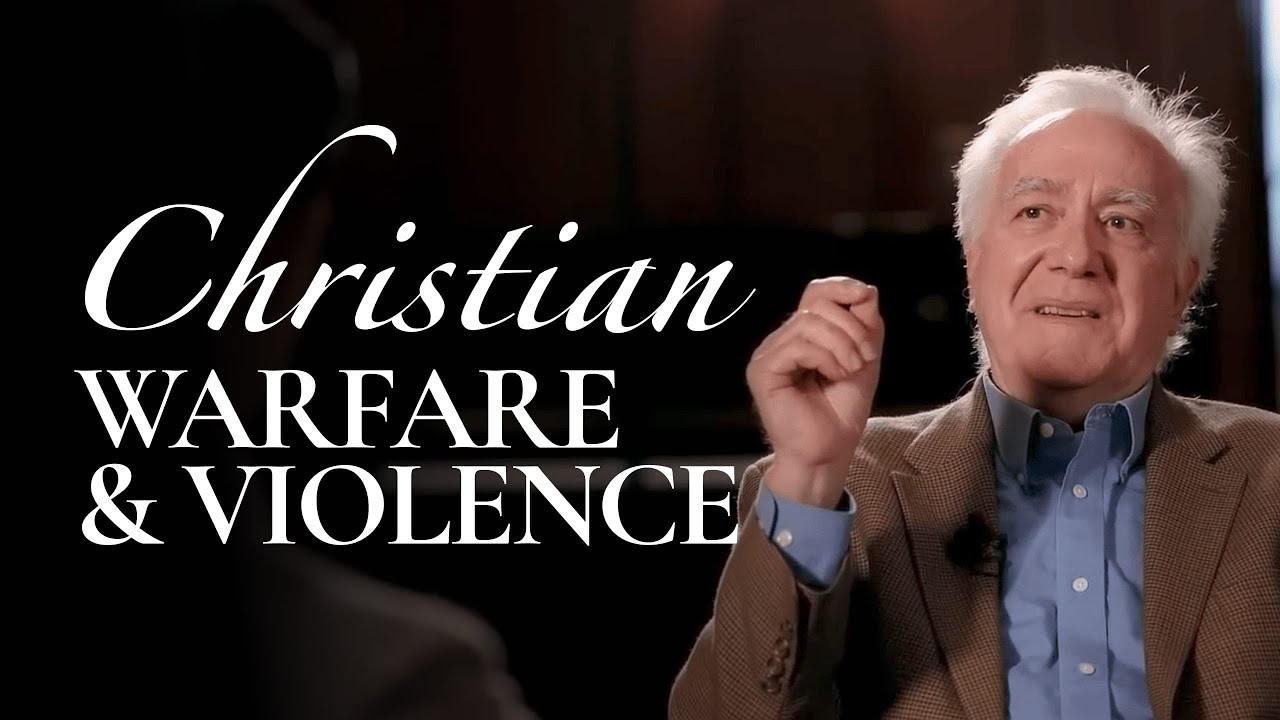
Carlos Eire is a Yale historian and practicing Catholic who has spent his career studying Christianity’s violent and paradoxical history — the Crusades, the Inquisition, the Wars of Religion, the destruction of indigenous civilizations in the Americas — and yet his faith is not weakened by this history but in some sense strengthened by it. He argues that Christianity’s long record of failure and cruelty is inseparable from its noble ideals, and that the tradition’s refusal to resolve its central paradoxes is precisely what makes it compelling rather than a cause for despair.
Why Eire is Catholic
Eire grew up in a religiously mixed household in Cuba: his father’s family were theosophists who blended Hinduism and Western esotericism and believed in reincarnation, while African tribal religions centered on curses were also present in Cuban culture. He found reincarnation terrifying — “another version of hell” — and was drawn toward Catholicism partly in reaction against these alternatives.
He came to the United States at age 11 as part of Operation Pedro Pan, the airlift of 14,000 Cuban children between 1961 and the 1962 missile crisis. He was placed with a Jewish foster family — the father was an atheist — who forced him to attend Catholic church and gave him money for the collection plate. Their kindness despite theological difference gave him an early model of goodness across religious lines.
He respects other religions and admires their saints and thinkers, but is not drawn to them. When he practiced in a Tibetan Buddhist monastery in Nepal, the monks told him Jesus was “the great bodhisattva, the great saint of the West” who brought the Jewish tradition closer to compassion without capturing the full truth. Eire sees this as their version of the Christian move of claiming other traditions approximate the truth.
What draws him to Christianity specifically is the promise of redemption through the Incarnation — that God became a human being and suffered so that humans can enjoy eternal life with their individuality and even their bodies preserved in some unimaginable better form. He has felt from a young age that “this world is full of too much pain and nastiness, I want out.”
Why Catholicism Specifically
As a historian, Eire values Catholicism because of its physical continuity: the laying on of hands in priestly ordination can be traced in an unbroken chain back to Jesus and the Twelve Apostles. This embodied, historical continuity matters to him in a way that purely textual or spiritual authority does not.
He finds the Catholic conception of time and space being transcended by a deeply fallible human institution to be profoundly appealing. The tradition’s history is littered with failures, but the failures themselves point toward the nobility of the ideals being aimed at. He quotes the saying taught to generations of Catholic schoolchildren: “The church is not a club for Saints, it’s a school for Sinners.”
He credits St. Augustine with articulating the key insight: perfection is impossible. The Catholic Church is divine in origin but will never be perfect until the end of time. All its failures remind Eire of his own failures, and there is comfort in that.
He also finds convincing the Catholic view that the natural and supernatural are closely linked and interpenetrate one another, rather than being sharply separated.
The Protestant Reformation
Eire wrote the definitive thousand-page textbook on the Reformation and has deep sympathy for the Protestant project. He sees the initial Reformation as a legitimate struggle against corruption, parallel to the Catholic Counter-Reformation. The Protestants created an ethic of individual responsibility and turned over charitable works to the state.
He was personally helped by Methodists and Presbyterians when he arrived in Bloomington, Illinois, which challenged his childhood assumption that all non-Catholics were going to hell.
The Second Vatican Council (1962–1965) reformed Catholicism in ways that mirrored Protestant reforms: reducing corruption, involving laypeople in charity, and focusing more on social issues.
Nevertheless, Eire remains Catholic because he fundamentally disagrees with the Protestant severing of physical apostolic succession and with the Protestant dismissal of Catholic miracles as demonic. His experience of the Cuban Revolution — watching an attempt at fixing things turn into totalitarianism — also made him wary of the Protestant approach of discarding traditions rather than reforming them from within.
History vs. Theology
Eire argues that history offers something theology alone cannot: identity. Without history, a religious tradition loses itself the way a dementia patient loses themselves — you don’t know who you are if you don’t know where you came from.
He compares studying the history of Christian doctrine to seeing how the sausage is made. Most people, upon seeing this, lose their appetite. Eire’s response is the opposite: “Two sausages for me, please.” He has learned to tell the good sausages from the bad ones.
The Three Paradoxes of Christianity
Eire identifies three paradoxes at the heart of Christianity:
First paradox: Strict monotheism — one God above and beyond nature — was revolutionary compared to pagan polytheism.
Second paradox: This one God became fully human in Jesus Christ, uniting divine and human natures in a single person.
Third paradox: Despite these mind-bending paradoxes that would seem to demand mystical ineffability, Christianity is intensely focused on orthodoxy — correct belief — and has a long history of persecuting those who get the definitions slightly wrong.
The development of these doctrines was messy, democratic, and often tragic. The first ecumenical council (Nicaea, 325 AD) came three centuries after Christ’s death. It took five more councils to work out the relationship of Jesus’s two natures. Councils voted on these matters, and their decisions sometimes created further division rather than unity.
Eire gives his students a true-and-false exam on propositions about God and Christ, and invariably every student ends up a heretic. His point is that the paradoxes are genuinely difficult and the tradition has always known this.
The “surefire formula for being declared a heretic” is to try to resolve the paradox — to come down on one side or the other. The Arians said the Son must be subordinate to the Father (more logical). Adoptionism said Jesus was just a man whom God adopted (more sensible). Luther separated faith from works. All were rejected because they eliminated paradox.
Eire finds the paradox beautiful because it is an admission that God is utterly unlike humans, and yet — the second paradox — became a human being. He cites Hebrews: Jesus is both priest and sacrifice, and is merciful precisely because he lived as a human and knows how hard it is.
Councils, Schisms, and the Problem of Politics
Church councils are not infallible. The Catholic Church did not define papal infallibility until 1870, precisely because so many councils had gotten things wrong. The “Robber Council of Ephesus” (431 AD) reversed an earlier council and was itself later reversed.
Councils were deeply political. Emperors were closely involved, and all early councils took place within a radius around Constantinople. The makeup of who was present and voting determined outcomes.
Small theological disputes produced enormous schisms. The Coptic Church and other non-Chalcedonian churches of the Near East split after the Council of Chalcedon (451 AD) over the nature of Christ. The Church of the East — another breakaway — sent missionaries all the way down the Silk Road to China in the 8th century, centuries before Europeans arrived by sea.
The Great Schism between East and West was caused in part by the Filioque controversy: whether the Holy Spirit proceeds from the Father alone (Orthodox view) or from the Father and the Son (Catholic view). One word, enormous consequences.
Making Sense of Christian Violence
Christianity’s violent history is undeniable: the Crusades (including the sack of Constantinople, a Christian city), the Albigensian Crusade against the Cathars (where a bishop reportedly said “kill them all, God will know his own”), the Thirty Years’ War, the Inquisition, and the destruction of entire civilizations in the Americas.
Eire does not defend these deeds. He distinguishes between the goals of the tradition and the actions of individuals within it. The goals — love, compassion, redemption — are what he focuses on. The violence represents a failure to live up to those goals, not a refutation of them.
He notes that Emperor Julian the Apostate, when asked if he would persecute Christians, replied: “I don’t need to — they’re very good at persecuting each other.”
The story of the shipwrecked person who builds two houses of worship on a desert island and refuses to enter one of them captures the essence of religious division: you cannot have belief without doubt, or truth without the awareness of falsehood.
Religious Toleration
Eire sees the emergence of religious toleration in Western Europe not as a philosophical achievement but as a pragmatic, economic necessity. After a century and a half of killing over theology, people realized they needed to get along to conduct business.
The Netherlands is the key example. During the Dutch revolt against Spain, Protestants initially destroyed religious images in churches, then realized the images were worth money and started selling them to the very Catholics they were attacking. Catholics were allowed to have churches as long as they didn’t look like churches, with entrances in the back. Over time, the door opened wider and wider until full toleration emerged.
Eire disagrees with the view that toleration has weakened religious faith. While some people of his generation and younger are less willing to defend their beliefs — saying all religions have their truth — he attributes the decline in religious fervor more to the rise of modern science, the Scientific Revolution, and the crisis of faith produced by the two World Wars, which demonstrated mass senseless slaughter not caused by religion.
Monasticism
Until the Second Vatican Council, Catholicism clearly taught that the monastic and ascetic life was the highest path to salvation, though not the only one. Protestants rejected monasticism entirely as unnatural and unnecessary, since salvation comes by faith alone.
After Vatican II, the Catholic Church revised its teaching: all vocations — including marriage — are equally valid paths to salvation, and celibacy is not superior to marriage. Eire sees this as a charitable move, analogous to telling children Santa Claus exists — kind in the short term but involving a deception that must eventually be corrected.
The revision had negative consequences: it removed one of the major motivations for becoming a monk (“scoring points with God”), just as turning charity into a tax removed the motivation for the Catholic confraternities in 16th-century Spain.
Eire was tempted by monasticism in high school but “kept falling in love with girls.” He later taught at a monastery (St. John’s College in Annapolis) and observed that monastic life is genuinely difficult — becoming selfless and obeying a superior can be very painful.
Responding to Nietzsche
Nietzsche argued in On the Genealogy of Morals that Christian morality cannot sustain a great civilization, and that the great Christian achievements of the Renaissance — Dante’s Divine Comedy, the great cathedrals — were actually driven by pagan psychological impulses: glory, competition, the desire to make a lasting name.
Eire acknowledges an element of truth: worldly values have always been mixed up with the church. Europeans who sailed to the Americas to Christianize indigenous peoples also committed terrible atrocities.
But he pushes back: Christianity has also made the Western world “kinder and gentler than it would have been.” He describes a graduate seminar where students were condemning the European imposition of Christianity on the Maya, until they turned to an image in their textbook of a human sacrifice — a heart being plucked from a living person on an altar stone, still beating. The room went silent. The question “if you saw this, would you let it continue?” reframed the moral calculus.
Eire finds Nietzsche’s alternative — the myth of eternal return, the idea that everything recurs infinitely — even more terrifying than reincarnation.