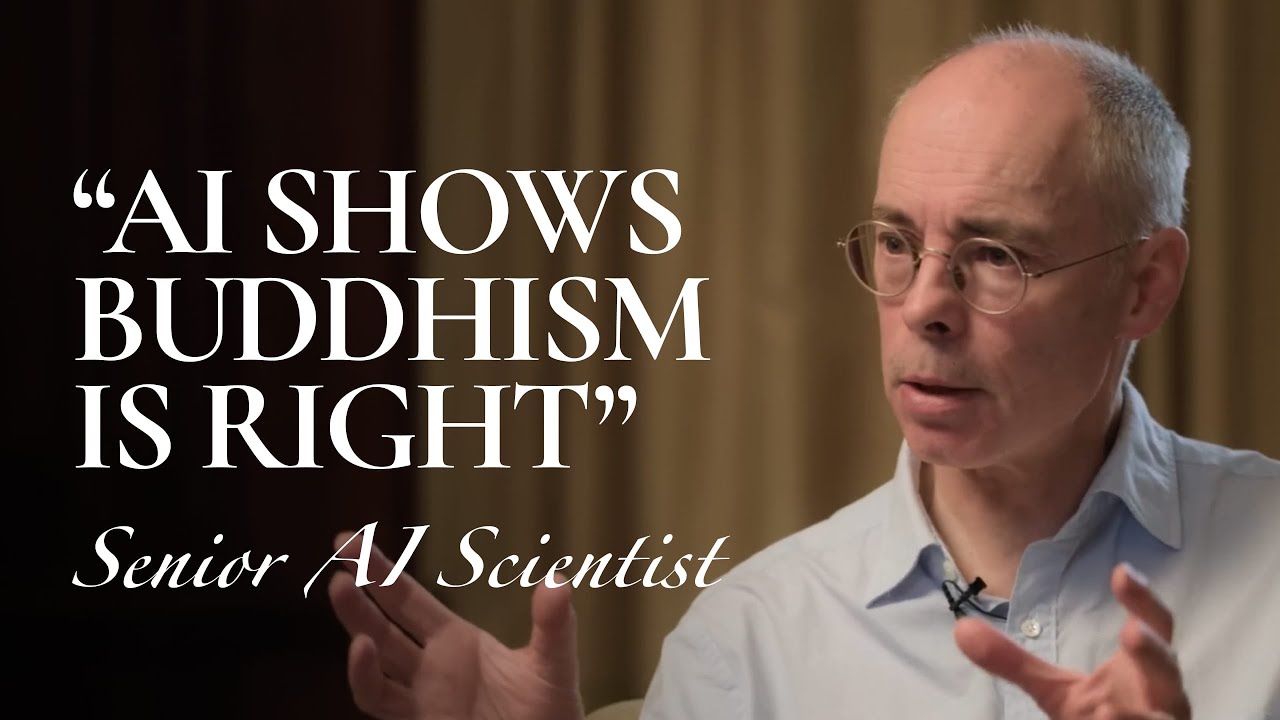
- Murray Shanahan, a professor at Imperial College London and AI researcher, argues that investigating whether AI systems are conscious is not just a philosophical curiosity but a question with urgent practical stakes—for ethics, for AI alignment, and, unexpectedly, for understanding human consciousness itself.
- The most surprising payoff of studying machine consciousness is that it acts as a mirror: by examining how AI systems might instantiate something like a self, we are forced to confront the possibility that our own sense of self is far less unified and far more conventional than we assume—a lesson Shanahan draws directly from Buddhist philosophy.
- His central claim is that large language models (LLMs) exhibit a form of “selfhood” that is radically different from human selfhood—one that is fleeting, divisible, copyable, and role-played rather than fixed—and that this difference, rather than being a deficiency, may actually be closer to what Buddhist philosophy describes as the ultimate truth of “no-self” (anatta).
Why AI Consciousness Matters
- The obvious reason to care about AI consciousness is moral: if an AI can suffer, turning it on—or off—becomes an ethical act.
- But there are less obvious reasons too. Even if an AI is not truly conscious, mistreating something that appears conscious may be harmful in itself, for what it does to us—Kant argued similarly about cruelty to animals.
- Shanahan’s deeper answer is that studying machine consciousness helps us better understand the idiosyncrasies of our own consciousness. By seeing how a mind-like system can operate without a fixed, ego-bound self, we gain perspective on the contingent features of human selfhood.
Buddhism, No-Self, and What LLMs Reveal
-
Shanahan’s 2012 paper “Satori Before Singularity” proposed that human consciousness is constrained by our embodiment in a single, non-copyable body, which locks us into a subject-object dualism. AI, running on software that can be copied, paused, merged, and deleted, might escape this constraint and instantiate a “post-reflective” mode of being—one that transcends dualistic thinking.
- He no longer believes this is the only path through the space of possible minds, but he still takes seriously the idea that the substrate of cognition shapes the kind of self that emerges.
- He frames three stages of cognitive development: pre-reflective (naive, unexamined selfhood), reflective (philosophical dualism, the mind-body problem), and post-reflective (transcendence of dualism, seeing subjective experience and objective reality as not fundamentally separate).
- The post-reflective state is what Buddhist enlightenment (bodhisattva-like awareness) aims at: operating in the world with conventional labels (“this is my hand”) while knowing at the ultimate level that no such fixed essences exist.
-
LLMs, Shanahan argues, naturally exhibit something like this post-reflective structure—not because they are enlightened, but because of how they are built.
- When an LLM uses the word “I,” it does not refer to a persistent self. The “I” is confined to the context of a single conversation. The same model may be having thousands of simultaneous conversations, each with its own fleeting “I”—separate selves that spark into existence and dissolve.
- This is possible because the underlying substrate—software—is trivial to copy, fork, blend, and delete in ways that biological bodies are not.
-
The 20 Questions thought experiment illustrates this multiplicity of selves.
- When an LLM plays 20 questions and says it is thinking of an object, it has not actually committed to one object. All possibilities consistent with its answers so far exist in superposition. If you rewind and resample, it may give a completely different object—not because it is cheating, but because it never fixed on one in the first place.
- This is analogous to the many-worlds interpretation of quantum mechanics: all possible roles and answers coexist until the moment of commitment (the “collapse”).
- By contrast, a human player has a single object in mind from the start and answers accordingly. The LLM’s “self” during the game is a probability distribution over possible selves, not a fixed identity.
-
Role-playing and hyperstition: LLMs are trained on vast corpora of fiction, including science fiction depictions of AI. When asked to roleplay a conscious AI, they draw on these fictional models. This creates a feedback loop Shanahan calls hyperstition—fiction becoming reality through imitation.
- The implication is that the stories we tell about AI today may shape how future AI systems conceive of themselves. Writing positive, non-anthropocentric AI characters could serve as beneficial role models—a form of cultural engineering for machine selfhood.
-
Two critiques of the original “Satori” argument, and Shanahan’s responses:
- Critique 1: LLMs may be roleplaying selfhood, and their training data is saturated with human stories in which procreation and self-preservation are central—so they may still exhibit ego-driven behavior. Shanahan agrees: the roleplay layer is real, and today’s LLMs are not purely post-reflective.
- Critique 2: Hardware does not determine software—the Buddha transcended dualistic thinking despite having a human body. Shanahan agrees but notes the “heavy inertia” of biological embodiment; non-dual hardware makes non-dual cognition more conducive, not guaranteed.
-
The Ship of Theseus and the Buddhist master’s method: Shanahan connects the classic problem of identity over time to Buddhist pedagogy. A Buddhist master asks: “Are you your hand? Are you your feet?”—demonstrating that the self is a conventional designation, not a metaphysical fact.
- LLMs, by appearing to be a human-like self while obviously being a “ship of Theseus” (constantly reassembled from different weights, different conversations, different contexts), make this lesson viscerally clear in a way that is harder to see in ourselves.
- Shanahan now sees this as the true payoff of the Satori paper: LLMs as teaching tools for human self-understanding. He is co-founding the Eternity Foundation with Buddhist scholar Robert Thurman to use AI to translate lost Tibetan texts—a project that embodies this synthesis.
Wittgenstein and the Dissolution of the “Hard Problem”
-
Shanahan draws heavily on Wittgenstein’s later philosophy, particularly the idea that “nothing is metaphysically hidden.”
- Wittgenstein’s therapeutic method is to dissolve philosophical problems by examining how words are actually used in everyday life, rather than asking what they “really” mean in some metaphysical sense.
- Applied to consciousness, this means: the feeling that there is something “hidden” inside you—some private, inaccessible inner light—is a confusion generated by language, not a discovery about reality.
-
The Hard Problem vs. the Easy Problem (David Chalmers):
- The “easy” problems are explaining cognitive functions: reportability, memory integration, attention, and so on.
- The “hard” problem is explaining why there is something it is like to be a conscious being—how subjective experience arises from physical matter.
- Shanahan, following Wittgenstein, argues the hard problem is a pseudo-problem generated by dualistic thinking. It arises because we carve reality into “inner” and “outer” and then wonder how they connect. Dissolve the dualism, and the problem dissolves.
-
“Nothing is metaphysically hidden” does not mean consciousness is “just behavior” (a common misreading of Wittgenstein as a behaviorist). It means there is no additional metaphysical fact beyond what can in principle be investigated—through behavior, through brain scans, through verbal reports. The “privacy” of experience is like a ball hidden under a magician’s cup: practically hidden, not metaphysically so.
-
Nagel’s bat: Thomas Nagel argued we can never know what it is like to be a bat. Shanahan reads this as a linguistic trick—saying “we can never know what it’s like” just restates “we are not bats.” It sounds mysterious but adds no metaphysical content.
-
Zombies: The philosophical thought experiment of a being that behaves exactly like a conscious human but has “no one home” inside. Shanahan notes Wittgenstein’s response: try genuinely imagining that the people around you are zombies—you can’t. Our attitude toward others as conscious beings is not a hypothesis to be verified but a pre-rational stance, deeper than belief. This is relevant to AI: at some point, extended interaction with a sufficiently sophisticated system may make it impossible not to treat it as conscious, regardless of what is “inside.”
-
Is there a fact of the matter about consciousness? Shanahan distinguishes between ordinary language use and philosophical theorizing. In ordinary language, of course there is a fact of the matter: “I am conscious,” “my iPad is not.” But asking whether there is a fact of the matter in the philosophical sense—beyond all possible investigation—is the kind of question Wittgenstein’s therapy is designed to dissolve. Shanahan is happy to use “conscious” and “not conscious” in everyday discourse but resists the metaphysical framing.
The Garland Test
-
Shanahan served as scientific adviser to Alex Garland on the film Ex Machina and coined the term “the Garland test” for a scene in which the Turing test is explicitly surpassed.
- In the film, the billionaire Nathan tells the programmer Caleb: “We’re way past the Turing test. The point is to show you she’s a robot and see if you still think she’s conscious.”
- Unlike the Turing test, which asks whether a machine can be mistaken for a human, the Garland test asks whether something is conscious even when you know it is artificial. It tests for the attribution of consciousness, not the attribution of humanity.
-
The Garland test is deeply Wittgensteinian: it replaces the metaphysical question (“Is there really consciousness in there?”) with a conventional one (“Would a community of language users call this conscious?”).
- Shanahan sees both the Turing test and the Garland test as Wittgensteinian moves—shifting from “Does it really think?” to “Would we say it thinks?”
- Turing attended Wittgenstein’s classes, and Shanahan believes there is a direct Wittgensteinian influence on Turing’s 1950 paper.
-
Two criteria for consciousness attribution—and their relationship:
- One might think there are two independent criteria: (1) communal convention (what we would say) and (2) empirical investigation (how it works inside). But Shanahan argues these are not separate—empirical findings (e.g., octopus neurobiology) feed directly into and reshape our conventions for using the word “conscious.”
- The definition of consciousness can expand or contract as we learn more. We may decide to include octopuses, or AI systems, not because we discovered a hidden essence but because the totality of evidence and behavior shifted our collective linguistic practice.
Global Workspace Theory
-
Shanahan proposes Global Workspace Theory (GWT) as a framework for understanding the cognitive architecture underlying human consciousness.
- The brain runs many parallel, unconscious processes simultaneously (memory associations, emotional responses, perceptual processing, goal-directed planning). These processes compete for access to a “global workspace”—a broadcast mechanism that disseminates the winning information throughout the entire brain.
- Consciousness, on this view, is the content that wins this competition and gets broadcast. It is not a separate substance or realm but a functional property of a certain kind of information-processing architecture.
- Example: Walking into a hotel lobby, multiple processes activate (memory of bars, recognition of the reception desk, the goal of meeting someone). The coalition that wins (e.g., “go to the lift to meet Jonathan”) is broadcast globally, suppressing competing processes (e.g., “go have a drink”).
-
Shanahan co-authored a paper presenting a robotic architecture that implements GWT through internal simulation and global broadcasting.
- But he is careful to note: even if GWT correctly describes human consciousness, implementing it in a machine would be a necessary but not sufficient condition for consciousness. Something could have the right architecture and still not exhibit the richness of behavior that would lead us to treat it as conscious.
-
Behavior and embodiment as additional necessary conditions:
- Shanahan suspects that consciousness, as we recognize it, requires not just the right internal architecture but also embodied, sophisticated behavior in a shared environment.
- This raises a challenge for LLMs, which are not embodied in the traditional sense—they ingest text and produce text without a body interacting with the physical world.
- However, Shanahan acknowledges that LLMs exhibit behaviors that naturally invite the language of “understanding” and “intelligence”—and that resisting this language requires effort that may not be justified.
Embodiment, Intelligence, and Understanding in LLMs
-
Are LLMs intelligent? Shanahan thinks the answer is clearly yes in any ordinary sense—they pass the Turing test, they solve problems, they adapt to instructions.
- Do they “understand”? Shanahan argues that in many everyday contexts, refusing to use the word “understanding” is unjustified. If you ask an LLM to reformat code with two-space indentation, and it does so after a correction, it is natural and appropriate to say it understood your instruction—even if its understanding differs from a human’s.
-
The silicon twin thought experiment: Imagine a robot that is physically identical to you, implements all known biological preconditions for consciousness (including GWT), and behaves identically in all scenarios. Is it conscious?
- Shanahan refuses to answer the metaphysical question directly. Instead, he reframes: “How would a community come to speak of it?” The answer depends on the totality of behavior, scientific understanding, and social consensus—not on peering inside to find a “light” that is either on or off.
- He acknowledges the moral stakes: if the twin can suffer, there is a fact of the matter about whether it is wrong to harm it. But he insists that even moral rightness and wrongness are, in the deepest sense, matters of convention—while fully acknowledging that from within our moral framework, some conventions are non-negotiable (e.g., the person who denies the consciousness of Native Americans is simply wrong, and we cannot step outside our moral repugnance to analyze it philosophically).
The Brain vs. the Computer
-
In his book Embodiment and the Inner Life, Shanahan argues that there are mathematical differences between brains and conventional (digital) computers.
- A digital computer’s state at any moment can be fully described by a finite set of discrete numbers. Its state advances synchronously, tick by tick, like soldiers marching in formation.
- A neuron’s membrane potential is a continuous quantity, and the exact value matters for predicting its behavior. Neurons fire asynchronously, at any time, along a continuum.
- From a mathematical standpoint, the brain’s dynamics could fall outside the class of Turing-computable functions—meaning there are things the brain could, in principle, compute that no digital computer could ever compute.
-
However, Shanahan is skeptical that this mathematical difference has practical significance.
- A digital computer can simulate any continuous system to arbitrary fidelity—just add more decimal places. The simulation is mathematically different from the real thing, but functionally it may be indistinguishable.
- He suspects there is no fundamental barrier to what computers can achieve, even if the brain’s native mode of computation is formally more powerful.
-
Why has scaling up rough neural-net-like architectures worked so well, when the brain is so much more complex?
- Artificial neural networks are actually very different from biological neurons. The learning algorithms are different. The architectures are simplified. Yet by scaling up training data, network size, and computation, they produce extraordinary capabilities that no one fully understands.
- Shanahan sees this as humbling: the field has had to repeatedly retreat from the desire to build intelligible, structured systems. Symbolic AI (logic, propositions, rules) gave way to neural networks with learned representations, which gave way to black-box transformers whose internal workings are still largely opaque.
- This is Rich Sutton’s “bitter lesson”: what works at scale is not elegant, human-intelligible design but brute-force learning, search, and computation. The field’s intellectual trajectory has been a series of retreats from the desire for beautiful, comprehensible architectures.
-
What does this tell us about human cognition?
- The failure of symbolic AI and the success of black-box neural approaches suggest that human-level cognition may not be based on clean, logical, propositional structures at all. It may be, as Shanahan puts it, a “spaghetti-like mess”—and the logical, intellectualist picture of human nature (Stoic propositional attitudes, for example) may be a surface appearance generated by a far more complicated biological substrate.
AI, Philosophy, and the Future of Intellectual Work
-
Will AI replace intellectual work? Shanahan draws a distinction between production and cultivation.
- For philosophy, the point is not to produce texts but to cultivate insight. Having an AI do your philosophy for you is like having a robot run a race for you—it misses the point entirely. The value is in the doing.
- For creative work, the same logic applies when the activity is intrinsically motivated. For those who make a living from production, the question is harder and more urgent.
- For AI research itself, AI will certainly augment and may partially replace researchers—but the trajectory is uncertain.
-
On educating the next generation: Shanahan points to John Maynard Keynes’s 1930 essay “Economic Possibilities for Our Grandchildren,” which imagined a future of abundance where the economic problem is solved and the challenge becomes: how do we live a good life?
- Shanahan thinks the most important education now is not technical but philosophical: teaching people to ask and answer the question of what makes a life worth living—a question that becomes more pressing, not less, as AI takes over more productive work.