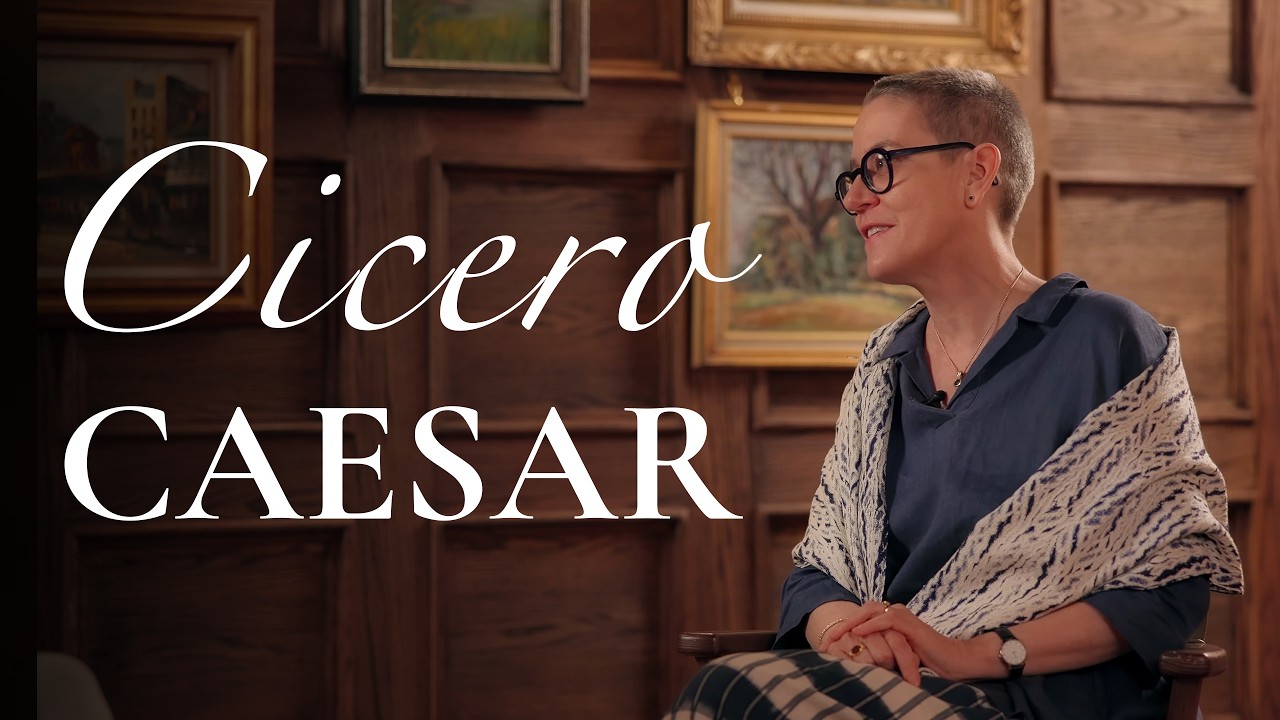
The late Roman Republic was a rare historical period when the leading political figures—men like Cicero and Caesar—were also the leading intellectuals, producing serious philosophical treatises, grammatical works, and epic literature while simultaneously waging wars, running the state, and shaping the course of Western civilization. This episode, featuring classicist Katharina Volk, explores how this fusion of the contemplative and active life was possible, what it looked like in practice, and what it might mean for us today.
The intellectual world of the late Roman Republic
Rome in the middle of the first century BCE experienced a cultural flourishing in which the senatorial aristocracy embraced Greek literature, philosophy, and rhetoric as a core part of their identity—not as a leisure activity but as something that shaped their ethical decisions and political actions.
A striking example: Brutus tested potential co-conspirators for Caesar’s assassination by engaging them in philosophical debate about whether a wise man should risk his life for a corrupt republic. Only those who passed the philosophical test were admitted to the conspiracy.
Roman prose writing reached a new level of excellence, and Cicero and Caesar became the two masters of Latin whose style is still taught today.
The intellectual class was two-tiered.
At the top were the “gentleman scholars”—senators and aristocrats like Cicero who studied philosophy, wrote treatises, and debated ideas as part of their identity as members of the ruling class. They considered themselves learned aristocrats, not professional intellectuals.
Below them were Greek professional scholars who taught, wrote in Greek, and focused on minute doctrinal debates. They often lived in the households of Roman aristocrats as tutors and guests.
Remarkably, the dilettantes had far greater influence on intellectual life than the specialists. Cicero’s philosophical writings shaped Western thought more than most professional philosophers of antiquity.
Their intellectual life was deeply social.
Aristocrats studied together, exchanged books, borrowed from each other’s private libraries, and dedicated works to one another in a culture of reciprocal literary gift-giving.
Cicero’s 900 surviving letters to his friend Atticus reveal a constant stream of questions, debates, and updates on writing projects.
This social learning mapped directly onto their political life, since the same men were senators running the Republic.
Why this combination is nearly impossible today.
The modern university system, with its long periods of training, professionalization, and institutional gatekeeping, has created a sharp divide between specialists and political actors.
The 18th and 19th centuries still had gentleman scholars in England and Europe, but this class has largely vanished.
Today’s political and business elites specialize in STEM fields rather than the humanities, making the kind of erudite political class seen in Rome difficult to imagine.
Roman versus Greek intellectual culture.
The common perception that Greek culture was superior and Roman culture derivative is partly a product of 19th-century Romanticism, which valued originality over systematization.
The Romans were less interested in being original thinkers and more interested in applying philosophy, systematizing it, and passing it on to a wider public—which is why so much of Hellenistic philosophy (Stoicism, Epicureanism) survives only through Roman sources.
Whether one prefers Greek or Roman intellectual culture says more about the values of one’s own age than about the inherent quality of either tradition.
Cicero: the skeptic in politics
Marcus Tullius Cicero was a “new man”—the first in his family to enter Roman politics—who rose to the consulship through extraordinary oratorical skill and relentless self-cultivation.
He came from a wealthy equestrian family (the class just below senators) and chose to pursue a political career.
He was elected to every office on his first try, became consul in 63 BCE, and famously suppressed the Catilinarian Conspiracy—though his extrajudicial execution of conspirators created enemies that later contributed to his exile.
He was politically sidelined during the rise of Caesar and the First Triumvirate, joined the losing senatorial side in the civil war, and was eventually assassinated in 43 BCE by the Second Triumvirate.
Cicero was a self-proclaimed follower of the Academic Skeptics, a school descended from Plato that traced its skepticism back to Socrates.
The Academic Skeptics held that nothing can be known for certain, so one must examine all sides of every question and then withhold final judgment.
A softer version, probabilism, allowed one to act on what is “similar to the truth” or “approvable” without claiming absolute certainty—and to change one’s mind at any time.
Skepticism suited Cicero both intellectually and politically.
The skeptical method of arguing all sides was essentially the same skill as oratory, which was the foundation of Roman education and political life.
Cicero was famous for changing his positions, compromising between factions, and agonizing over decisions—as seen in his letters debating whether to join Pompey after Caesar crossed the Rubicon.
Probabilism resolved the apparent paradox of how a skeptic could be a forceful political actor: you act on what is “sure enough for the purpose of action” while remaining humble and open to revision.
Skepticism also gave Cicero license to indulge in metaphysical speculation without committing to it.
At the end of On the Republic, he presents a dream vision in which virtuous statesmen are rewarded with a blessed afterlife among the stars—but frames it as a dream (not a truth claim), just as Plato framed his afterlife myth as a story.
He often presented his ideal scenario and then added a skeptical hedge: “But if it turns out otherwise, that’s fine too.”
Cicero believed that political service was humanity’s highest calling, consistent with the ancient view that humans are by nature social and political animals.
He was convinced he acted for the common good rather than self-interest or glory, and while he was not always successful, his philosophical training likely reinforced this commitment.
Philosophy was, for Cicero, “politics by other means”—when he was sidelined from active politics in the 50s and 40s BCE, he wrote philosophical works as a form of continued public service, educating the Roman elite in Greek philosophy and moral reasoning.
Caesar: rationality imposed on the world
Caesar was not only a general and dictator but also a serious intellectual whose philosophical commitments were reflected in his writing style, his political actions, and even his grammar.
He was a famous orator (though his speeches survive only in fragments, crowded out by Cicero’s dominance of the record).
His war commentaries are famous for their spare, unadorned, almost blunt style—terse and to the point, with little embellishment.
Caesar wrote a treatise on Latin grammar, De Analogia, arguing for strict regularity in language (analogy) over conventional usage (anomaly).
The debate between analogy and anomaly was about whether language should follow rational rules or accepted habits—for example, whether irregular forms should be regularized.
Cicero took the opposite side, favoring anomaly (conventional usage), which matched his abundant, copious rhetorical style. Caesar’s preference for analogy matched his spare, rational style.
The contrast is aesthetically striking: Caesar the blunt, hard-edged political actor preferred rational regularity in language; Cicero the flexible compromiser preferred the richness of convention.
Caesar reportedly wrote De Analogia while fighting a dangerous military campaign in Gaul—composing a treatise on Latin grammar while leading an army, with “spears flying left and right.”
This image captures the extraordinary fusion of action and contemplation in the late Republic.
Caesar was famous for his ability to multitask and his cold-blooded rationality under pressure.
Caesar’s calendar reform is another example of imposing rationality on habit.
The Roman calendar had 355 days and relied on irregular intercalation by politically motivated priests, leaving it severely out of sync with the seasons.
Caesar, with the help of the Greek astronomer Sosigenes of Alexandria, reformed it into the 365-day Julian calendar—the basis of the calendar we use today, requiring only a minor tweak in the early modern period.
He also wrote a treatise explaining the reform, demonstrating that he understood the science himself.
Caesar may have been influenced by Epicureanism, though the evidence is ambiguous.
Epicurean atomism—the view that reality is nothing but atoms and void—could theoretically undermine the force of convention, habit, and traditional Roman values, making it easier for Caesar to disrupt the Republic and impose new orders.
Caesar did express Epicurean-sounding views about death being nothing to fear (just the dissolution of atoms) and displayed a notable nonchalance in the face of mortality.
However, the connection between Epicurean metaphysics and Caesar’s political actions is speculative.
The coherence between ideas and lives
The most striking feature of both Cicero and Caesar is the deep consistency between their philosophical commitments, their political behavior, and even their rhetorical styles.
Cicero’s skepticism matched his political flexibility, his willingness to compromise, and his abundant, many-sided oratorical style.
Caesar’s rationalism matched his blunt political style, his willingness to break with tradition (crossing the Rubicon, calendar reform, declaring himself dictator for life), and his spare, unadorned prose.
This congruency between thought and action is aesthetically remarkable and suggests that their intellectual lives were not separate from their political lives but deeply intertwined with them.
The fall of the Republic of Letters
The aristocratic intellectual culture of the late Republic did not survive the fall of the Republic itself.
Under Augustus and the Empire, the senatorial class lost real political power, which was concentrated in the hands of the emperor. The Senate became largely ceremonial.
Intellectual activity continued, but the tight intertwining of political action and intellectual production dissolved. Senatorial scholars like Seneca and Pliny the Elder became administrators and advisors rather than independent political actors.
The Republic of Letters became, in effect, a bureaucracy of Letters.
Is the combination of action and contemplation desirable?
One concern is that intellectual flourishing tends to coincide with political chaos—the late Roman Republic, the Greek Golden Age during the Peloponnesian War, the Warring States period in China, Hegel during the Napoleonic Wars.
However, it is difficult to find any period of history that was truly peaceful, and stability can also produce intellectual flourishing (Victorian England, the Augustan period after the civil wars).
Intellectual flourishing seems to result from a confluence of many factors rather than any single condition.
A deeper concern, raised by Rousseau, is that studying virtue may actually corrupt it—that Rome was fine when Romans practiced virtue and declined when they began to study and debate it.
Volk argues this does not hold water: suppressing ideas is both impossible and undesirable, and the mild, humanistic ideas of the Roman elite were far less disruptive than other ideological movements in history.
The greater danger is the suppression of ideas, not their airing and discussion.