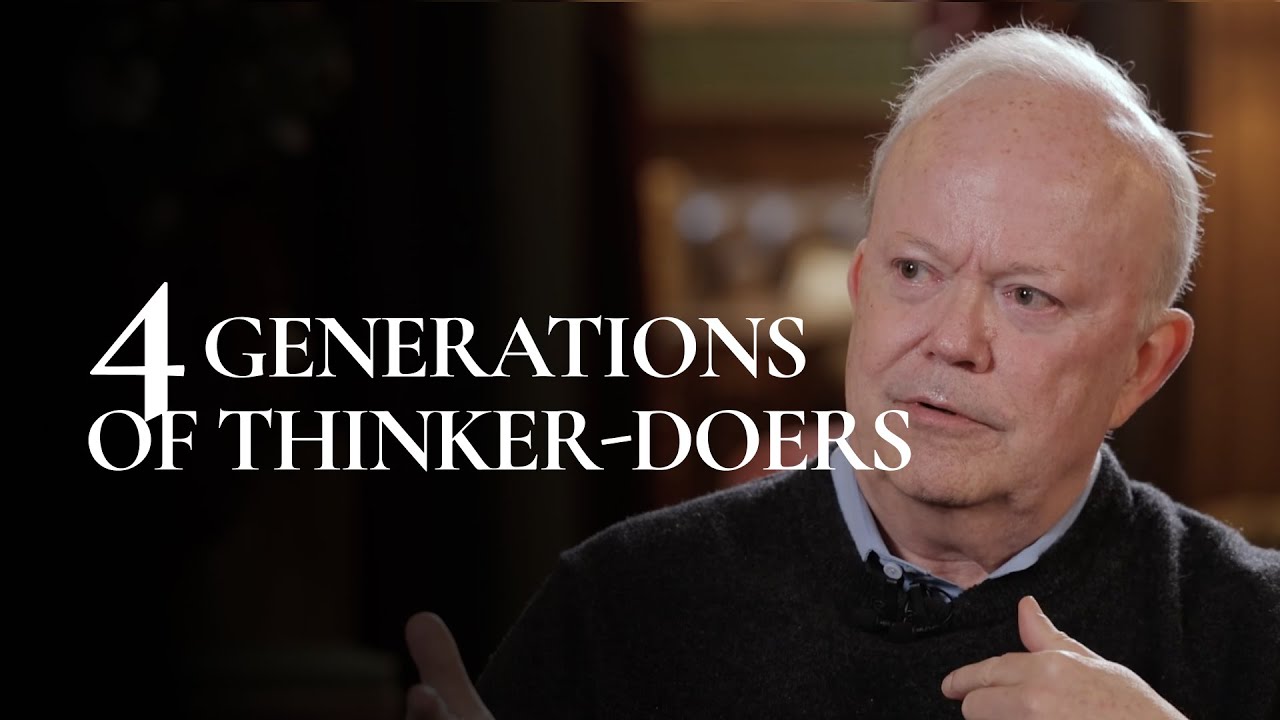
Jim O’Shaughnessy is a legendary Wall Street investor, writer, and philanthropist whose career spans four acts: self-education in the humanities, building a quantitative mutual fund empire, founding a media and culture company (OSV), and now pursuing a capstone mission to solve the mind-body problem. Across all four, he embodies a rare synthesis of deep contemplation and decisive action, a tradition stretching back at least four generations in his family.
A Family Built on Books, Curiosity, and Humility
Jim’s family has sustained a fusion of intellectual depth and entrepreneurial success across four generations, rooted in a shared voracious curiosity and immersion in the great books, history, music, and philosophy.
His grandfather, I. O’Shaughnessy, was one of the most successful oilmen of the 20th century, trained in the liberal arts, and the then-largest donor to Notre Dame, where he endowed a humanities building.
Jim’s father introduced him to the Encyclopedia Britannica as a child and surrounded the household with classical music, books, and ideas more typical of a college professor’s home than a businessman’s.
Jim began writing handwritten letters to his children starting when his eldest son Patrick was six days old, planning to give them on their 21st birthdays, deliberately leaving the letters unedited so his children could see who he actually was at each stage of life.
The family managed the usual tension between intellectuals and businessmen through kindness, charity, and genuine curiosity about each other’s passions rather than derision.
Studying the classics together cultivated humility: Shakespeare and the ancients make clear the fragility of human beings, which Jim believes leads to a generosity of spirit. His mother reinforced this with old-fashioned values: treat everyone with respect regardless of station, honor your word on a handshake, and remember that “where much is given, much is required.”
Act One: A Rebellious Autodidact
Jim’s formal education was largely irrelevant to his real learning, which was self-directed and obsessive.
In third grade, he raced through the SRA reading system all the way to eighth-grade level; rather than being rewarded, he was punished by being made to sit at his desk. His father’s response was to point him at the Encyclopedia Britannica and say “read that.”
At 16, he discovered Laozi’s Dao De Jing in a library and read it five times, beginning a deep engagement with Eastern philosophy. He was drawn to the idea of non-duality, reinforced by Schrödinger’s writing in What Is Life? about the unity of all minds.
He later found Western philosophers saying the same things in different language, and developed a lifelong practice of rereading favorite books because they reveal different things as the reader changes. He memorized 100 poems as a young man, which proved endlessly useful for cross-pollination in his essays and thinking.
The Dao De Jing specifically tempered his youthful authoritarianism: the best king is one where “the people did it themselves,” which reshaped his approach to leadership and control.
On religion, Jim occupies a middle ground: he rejects naive scientific materialism and suspects there are dimensions beyond the physical, but he is skeptical of institutional religion’s catechisms and rules. He is fascinated by the structural similarities across religions (death-and-rebirth cycles, flood myths, virgin births) and by the pattern that the founders of major traditions (Jesus, Buddha, Socrates) never wrote anything down and were not practitioners of the religions named after them. His approach is synthetic: he takes what improves life from each tradition rather than seeking one capital-T truth.
Act Two: Building a Quantitative Investing Empire
Jim’s entry into finance was accidental: he overheard his father and uncle making investment decisions based on gossip rather than earnings or revenue, found it absurd, and went to the James J. Hill research library in St. Paul to systematically study the Dow Jones 30 stocks.
His first strategy, based on Black-Scholes implied volatility differentials in options, stopped working almost immediately after he discovered an academic paper had already published the same formula. This taught him that mechanical arbitrage opportunities get arb’d away instantly, but human behavioral biases do not.
He dove into behavioral psychology and found studies showing that actuarial (statistical) decision-making consistently outperformed expert human judgment. A famous study had doctors reading X-rays: the statistical method was a ceiling humans couldn’t touch, not a floor they soared above. This crystallized his insight: “We’ve met the enemy, and it’s us.”
A formative failure came at age 27 going into the 1987 crash: he had amassed the largest put position of his career, all the numbers said hold, but he got calls from brokers and friends urging him to get out because a rally was coming. He sold the day before the market dropped nearly 24%. This taught him that fear, greed, and hope are the “four horsemen of the investment apocalypse” and that his emotions subtracted value.
He concluded that markets are right over time even if they have bubbles and crashes, and that instant market feedback is what makes investing the “Olympus of business”—it tests not just domain knowledge but human psychology, evolutionary biology, and genetics (one Scandinavian twin study found 45% of investment decisions are genetic and cannot be educated away).
Jim built his career on factor investing, translating academic research (Fama-French, CAPM) into practical strategies through a series of books. He was deliberate about the bridge between academia and practice: academics often ignore liquidity, market impact, and the difference between a micro-cap stock and one that has grown into a large-cap. His books imposed real-world constraints on theoretical models.
Writing books was central to his business strategy: in the 1990s, a book was credentialing. He sent the manuscript of What Works on Wall Street to Barron’s before publication, gambling that the publicity would drive demand. Barron’s ran a two-page spread calling him a “young, little-known asset manager,” McGraw-Hill was furious, but the book instantly hit the New York Times bestseller list.
His fourth book made explicit predictions for 2006–2026: S&P 500 returns of only 3–5% annually, small-cap stocks outperforming large-cap, and large-cap value outperforming large-cap growth. The first came true only because the Great Financial Crisis compressed terrible returns into a short period; the other two were wrong. He now says the book should have been a continuously updated blog post rather than something “set in stone.”
A recurring lesson from his market experience is intellectual humility. During the dot-com bubble, he wrote “The Internet Contrarian” in April 1999 calling it the biggest bubble of his career and received hate mail. He nonetheless started Netfolio, an early robo-advisor, and turned down a major investment bank’s offer to invest because his VC board believed taking “bricks-and-mortar” money would destroy their IPO chances. He doesn’t regret this: he probably wasn’t mature enough at 40 to handle being a billionaire, and wealth can corrupt.
Act Three: OSV — Culture, Media, and Finding Geniuses
After selling OSAM (his asset management firm), Jim founded OSV (O’Shaughnessy Ventures) to pursue everything he cared about but never had time for: film, books, podcasts, lectures, and culture.
He believes everything is downstream of culture and was motivated by the anti-growth, pessimistic attitude pervading society. OSV’s mission is to find things “worthy of being rooted for” rather than defaulting to pessimism.
OSV’s venture investing relies on what Jim calls “imbued intuition”—pattern recognition built over 40 years of seeing the same situations repeat. He now invests in founders as humans and ideas about where the world is going, a stark contrast to the purely quantitative public-market approach of Act Two.
He is particularly excited about the “Great Reshuffle” thesis (dating to 2017): AI and new innovation are ripping up and rewriting all the playbooks. He believes AI should be decentralized to advance human flourishing rather than tightly controlled by a few.
A core part of OSV is a fellowship program that finds and funds geniuses who in earlier eras might have lived and died without anyone recognizing their talent. One example: a woman going around Japan fixing dilapidated houses, an experiment in one country that could be synthesized and borrowed elsewhere.
OSV’s publishing arm, Infinite Books, is run by writers (editor-in-chief and CEO is Jimmy Sony) and uses AI to evaluate thousands of manuscripts that traditional publishers reject without reading. The AI does initial scoring against fine-tuned models of great books, then human editors add feedback. The goal is to give every author actionable feedback rather than the silence of the slush pile. Jim sees this as a shot across the bow of traditional gatekeeping.
Jim is writing his first novel, a WWII thriller about a genius Nazi art thief working for Göring’s extra-legal division (the “Gestapo,” nicknamed “ghostapo” by German troops). The plot centers on Raphael’s Portrait of a Young Man, the most valuable piece of art still missing, and the Bank for International Settlements in Basel, Switzerland—a real extra-legal institution created in 1930 where Swiss authorities cannot enter and bankers have diplomatic immunity.
He is writing the novel as an aggressive experiment in AI-augmented creation: AI handles research (which would have taken years with human research assistants), critiques the writing, and suggests improvements. Human writers and AI collaborate in a writer’s room. Jim owns the plot himself. Marketing will also be AI-driven and continuous rather than confined to a two-week window.
He views this as “intelligence amplification” and compares current fears about AI to Socrates’ opposition to writing and professors confiscating calculators. The key is having a thesis and a plot, then using AI to iterate at impossible speed.
Act Four: Solving the Mind-Body Problem
Jim’s final act is personal: at 36, he developed a frozen neck that no doctor, specialist, chiropractor, or treatment could fix. He discovered Dr. John Sarno’s Mind Over Back Pain, threw it across the room on first reading, but his wife recognized herself in its pages and urged him to reread it.
Sarno’s theory: the mind and body are not separate (Descartes did us a disservice). Emotional suppression causes physical symptoms that divert attention from emotional pain. Reading and understanding this is itself the cure—purely semantic content in the mind resolving bodily issues. After reading the book six times, Jim’s neck was completely cured.
Jim sees this as a Western affliction tied to the mind-body divide and believes it is needlessly pervasive. He wants to assemble a cross-disciplinary team (the “Avengers”) to solve mind-body problems at scale, building on Sarno’s work with advances in hypnosis, the frequency method, and other approaches.
He connects this to William James, whose unpublished writings in Boston he is digitizing. James’s core insight—“the greatest invention during my lifetime was that a man could change his being by changing his mind”—is the philosophical foundation for this final act.
The capstone ambition: stop needless suffering and allow people to more fully enjoy their lives.