-
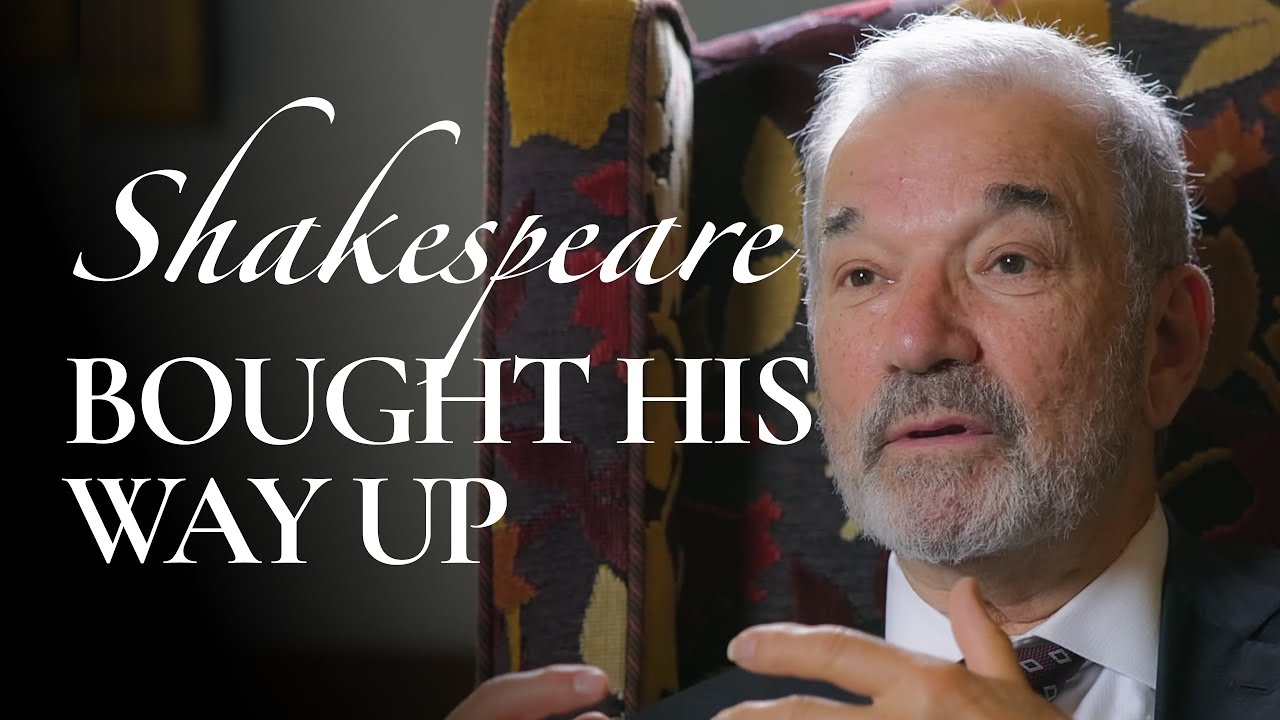
Stephen Greenblatt, one of the foremost Shakespeare scholars, discusses Shakespeare’s intense social ambition — how the greatest playwright in history spent enormous sums to buy a coat of arms and become a gentleman, revealing a side of Shakespeare that complicates the romantic image of the artist as indifferent to worldly status.
- Shakespeare was born in 1564 to John Shakespeare, a successful glover and alderman, and Mary Arden, from a once-noble family that had fallen into obscurity. His father had applied for a coat of arms to make the family gentlemen, but financial troubles derailed the application. Roughly a decade later, Shakespeare himself used his earnings as a playwright and actor to complete the purchase, making himself and his descendants gentlemen.
- This story humanizes Shakespeare and mirrors patterns of social mobility that persist today — Greenblatt notes that in both Shakespeare’s era and ours, money can open doors that are supposed to be based on merit or principle alone.
- The distinction between gentleman and commoner in Elizabethan England was not trivial: it determined how people treated you (taking hats off, standing when you entered), whether you could be whipped or arrested like a vagabond, and even the manner of your execution. Literacy in Latin could literally save your life under the medieval “benefit of clergy” rule.
-
The College of Heralds systematized social mobility — but also policed it.
- The easiest path to gentleman status was a university degree. Shakespeare’s exact contemporary Christopher Marlowe, son of a cobbler, went to Cambridge and was thereafter styled “Christopher Marlowe, gentleman” — a designation that saved his life when he was arrested on capital counterfeiting charges abroad.
- Shakespeare, unable to attend university due to his father’s financial collapse, instead used his theatrical earnings to pay the College of Heralds to process the coat of arms application his father had started. The Heralds enhanced his family genealogy — somewhere between fabrication and romanticized storytelling — and granted the arms, though another herald later complained that “Shakespeare the player” should never have received one, since acting was considered among the lowest professions.
- Shakespeare’s coat of arms came with a motto: Non sans droit (not without right) — half defiant, half defensive. A clerk’s accidental comma placement could turn it into “no, without justification,” and his colleague Ben Johnson later mocked the whole enterprise in a play where a buffoon buys a coat of arms with the humiliating motto “not without mustard” — likely performed while Shakespeare was on stage.
-
Shakespeare’s profession itself embodied social transgression: a low-status person playing high-status roles.
- In Elizabethan England, actors were legally restricted from wearing noble clothing offstage, and the profession was considered tainted — comparable to prostitution. Yet the plays were mostly about the aristocracy, so actors spent their working lives impersonating their social betters.
- Greenblatt notes an inversion: in Shakespeare’s time, a lowly person played high-status figures; today, high-status actors often play low-status ones. The social meaning of performance has flipped.
- Despite the stigma, Shakespeare’s great actor contemporaries like Richard Burbage were famous and wealthy — when Burbage died, the whole nation noticed, whereas Shakespeare’s death passed largely unremarked.
-
Shakespeare’s plays both display and critique social ambition, but he is deeply cautious about upward mobility.
- In plays like Twelfth Night and The Winter’s Tale, characters who rise from low to high status turn out to have been noble all along — Shakespeare uses the romance device of hidden royal blood to make social mobility palatable and conservative.
- In Julius Caesar, the issue is not class mobility but factional preeminence: Caesar’s attempt to rise above his equals provokes his assassination. Shakespeare, acutely sensitive to Elizabethan court factionalism under Queen Elizabeth I, consistently marks the drive for supreme power as extremely dangerous.
- The positive model of social ascent in Shakespeare is always structured as return — not exceeding your station but recovering a lost one. Prince Hal descends into the tavern world and then rises again as Henry V, but this is framed as reclaiming his rightful place. This mirrors Shakespeare’s own life: restoring his father’s lost status and his mother’s noble Arden lineage.
-
Greenblatt’s new book, Second Chances, explores Shakespeare’s obsession with loss and recovery across his entire career.
- The pattern is most visible in the late romances (The Winter’s Tale, The Tempest, Pericles, Cymbeline) — plays explicitly about disaster and recuperation, getting back what was thought lost forever. But Greenblatt argues the pattern runs through all of Shakespeare’s work.
- The book is co-written with British psychoanalyst Adam Phillips, with Greenblatt’s half focused on Shakespeare and Phillips’s on Freud, both exploring whether someone in a disastrous place can come back and have a second chance.
-
Greenblatt argues that literature, especially Shakespeare, offers something philosophy often cannot: truth through contradiction and embodiment rather than abstract consistency.
- Greenblatt acknowledges that philosophy — from Socrates and Plato onward — has attacked literature for holding contradictory ideas simultaneously. But he argues this “double consciousness” is closer to the truth of human experience than philosophical consistency.
- Shakespeare was a master of double consciousness: he bought a coat of arms while mocking such pretensions in his plays; he invested in real estate while ridiculing entrepreneurs in Hamlet; he devoted his life to theater while laughing at it and regretting making himself a show. Greenblatt sees this not as hypocrisy but as an honest reflection of contradictory human nature — influenced, he suggests, by Christianity’s own double consciousness about Christ being both God and man, mortal and supreme.
- When pressed on whether this framework would excuse someone who wrote emancipatory literature while owning slaves (the example of Thomas Jefferson), Greenblatt resists the simple moral pass but argues for understanding how contradictory our inherited positions are, and beginning from that acceptance.
-
Shakespeare’s stated artistic goal was modest — “to please” — but this should not be mistaken for a limited view of art’s power.
- In his sonnets, Shakespeare makes extravagant claims about immortalizing his subjects in verse — claims he never made for his plays. Greenblatt explains this as genre awareness: plays performed before thousands in grease paint and borrowed costumes felt like a different, more fleeting enterprise than poetry.
- Yet Shakespeare also understood something dark about theatrical power — the ability to manipulate large crowds to cry, scream, love, and hate. He associated this with necromancy (Prospero waking the dead) and with dangerous political manipulation (Antony’s funeral oration in Julius Caesar, Iago’s machinations in Othello). He was suspicious of the very power he wielded.
- Shakespeare likely saw his greatest genius as theatrical — in plotting, impersonation, and the staging of action — even if his sonnets were the vehicle through which he expected to achieve immortal glory. In his own time, the educated elite knew him at least as much for his long poems Venus and Adonis and The Rape of Lucrece as for his plays.
How Shakespeare Became Upper Class | Harvard's Stephen Greenblatt
Johnathan Bi • • 43min → 5 min • #24