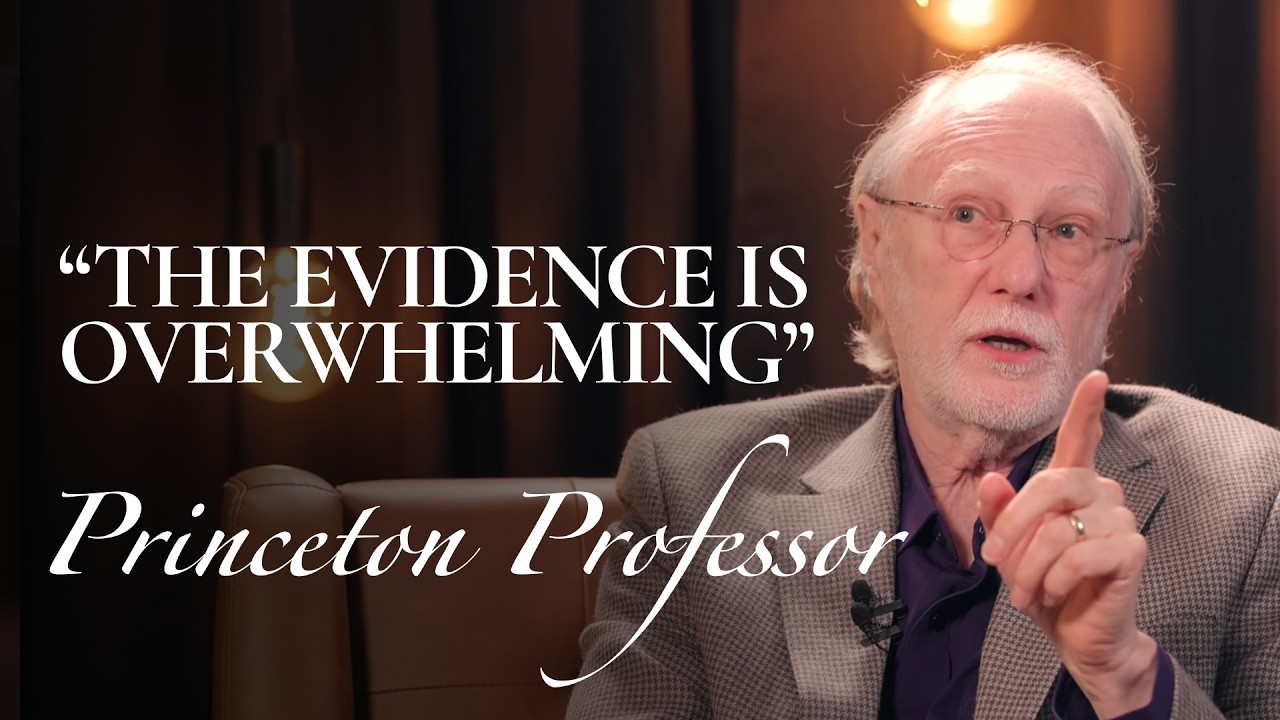
- Dale Allison, a Princeton historian and New Testament scholar, argues that a wide range of “metanormal” phenomena—levitation, near-death experiences, terminal lucidity, reincarnation memories, apparitions, and more—are well-documented across cultures and traditions, and cannot be easily absorbed into a materialist worldview. His book Encountering Mystery surveys these experiences across religions and eras, drawing on both historical records and modern scientific studies. He contends that this evidence has been systematically ignored or suppressed not only by atheists and materialists, but also by religious authorities who find it threatening to doctrinal control. The episode explores the nature of these phenomena, the psychology behind belief and skepticism, the problem of evil, and how individuals might navigate spiritual experience in a pluralistic world.
The Evidence for the Metanormal
-
Near-death experiences (NDEs) with veridical elements
- Patients under anesthesia report observing specific, verifiable details—such as a doctor’s red tennis shoes, mustard on a tie, or events in adjacent operating rooms—that they could not have known through normal means.
- These accounts come from credible medical professionals (doctors, nurses) who are often materialists themselves and are genuinely puzzled by the accuracy of patient reports.
- A key collection of such cases is the book The Self Does Not Die, which includes only medically confirmed testimonies.
- Studies show that people who report NDEs describe operating procedures far more accurately than those asked to imagine them, suggesting something beyond guesswork.
-
Terminal lucidity
- Patients with severe brain damage—advanced Alzheimer’s, brain cancer, or dementia—who have been non-communicative for months or years suddenly regain full mental clarity shortly before death.
- Examples include a woman whose brain was largely destroyed by cancer but who woke up lucid and conversed normally hours before passing.
- Studies suggest this occurs in roughly 10% of dementia cases; hospice workers confirm it is a recognized phenomenon they call “rallying.”
- This is difficult to explain under materialism, which holds consciousness as an emergent property of brain function: if the brain is gone, consciousness should be too.
-
The antenna model of consciousness
- An analogy (not a scientific model) proposed by William James: the brain may not produce consciousness but instead receive or filter it, like a radio receiving a signal.
- This explains why reduced brain activity (during meditation, sleep, or near-death) can correlate with heightened conscious experience rather than diminished awareness.
- It also accounts for NDEs: as the brain shuts down, the “signal” may become clearer, not weaker.
-
ESP and psychokinesis
- J.B. Rhine’s card-guessing experiments at Duke University in the 1930s produced statistically significant results, especially in the Pratt-Pierce experiment where participants were in separate buildings.
- Critics like E.P. Hansel attempted to explain away the results by alleging cheating—despite no evidence—revealing a dogmatic commitment to materialism.
- Meta-analyses of ESP studies in the 1990s, including corrections for unpublished negative results (“file drawer effect”), still found statistically significant outcomes.
- Allison notes that most metanormal phenomena do not manifest well in lab settings, but even the subset that does shows compelling evidence.
-
Apparitions and public miracles
- The 1968 Zaytun apparitions in Cairo: thousands reported seeing the Virgin Mary above a Coptic church dome over many nights. The light persisted even when the electrical grid was cut; no mechanical source was found.
- The 1917 Fatima miracle: three children saw Mary; crowds witnessed atmospheric anomalies (“the miracle of the sun”), though only the children saw the figure.
- The 1996 “milk-drinking miracle”: statues of Ganesha worldwide appeared to drink milk offered on spoons. While capillary action may explain some cases, the scale and simultaneity remain puzzling.
- Icons oozing oil: Allison personally witnessed an Orthodox icon in Pennsylvania exuding oil for 10 minutes. Though fraud exists (e.g., injected oil), Catholic and Orthodox authorities rigorously vet such events, often more skeptically than atheists.
Why This Evidence Is Suppressed
-
Materialist dogmatism
- Many materialists treat their worldview as unfalsifiable, dismissing contradictory data via ad hoc explanations (e.g., “they cheated,” “it’s selection bias”) rather than engaging with the evidence.
- Allison compares this to religious fundamentalism: both refuse to allow evidence to challenge core assumptions.
-
Religious resistance
- Protestant skepticism: The Reformation rejected Catholic miracles (relics, Eucharistic miracles) to delegitimize Rome. This birthed “cessationism”—the idea that miracles ended with the apostolic age—which fed into Enlightenment skepticism and modern atheism.
- Doctrinal control: All religions tend to accept only miracles that confirm their own truth claims. Catholics accept Marian apparitions; Protestants do not. Levitation by a Catholic saint doesn’t prove Catholicism true, nor does Buddhist levitation prove Buddhism.
- Fear of chaos: Metanormal experiences are often messy, unpredictable, and not easily institutionalized. Religious hierarchies prefer controlled revelation over spontaneous, unregulated encounters.
-
Social repression
- A study of elderly widows found that only 1 in 50 admitted to sensing a deceased spouse—until interviewers normalized the experience as common and non-pathological. Then, 25 out of 50 (50%) reported such contact.
- People stay silent due to fear of being labeled crazy, possessed, or delusional. Allison’s own daughter suffered PTSD from a nightmarish metanormal experience but hid it for years out of shame.
Personal and Familial Experiences
-
Allison’s formative experience
- At 16, sitting under a Kansas night sky, he felt surrounded by a mysterious, loving presence he interpreted as God. Though ineffable, it was undeniably real to him and set the course for his life in religious studies.
- He rejects the evangelical interpretation (“you got saved”) but affirms the reality of the encounter.
-
Family patterns
- His son observed a Tibetan master visibly glowing during an audience—a phenomenon others in the group independently confirmed. His son first sought natural explanations (light reflection) before accepting what he saw.
- His daughter had a dream that precisely matched a real church visit a week later (entering a side door, darkness, a woman saying “the electricity is off”).
- Allison speculates that some people are “thin” (more permeable to metanormal experiences) and others “thick,” possibly due to genetics or family storytelling culture—but admits he cannot disentangle the two.
-
Glowing saints
- Unlike most metanormal events (which occur across contexts), glowing appears restricted to recognized holy figures in traditions like Sufism, Buddhism, and Christianity.
- Allison has no secular examples and finds this category uniquely tied to sanctity.
Categories and Ambiguities of Metanormal Experience
-
Private vs. public
- Private experiences (like Allison’s at 16) are subjectively powerful but not evidential to others.
- Public events (icons oozing oil, apparitions) are testable in principle but often resisted by religious authorities who view them as sacred objects, not lab specimens.
-
Spontaneous vs. induced
- Some experiences happen unprompted (NDEs, terminal lucidity).
- Others arise from disciplined practice: Buddhist meditators report predictable phenomena (e.g., visions, sensations) that teachers recognize as common side effects of deep practice.
-
Moral valence
- Contrary to popular belief, metanormal abilities do not reliably indicate moral goodness.
- In the Bible, Pharaoh’s magicians replicate Moses’ miracles.
- Jesus warns of false prophets who perform wonders yet are rejected.
- Figures like Sai Baba (Hindu miracle worker) and some Tibetan masters were accused of sexual misconduct despite reputed powers.
- Allison rejects the idea that miracles validate a religion’s truth. They are ambiguous signs, not proofs.
- Contrary to popular belief, metanormal abilities do not reliably indicate moral goodness.
-
Radical good vs. radical evil
- Many report overwhelming experiences of transcendent love and acceptance, often accompanied by the conviction that “this is what reality is about.”
- Others encounter terrifying, malevolent presences—but none describe these as fundamental or ultimate.
- This asymmetry leads Allison to favor a monotheistic view (God is good) while acknowledging the reality of evil—though not as a co-equal Manichaean force.
Navigating Tradition and Experience
-
Allison’s pragmatic Christianity
- He remains Christian not because it’s “truer” but because it works for him: his devotional life, mentors (Origen, Gregory of Nyssa, Pascal), and community are rooted in this tradition.
- He views all religions as human constructs responding to the transcendent—each with insights and flaws.
- He corrects his tradition when evidence demands it (e.g., accepting evolution over literal Genesis).
-
Reincarnation and openness to revision
- If reincarnation data (from researchers like Ian Stevenson and Jim Tucker) became undeniable, Christianity would need to adapt—perhaps viewing it as rare or as access to a “library” of past lives.
- Knowledge must correct tradition, not the reverse.
-
Advice for seekers
- Most people benefit from practicing within a single ethical-spiritual tradition, which provides structure and moral guidance.
- Some, like Allison’s son, are called to explore multiple paths (Sufism, Buddhism, Christianity). This cross-traditional engagement may shape the future of religion.
- Ethical discernment is essential: not all traditions are morally equal (e.g., Odinism’s valorization of battle-death, Aztec human sacrifice).
- The experience of transcendent love carries an implicit ethical imperative: to embody and share that love in the world.
-
Humility in the face of mystery
- Allison insists he has no definitive answers. Religion, like the world, is a “buzzing confusion.”
- He resists dogmatism—whether materialist or religious—and advocates for openness, generosity, and ongoing inquiry.