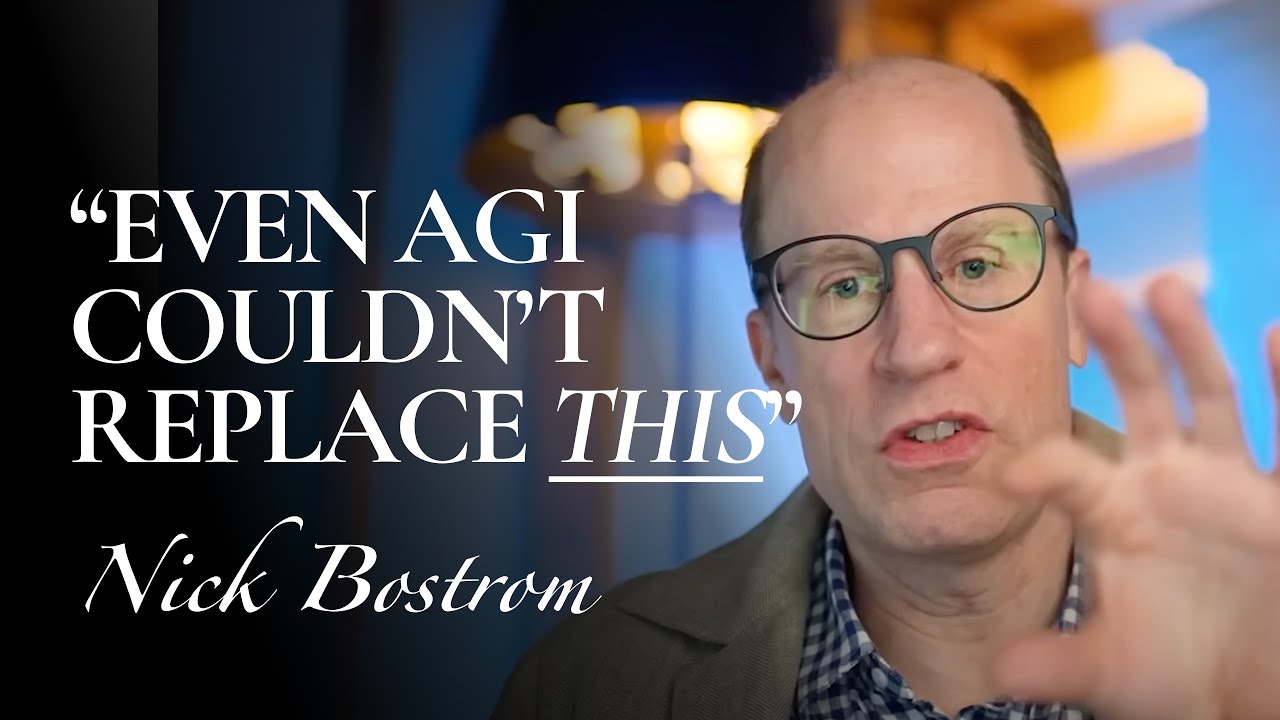
- Nick Bostrom, philosopher and author of Deep Utopia, discusses what the good life looks like in a world of full technological maturity—a state where superintelligent AI has made virtually all human labor and leisure redundant, and where advanced neurotechnology, robotics, and virtual reality can satisfy every material and experiential need. The conversation explores which human activities are most resistant to AI obsolescence on the way there, and how meaning, purpose, and pleasure might be sustained once we arrive.
Pre-Utopia: Three AI-Resistant Activities
-
Learning over production: Directly downloading skills into the brain would require reading and reconfiguring trillions of synapses—a task likely requiring mature superintelligence. Until then, the traditional process of learning (reading, thinking, practicing) remains the only reliable way to acquire fine-grained knowledge and understanding. This makes genuine intellectual engagement one of the more durable human activities in the near term.
- Bostrom notes that even Aristotle’s view of the contemplative life as the highest human activity may eventually be superseded, but for now, the hard work of understanding cannot be shortcut.
- He also suggests that if lifespans become extremely long, there may be value in not immediately knowing all answers—preserving some mysteries for future discovery, like saving a rare bottle of champagne.
-
Relationships over things: Even if a robot could functionally outperform a human parent in every measurable way, most people would still value the continuation of the existing human relationship. The value lies not just in the functional output but in the fact that it is this particular person relating to this particular child.
- Bostrom extends this to roles like priest, prostitute, and politician, where the demand may specifically require a human provider regardless of machine capability.
- He also emphasizes the importance of a “cognitive immune system”—robust judgment and the ability to think independently—especially in an age of social media and memetic manipulation.
-
Capital over labor: As AI makes human labor increasingly abundant and cheap, the economic return on long-term investment in human capital (e.g., decades of medical or legal training) declines sharply. Human capital is becoming a depreciating asset.
- Bostrom references Keynes’s 1930 prediction that by 2030, productivity gains would reduce the workweek to 15 hours. While productivity has indeed surged, working hours have not fallen nearly as much, due to status competition (wanting more than others) and a deeply ingrained work ethic.
- He suggests that vanity and social drives—not just material greed—keep people working far beyond what is necessary for subsistence.
Deep Utopia: The Challenge of a World Without Necessity
- In a state of full technological maturity, both work and most leisure activities become redundant. Any instrumental task can be outsourced to AI or robots, and any experience can be simulated. This creates a “post-instrumental” condition where there is nothing one must do to achieve any outcome.
- Bostrom argues that even if alignment is solved and AI works entirely in humanity’s favor, it remains genuinely difficult to imagine what a good life looks like in such a world—because nearly everything that currently gives life structure and meaning depends on scarcity, effort, and constraint.
Five Pillars of the Good Life in Deep Utopia
-
Bostrom proposes five “modes of defense” for sustaining a worthwhile life in technological maturity:
-
Hedonic well-being: Advanced neurotechnology could make every hour of every day immensely pleasurable—matching or exceeding the peak experiences available to humans today. While philosophically “boring,” Bostrom considers this perhaps the most important element, and on its own could make the transition worthwhile.
- He also notes a “minus one” mode: simply eliminating the immense suffering currently plaguing the human condition.
-
Experience texture: Rather than passive pleasure-seeking, utopians could attach their enjoyment to valuable experiences—appreciating beauty, understanding deep truths, contemplating moral virtue, or engaging with great art and nature. This transforms pleasure from “junkie-like” diffusion into something more like connoisseurship.
-
Autotelic activity: Utopians could engage in activities that are rewarding in themselves, not as means to an end. These would involve doing things through one’s own effort, even when a shortcut exists—similar to choosing to climb a mountain rather than being helicoptered to the top.
-
Artificial purpose: Since no goals are instrumentally necessary, utopians could adopt self-chosen goals that constitutively require personal effort. Games are the paradigm case: the goal of getting a ball into a hole is arbitrary, but adopting it creates genuine reasons to strive. This could be scaled up into complex, long-duration, multiplayer challenges spanning years.
-
Natural purposes and social-cultural entanglement: Some purposes survive not because they are instrumentally necessary but because they are intrinsically tied to particular relationships or traditions. Honoring ancestors, continuing a ritual that constitutively requires human participation, or maintaining an existing parent-child relationship are examples. These are “fainter” values—currently overshadowed by urgent practical needs—but would become visible once the “sun” of material scarcity sets.
- Bostrom acknowledges that recognition and esteem from others play a key role here, and raises the question of whether humans might come to value recognition from AI agents as much as from humans—which could either enrich or undermine these social entanglements.
Pleasure, Virtue, and Potential Conflicts
- Bostrom defends the centrality of pleasure against critics who see it as shallow. He points out that for Aristotle, the virtuous person is someone who takes pleasure in doing the right thing—so aligning pleasure with virtuous activities is itself a form of moral progress.
- With mature technology, pleasure could be “woven into” intrinsically valuable activities rather than being a separate, potentially distracting reward. For example, one could experience enhanced pleasure from reading, contemplation, or acts of kindness—not just from physical indulgence.
- He acknowledges potential trade-offs: some values may require occasional sadness or solemnity (e.g., mourning historical tragedies), and certain forms of pleasure might be inappropriate in specific contexts. The design space is vast and would need careful navigation.
Boredom and Interestingness
- Bostrom distinguishes between subjective boredom (the feeling of being bored, which neurotechnology could eliminate) and objective interestingness (whether an activity or experience is genuinely worthy of interest).
- One form of objective interestingness involves complexity, richness, and sophistication—which could be amplified without limit.
- Another form requires fundamental novelty—discovering something for the first time. This is inherently finite: there are only so many major discoveries (relativity, evolution, etc.) to be made. Once exhausted, this source of interestingness dwindles.
- He argues that even in current life, most fundamental novelty is concentrated in early childhood (discovering that objects persist, that other people exist). After that, the rate of profound new discovery drops sharply. From a cosmic perspective, most human lives are already highly repetitive.
The “Soft” Defense of Utopia
- Bostrom’s overall argument is that people who demand “deep purpose” or “world-historic meaning” should recognize that very few humans have ever actually possessed these things. Most lives, even good ones, are built from pleasure, social engagement, and aesthetic experience—not from global stakes or fundamental novelty.
- He suggests that the present moment is actually the “golden era of purpose”—because the stakes of AI development and civilizational trajectory have never been higher. If people cannot find meaning now, when so much hangs in the balance, it is unlikely they truly value global purpose as much as they claim.
- The appropriate way to evaluate utopia is not from the outside (as a dramatic story to be watched) but from the inside (as a life to be lived). The most interesting stories to read about are often the worst to live through.
Greatness, Suffering, and Saturation of Value
- Bostrom questions whether additional suffering—even if it produces great art or cultural milestones—is worth it. He suggests that the value of tragic beauty may “saturate”: one tragedy may produce beauty, but ten tragedies do not produce ten times as much. By contrast, the value of a pleasant experience (like a cup of tea) does not diminish with repetition.
- He speculates that humanity may have already had enough of war, disease, and suffering, and that at some point it is better to “unlock the next level” rather than continue cycling through horrors for the sake of dramatic richness.
Necessity and Human Nature
- A core tension in evaluating deep utopia is how important necessity is for a flourishing life. Bostrom notes that human psychology evolved under conditions of scarcity and threat—food scarcity, predators, disease. Removing these constraints creates a mismatch between our evolved psychology and our environment, which may manifest as obesity, social alienation, or other psychological ailments.
- He suggests this mismatch could be addressed in two ways: by adjusting our psychological apparatus (through neurotechnology) and by adjusting the environment (e.g., living in simulated savannahs rather than concrete buildings).
- He references the Unabomber as an extreme case of someone who believed modern life already lacks sufficient necessity and wanted to reverse technological progress—though Bostrom thinks many of the psychological costs the Unabomber identified are fixable without abandoning technology.
Memory Washing and Simulated Lives
- Jonathan proposes a thought experiment: what if utopians periodically wiped their memories and lived simulated lives (e.g., as Achilles) to recapture a sense of global stakes and meaning? Bostrom responds that this would fall into the category of artificial purpose—and that partial amnesia could be arranged for those who want it.
- He suggests that utopians could create “little holes in utopia”—pockets of genuine risk and constraint—but at human-scale stakes (e.g., a month of exclusion from social life) rather than life-or-death consequences like childhood cancer.
Theological Parallels
- Bostrom acknowledges the strong structural parallels between his vision of deep utopia and traditional theological conceptions of the afterlife: individuality is preserved, material concerns are resolved, and much of life is spent in contemplation. He notes that both religious and naturalistic lines of inquiry may be “climbing the same mountain from different sides”—starting from different assumptions but converging on similar conclusions about the ultimate conditions for a good life.
- He references Derek Parfit’s metaphor of different ethical traditions converging at a single peak, and suggests that fully thinking through the implications of a physicalist worldview leads to considerations traditionally developed in theological contexts.