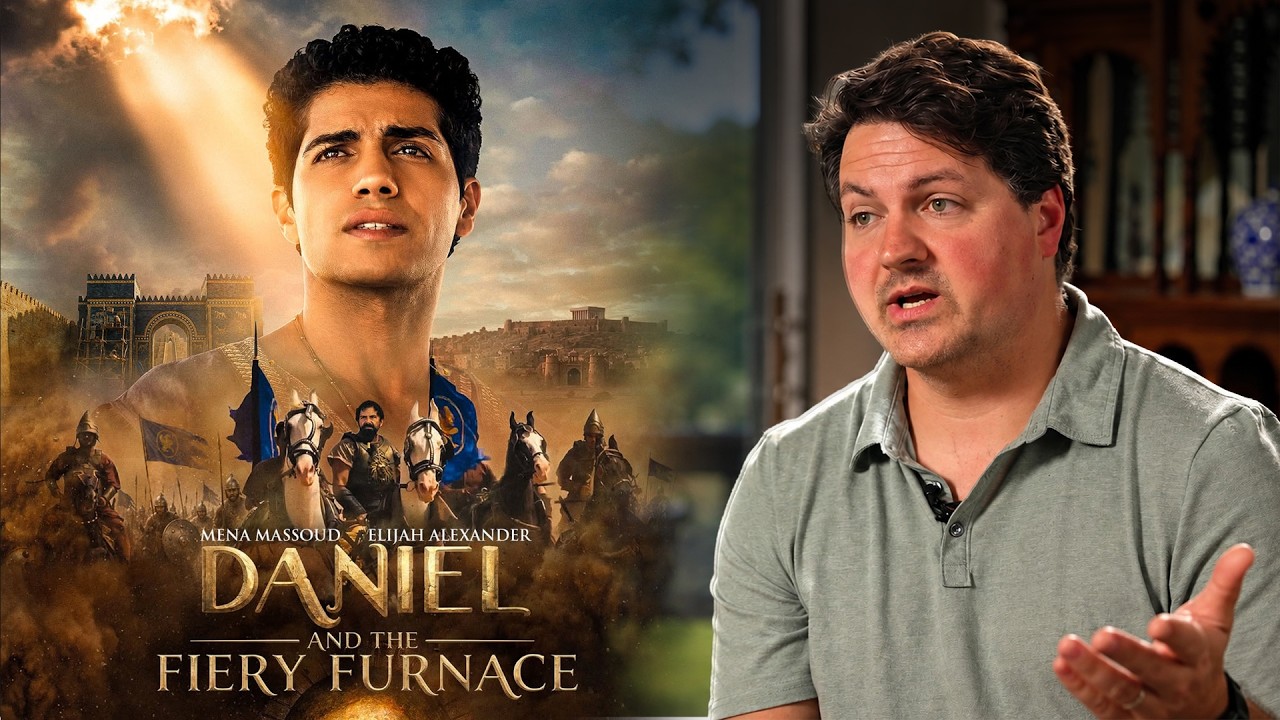
This episode is an interview with Daniel Kooman, director of Daniel and the Fiery Furnace, an independent film covering the first three chapters of the biblical book of Daniel, intended as the first in a planned series that will continue through the lion’s den and the prophetic visions; Kooman and his brothers wrote, produced, and directed the film on a micro-budget in India with an international cast including Mina Massoud (Aladdin) as Daniel and Elijah Alexander as Nebuchadnezzar.
Miraculous events during filming that shaped the final product
During the opening scene where Jeremiah warns King Jehoiakim of a coming “whirlwind,” the 40x40 ft canopy blew off, a flash flood filled the set with three inches of water, and all lights cut out; the crew kept rolling after a one-hour cleanup, and the resulting moody, dramatic lighting was deemed superior to the original setup.
While filming Daniel’s interpretation of Nebuchadnezzar’s dream at a stepwell location, a massive wind hit the set at the exact moment Daniel quoted the prophecy about “a rock cut out not from human hands” and a kingdom “not of this world”; flags and tents blew down, crew members took cover in terror, and a crack of thunder sounded — all captured on camera in the first take.
During pre-production location scouting for the fiery furnace climax, the crew prayed specifically for guidance; an hour later, a sunbeam broke through clouds and illuminated the precise spot where the statue and furnace platform would later be built, prompting the first AD to say, “You’re going to make a believer out of me.”
Theological framework: the Babylonian exile as the hinge of salvation history
The Babylonian exile (70 years) occupies roughly half the Old Testament’s narrative real estate because it marks the pivot from a story centered on Israel/Judah to one that opens salvation to the Gentiles; Daniel 2–7 is written in Aramaic (the Gentile lingua franca) rather than Hebrew, signaling this shift.
Daniel and Jeremiah were contemporaries from the royal house of Judah; the film imagines them together in Jerusalem before the exile, drawing on Jeremiah 29 (Jeremiah’s letter to the exiles) and the shared prophetic worldview shaped by Isaiah’s scrolls.
Fire is a central motif: it destroys (the king burns Jeremiah’s scroll) but also refines (Jeremiah 20:9 — “Your word burns inside me like a fire”); the furnace becomes a type of hell, yet the three men walk out unharmed because “they burn hotter than the fire” — the fire of God within them exceeds the furnace heated seven times over.
In Daniel 7, the “son of man” (Aramaic bar ‘enash) appears for the first time in Scripture; Jesus later adopts this exact Aramaic title, identifying himself as the figure Daniel saw, making the exile era a “proto-Christ event” where the path to Gentile salvation is forged.
Character dynamics: Daniel and Nebuchadnezzar as paradoxical partners
Nebuchadnezzar is introduced as a proud, volatile pagan king who nevertheless is called “the instrument of the Most High” (Jeremiah 27:6); he names Daniel “Belteshazzar” (“Bel protect the king”) after Daniel saves him from a lion — a scene invented to dramatize how the name change occurs, contrasting Daniel’s Hebrew identity (“God is my judge”) with Babylonian assimilation.
Their relationship evolves from captor/captive to a strange partnership: Nebuchadnezzar is allured by Daniel’s prophetic power (he tells the king the dream and its interpretation), but Daniel consistently deflects glory to “the God in heaven who reveals mysteries” (Daniel 2:28), modeling humility that disarms the king’s ego.
The film implies Daniel and his friends were made eunuchs (Isaiah 39:7; Daniel 1:3–4), removing the Abrahamic promise of descendants; this adds moral weight — their faithfulness costs them lineage — and the film leaves it ambiguous whether a nightmare sequence depicts reality or fear, to be resolved in future installments.
Nebuchadnezzar’s chapter 4 decree (the only biblical chapter written by a Gentile) is portrayed as genuine transformation after seven years of bestial madness; his self-humiliation (“I became like a cow”) mirrors the pattern that true encounter with God produces: the proud are laid low so they can become “sons” rather than mere servants.
Creative philosophy: textual fidelity as a creative constraint, not a straitjacket
Kooman argues that accuracy to the text serves both believers (who notice deviations) and seekers (who can test the film against the source); creativity flourishes within parameters — e.g., imagining how Jeremiah sent messages to Babylon, or how Belteshazzar got his name — rather than inventing contradictory plotlines.
The film includes explicitly Christian visual language (Jeremiah carrying a yoke evoking the cross; the fourth figure in the furnace identified as “the Son of Man”; Daniel forging a cross at the end) because the filmmakers are Christian and the archetypes permeate their imagination; Kooman acknowledges this may be unconscious but believes authenticity to their reading matters more than neutralizing the film for a hypothetical secular audience.
The “even if he does not rescue us” line (Daniel 3:18) is preserved as the true test of faith: the three men enter the furnace terrified, not presuming deliverance; Kooman contrasts this with modern “prosperity” readings — real faith endures even when God does not intervene, as with the apostles’ martyrdoms and modern persecuted Christians.
The film introduces Susanna (from Daniel 13, apocryphal) as Jeremiah’s sister and Daniel’s childhood friend to give Daniel vulnerability; a pivotal scene shows him doubting before the statue’s unveiling, and Susanna rebukes him into prayer — modeling that biblical heroes are “men just like us” (James 5:17) who humble themselves and kneel.
The dating controversy and the interviewer’s theological wrestling
The interviewer, a former seeker with academic training, argues the scholarly consensus favors a 2nd-century BC composition (Maccabean era) rather than 6th-century authorship; this challenges the book’s predictive prophecy (e.g., Alexander’s empire divided four ways) and Jesus’ citation of Daniel as a prophet — if Daniel is pseudepigraphic, Jesus either erred or accommodated.
Kooman responds that the self-humiliating nature of Nebuchadnezzar’s chapter 4 decree rings true only if it happened; more foundationally, the incarnation — “God became a man and died on a wretched tree, saying ‘Father, forgive them’” — is the “leveler” that crashes all scholarly debates; the seeker’s journey ends not in resolving every textual puzzle but in encountering Christ, as Nebuchadnezzar did after 69 years of crushing.
Production realities: micro-budget, India, and the CGI question
The film was shot in 22 days (vs. a typical 44) for roughly $4M (vs. a studio’s $50M); the India location (500-year-old forts near the Pakistan border) provided architectural authenticity impossible in Thailand, where they’d previously filmed.
Every CGI asset (furnace, statue, armies) was custom-built and composited onto real plates — practical chariots, horses, and locations grounded the digital work; Kooman rejects the “AI filmmaking” hype, noting that current tools lack “breath” (spirit/authenticity) and that audiences will ultimately crave the real, as with Nolan’s practical-effects ethos.
The crew included Hindus, Muslims, atheists, and Christians; several crew members reported being moved toward faith by the on-set phenomena, but Kooman frames these as “signs” that require eyes to see — referencing Jesus’ baptism where some heard the Father’s voice and others “only heard thunder.”
Future plans and the director’s posture
Sequels are planned: Daniel and Jeremiah (grayer, more Job-like suffering), Daniel and Nebuchadnezzar (chapter 4 madness/restoration), then the lion’s den; the prophetic visions (chapters 7–12) will be woven into the narrative chronologically rather than treated as standalone visions.
Kooman describes filmmaking as “one of the worst mediums for creative artists” — high risk, low volume (maybe 15–20 films in a lifetime), constant compromise between artistic vision and economic viability — but sees the refining fire of production as analogous to the furnace: “you’re getting chiseled and smashed… infuriating and also helpful and a blessing and terrible all at once.”