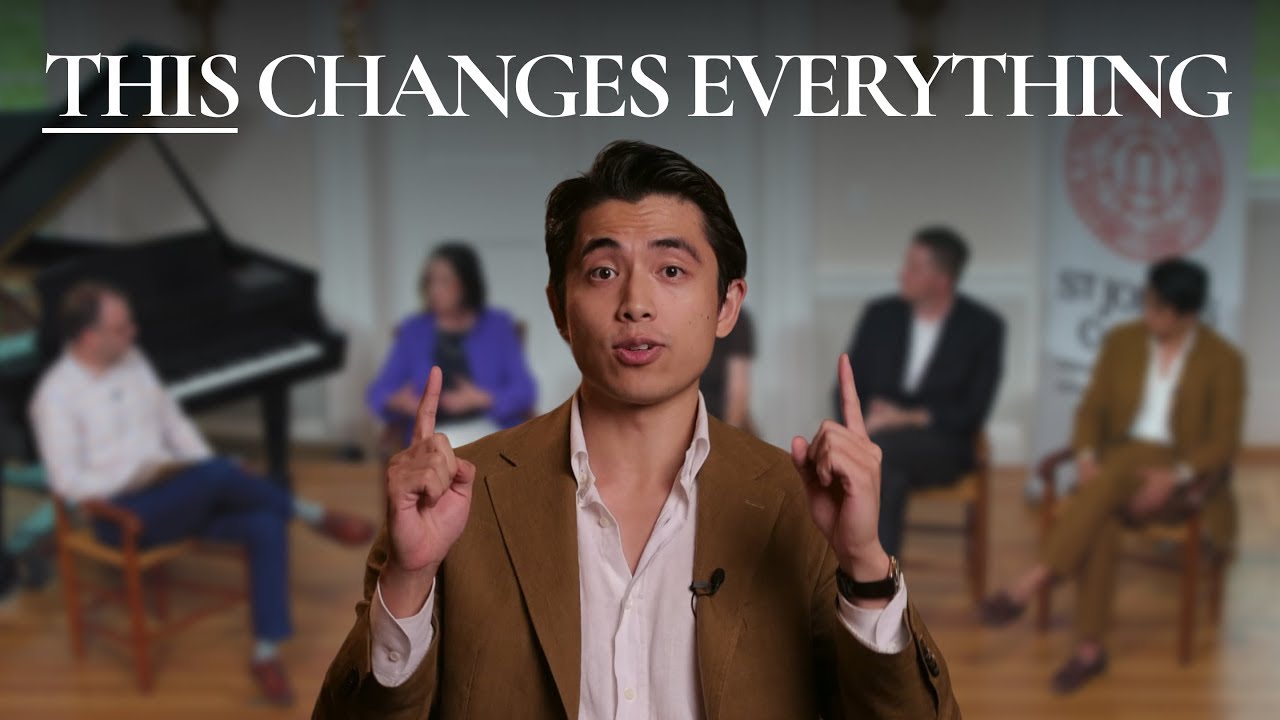
- A panel at St. John’s College featuring Brendan McCord (Cosmos), Hollis Robbins (University of Utah), and Zena Hitz (St. John’s), moderated by Jonathan, discusses whether AI can replicate the depth of human thought, learning, and literary creation — and what is at stake for education, philosophy, and intellectual community.
- The central tension is whether AI can produce not just competent text but works of genuine depth and meaning, and whether learning can occur without a living human connection behind the words.
- The conversation moves through three main questions: Can AI write a great book? What can AI contribute to education? And will AI replace or support intellectual community?
Can AI Write a Great Book?
-
The semantic content question: Jonathan argues that on the level of pure language, there may be nothing a human tutor or author could say that an AI could not eventually generate — including the questions and structure of Socratic dialogue.
- He points out that AI already outperforms some human therapy bots because patients do not feel judged or seek recognition from the system, removing a social barrier.
- But he acknowledges a negative dimension: in Plato’s Alcibiades, Alcibiades feels shame before Socrates because Socrates’ life backs up his words — his courage, endurance, and integrity give his speech a weight no AI could replicate.
-
The irreplaceability of human experience in literature: Hollis Robbins argues that AI cannot reproduce the lived experience behind great writing.
- She points to the Black Periodical Literature Project, which traces how emancipated slaves engaged with great books — reading, writing, and responding from a specific historical and personal vantage point.
- An AI can produce a Tennysonian poem, but it cannot say “how do you feel from the experience you have had to read great books.” The meaning of a text is inseparable from the human circumstances of its creation and reception.
- She emphasizes that great literature draws attention to dimensions of human experience that have not yet been articulated — something that requires a living perceiver, not a system drawing on existing training data.
-
The “insoulment” of speech vs. text: Zena Hitz draws on Plato’s Phaedrus, where Socrates warns that written words, once separated from their speaker, cannot explain themselves or adapt to the reader.
- The real goal is “living speech written in the soul of the person who knows” — understanding that comes through conversation, examination, and the spontaneous activity of the human mind.
- She argues that reading great books is an encounter with another mind — its perceptions, judgments, desires, and will — and that this encounter is essential to philosophy and education.
- She cannot see how a machine could replicate the act of looking behind someone’s words to understand what they are truly after.
-
Jonathan’s counterpoint on structure vs. mind: Jonathan agrees that insoulment is the goal but argues that what matters is not a human mind behind the text but a trustworthy structure to wrestle with.
- Religious texts like the Quran are already received as authoritative without a human author — the trust is in the divine structure behind them.
- He suggests that if an AI-generated text had sufficient depth and coherence, a reader could approach it with the same epistemic trust, working to understand its underlying structure just as one wrestles with Kant.
- He gives the example of video game AI opponents: players already try to discern the strategy and structure behind an AI’s behavior without assuming a human mind.
-
The genealogy of influence: Hollis Robbins adds that literature is never just a primary text — it exists within a web of influence, response, and critical conversation.
- Shelley’s Frankenstein carries meaning because of who Shelley read, lived with, loved, and quarreled with. Human writing embeds its entire literary and experiential inheritance.
- AI can deliver words, but understanding the genealogies of influence — how texts shape and are shaped by other texts and lives — remains a human scholarly task.
-
The question of whether it would matter: Jonathan separates two distinct questions: (1) Can AI write a book with the deliberateness of Frankenstein, where every detail connects to a deeper structure? and (2) Would it matter that no human wrote it?
- He concedes AI cannot do this now but sees no theoretical barrier. For some genres, like Frankenstein, he suspects the reader’s enjoyment would not diminish if the author were unknown.
- Hollis counters with the monster’s story: the monster read Milton eloquently but was rejected for aesthetic reasons — showing that society’s response to a text is shaped by who or what produced it, not just what it says.
The Upside of AI in Education
-
The crisis in public education: Hollis Robbins notes that state legislators are primarily using AI for workforce alignment — matching curriculum to job openings — which systematically excludes philosophy and the humanities.
- She pushes back on the focus on whether AI can write novels and asks instead how AI can support human flourishing and broaden the conversation about education’s purpose.
-
Brendan McCord’s Humboldtian model: Brendan describes his children’s school, Alpha School in Austin, which uses a three-part educational model inspired by Wilhelm von Humboldt’s vision of self-development.
- Two hours of AI-driven personalized learning: AI handles content delivery in math and language at a highly individualized pace, with a human guide helping with motivation and unblocking. Results are described as shockingly good.
- Experiential, challenge-based learning: The rest of the day involves real-world tasks — his kindergartener must ride a bike five miles without stopping and speak publicly in front of 100 people.
- Philosophical tutoring and metacognition: Children are introduced to thinking about thinking — puzzles like “What is the difference between a bird and a plane?” or “If the AI and Daddy disagree, who is right?” — sparking curiosity and intellectual autonomy.
- Brendan sees this as consistent with Humboldt’s ideal of Bildung — cultivating a harmonious, self-directed individual — and notes that his daughter now actively asks AI questions to pursue her own interests, like gardening.
-
The risk of passivity and inequality: Brendan warns that the same technology can breed dependence, passivity, and doom scrolling, especially when parents lack time or resources.
- He raises the possibility of two emerging classes: those raised with AI as a tool for self-direction and those raised with it as a substitute for human engagement — a form of early childhood enfeeblement.
Will AI Replace Intellectual Community?
-
The risk of social isolation: Zena Hitz worries that even well-designed AI could shortcut the drive to seek out human conversation and community.
- Social media already provides an easier but worse form of interaction, contributing to epidemics of loneliness and isolation. AI conversation about the Phaedrus could further reduce the incentive to read with a friend or visit a professor.
- She sees intellectual community as her life’s purpose and fears AI could atomize learning.
-
Counterpoint: AI as a bridge to community: Jonathan and Brendan argue that AI can be designed to lead people toward human connection rather than replace it.
- Jonathan suggests using AI as a sorting mechanism: people who ask self-help questions could be directed to relevant great books and then connected with others reading the same text.
- Brendan points to the Catherine Project, which uses internet technology to bring people together for face-to-face great books reading groups — a counterpoint to technological determinism.
- He argues that if good people retreat from building technology, only those looking to exploit will shape it. The response should be to build better systems that lead to community.
-
Finding one’s fellows through AI: Brendan describes a project backed by Cosmos, built by Gavin Leech, that uses LLM embeddings to analyze written works and connect people with similar intellectual profiles.
- Another project, called Lightning, allows users to answer questions and receive a “philosophical genealogy” — identifying which thinkers and traditions they align with, helping them find their reading path and intellectual community.
- He contrasts this with the haphazard way people currently sort themselves into colleges and communities, suggesting AI could do this far more effectively.
-
The question of who builds the technology: The panel closes with a concern about the aims of AI’s builders.
- The moderator notes that in computer science culture, transhumanist and successor-species narratives are prevalent — Peter Thiel hesitated for 25 seconds when asked whether the human species should be preserved.
- Brendan responds that the expansion-of-human-agency view is not the majority position but has found resonance. He warns that both optimistic and pessimistic camps share an eschatological, end-times narrative, and that there are few resources devoted to thinking carefully about the human good.
- He argues that institutions like St. John’s must remain engaged in this moment — never has it been more important to unite perennial human questions with the work of building technology.