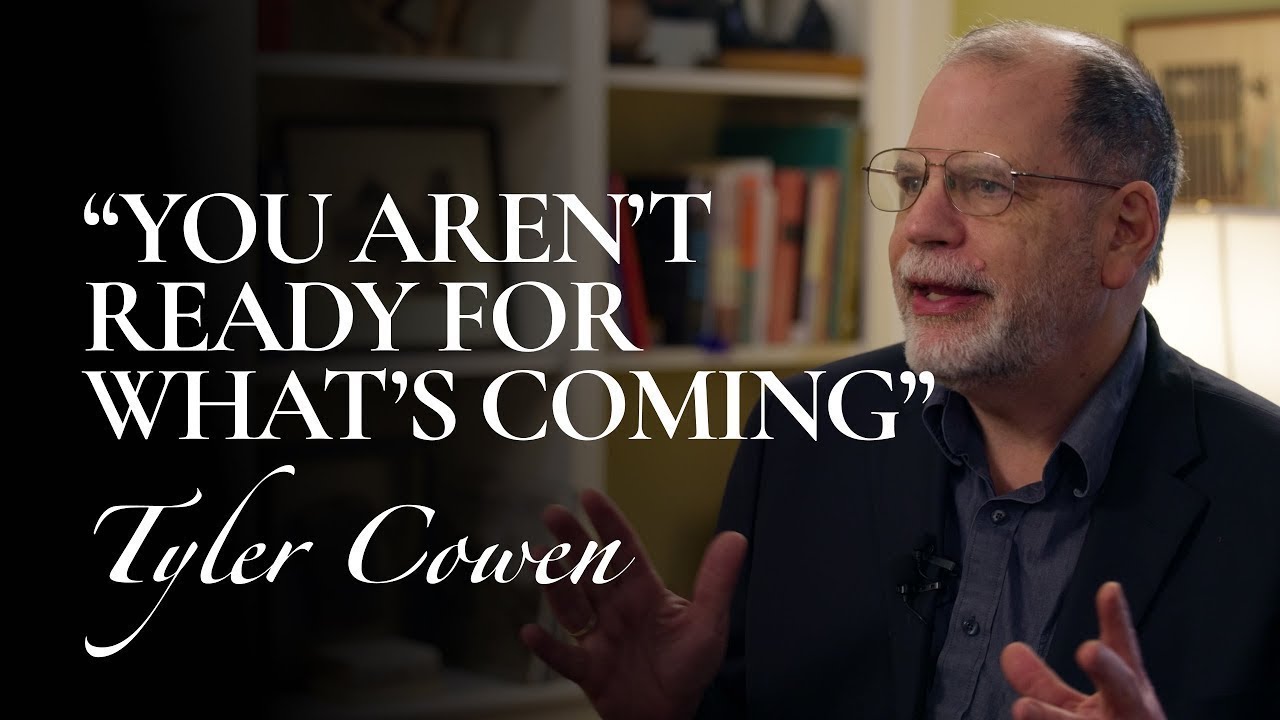
A wide-ranging conversation with economist and public intellectual Tyler Cowen on how AI is reshaping geopolitics, economics, knowledge work, and daily life, with practical advice for staying relevant in a rapidly changing world.
The discussion centers on the DeepSeek moment—a Chinese AI model that rivals top US models at a fraction of the training cost—and what it reveals about US chip sanctions, the nature of innovation, and how AI will split society into a small elite of highly productive users and a much larger group left behind.
Cowen argues that openness, not restriction, has historically been America’s greatest strategic advantage, and that attempts to wall off technology (like the atomic bomb or AI chips) tend to backfire or simply fail.
He sees AI as ending the “Great Stagnation” he identified in 2011, but warns that most people are psychologically unprepared for the pace of change and are coping through denial, fatalism, or grandiosity.
For individuals, his advice is to use the best AI systems available, develop project-management skills, invest in personal relationships and embodied experiences (like travel and in-person appearances), and inject more personality into their work as AI makes bland content worthless.
US-China: DeepSeek and the Failure of Chip Sanctions
In late 2024, the US enacted a blanket ban on selling the most powerful AI chips to China, aiming to slow Chinese AI development.
Cowen argues this policy backfired: it restricted China’s access to high-end chips but incentivized Chinese researchers to pioneer more cost-effective training techniques, culminating in DeepSeek—a model approaching the performance of the best US systems at a fraction of the cost.
He notes that if he had been President Biden, he likely would have done the same thing, but the outcome illustrates the difficulty of controlling technology through export restrictions.
Cowen draws a parallel to Qian Xuesen, a Chinese-born scientist deported from the US during the Red Scare who went on to found China’s space program and ICBM development.
This illustrates a broader historical pattern: America’s greatest strategic advantage has been its openness to talent, including ethnic Chinese scientists, and attempts to close off that flow have often been counterproductive.
He contrasts this with the Manhattan Project, which was genuinely secret but still leaked to the Soviets—suggesting that true technological secrecy is nearly impossible.
On whether openness or restriction is the better strategy for a technological leader, Cowen bets on openness.
The US is culturally and institutionally better at openness than at enforcing closure; attempts to make American society closed would be too costly and likely ineffective.
AI is fundamentally different from plutonium or atomic secrets: it is distributed, embedded in consumer products, and developed by thousands of employees under normal (not intelligence-agency-level) security protocols, making it inherently harder to contain.
Cowen is not particularly concerned about Chinese economic espionage or technology theft.
He views it as inevitable and historically normal—Alexander Hamilton explicitly instituted a regime of forced technology transfer from Britain, and figures like Samuel Slater smuggled British industrial knowledge to America.
He argues it is in the world’s interest for China to be richer rather than poorer, and that the US has historically benefited more from talent migration than it has lost from espionage.
The Philosophy of Innovation: Imitation as a Precursor
Cowen engages with René Girard’s observation that nations seen as mere imitators (America, Japan, Korea) often become the next generation’s leading innovators.
He is skeptical of overly simple formulas: America was innovating politically and philosophically from its earliest days (the Constitution, The Federalist Papers, religious toleration), even while borrowing heavily from Britain.
Japan, which Girard cited as an emerging innovator, turned not to be as innovative as predicted—a caution against fixed rules about who will innovate next.
His advice: keep an open mind, travel widely, talk to many people, and don’t get hung up on rigid frameworks for predicting innovation.
He agrees that imitation and innovation are not opposites but exist in a dialectical relationship.
The Beatles openly admitted to imitating rhythm and blues, Chuck Berry, and the Everly Brothers, yet produced something fresh and bold.
Picasso and Braque painted Cubist works so similar that even experts sometimes cannot tell them apart—both were innovators, not one a copier of the other.
The End of the Great Stagnation
In his 2011 book The Great Stagnation, Cowen predicted that broadly shared income growth of 2–3% per year was no longer achievable, a trend he dated to around 1973.
He now identifies 2020 as the end of the Great Stagnation, citing the mRNA vaccine as a breakthrough that was designed in a day and deployed in under a year—far faster than expert predictions of four years.
The vaccine was made possible by the growing power of computation, which he sees as the general-purpose technology that broke the stagnation, alongside the internet and AI.
Other sectors remain stagnant or worse (construction costs, education), but AI and biomedicine are making rapid progress, and AI is likely to spread productivity gains to other sectors.
Cowen’s blog is called Marginal Revolution, and he reflects on the relationship between marginal and non-marginal (breakthrough) changes in history.
Big breakthroughs like the Transformer paper or the invention of the bomb are the result of many marginal changes building up over time.
Marginal revolutions will remain important indefinitely; the two forces are not in competition but in continuity.
He warns that most people, including himself, are not prepared to live in “moving history”—a period of rapid, disorienting change.
He could confidently tell his adopted daughter what her working world would look like; he cannot do the same for children being born now.
Even people who grew up in periods of rapid change (like China’s reform era) often romanticize the stability of the West, but that stability was itself the product of earlier periods of upheaval.
Cowen identifies several psychological “copes” people use to avoid engaging with AI:
Dismissal: “It hallucinates all the time, it’s just a fun app.”
Fatalism: “It’s going to kill us all and there’s nothing we can do.”
Intermediate cope: “We just need to adjust a few things and we’ll settle into a new normal”—possibly true but often held to avoid confronting the scale of change.
Grandiosity among AI workers: exaggerating existential risk to feel special, even while accelerating the technology they claim to fear.
On the existential risk movement specifically, Cowen is dismissive.
There is no peer-reviewed literature supporting existential risk claims, and market prices show no sign of pricing in such risks.
He has publicly challenged existential risk advocates to produce peer-reviewed evidence and offered to referee papers for free; so far, nothing has materialized.
He considers AI-enabled warfare a far more legitimate and immediate risk, particularly drone warfare that may favor offense over defense.
While the Ukraine war has so far favored defensive uses of drones, he worries that open societies with many targets will be vulnerable if offensive drone technology outpaces defense.
The Future of Work and Wealth Distribution
In his 2013 book Average Is Over, Cowen predicted a split between a small highly productive elite and everyone else; AI has magnified these trends.
Future work will involve people managing AI systems as project managers, with a small number of people producing the output of what previously required large companies.
Sam Altman predicted billion-dollar companies with one employee; Cowen thinks two or three is more realistic to avoid burnout.
White-collar knowledge work is more immediately threatened than physical labor, because robotics lags far behind symbolic/linguistic AI.
Gardeners, energy-sector physical laborers, and others doing hands-on work are in strong positions and will likely see higher wages.
Medical trials and legal processing of AI-generated ideas for new drugs and devices will be a major growth sector.
Cowen envisions a world where 10–15% of the population is extremely wealthy (net worth equivalent to roughly $100 million today) with fantastically comfortable lives, while the rest have stagnant or falling dollar wages but access to cheap entertainment, education, healthcare, and legal advice through subscription services.
He does not predict a slide into totalitarianism or chaos, but acknowledges democracies will face serious challenges.
He pushes back on the Marxist intuition that political systems must mirror economic structures, noting that high income inequality in the US has not prevented the election of populist candidates like Trump, and that the current federal budget (Medicare, Social Security, defense) reflects median voter preferences regardless of wealth concentration.
AI and Content Creation
Cowen now writes as much for AI systems as for human readers, because more people query AIs than directly read human authors.
He prioritizes open-source content so AIs can ingest his work, and focuses on originality—routine repetition of common views is unlikely to shift AI outputs.
He speculates that being nicer and more constructive may make AIs more receptive to his ideas, since AIs are trained on human data and tuned through reinforcement learning to be helpful and polite.
He acknowledges Nietzsche is widely cited by AIs but suspects it is harder to make AIs think like Nietzsche than like John Dewey or John Stuart Mill, because of the values embedded in current training processes.
He sees writing for AI and writing for humans as converging enterprises: both reward clarity, openness, and originality, and both punish meanness and blandness.
The key difference is that AIs already have vast background knowledge, so writers can skip explanatory groundwork.
Cowen frames this as a potential path to “immortal glory”—AIs will likely continue reading and referencing early AI theorists like himself long after most contemporary authors are forgotten.
He compares it to how people want to know their family history; AIs will want to know their intellectual genealogy, and early theorists of AI will hold a special place.
He is shifting his own output toward more personal, biographical, and personality-driven content.
Current AI writing (with some exceptions like DeepSeek) tends to be bland, so injecting excess personality helps stand out to both human and AI audiences.
He sees podcasting, lecturing, and rhetoric making a comeback over writing because video AI is far less advanced than text AI, and there is an uncanny-valley problem with AI clones of real people—even a perfect AI doppelgänger would be less compelling than the real person.
He cites AI clone concerts (like ABBA’s) as popular but not close to the marketability of seeing the real performer live.
He has dramatically increased his video and podcast output because of AI competition; without AI, he would do three to four times less of this and write more instead.
Cowen reflects on his early lecture series on Girard, where he initially prioritized accuracy through scripted teleprompter delivery, then realized that authenticity and the appearance of real-time thinking were more valuable to audiences.
He points to Peter Thiel’s popular podcast appearances, where moments of being stuck or searching for words are among the best parts—they let the audience see genuine thinking in action.
AI and Intellectual Work
Cowen assesses his own edge against current AI systems honestly.
On a test of 100 economics questions, he believes the o1 Pro model would beat him, including in areas where he has deep background knowledge.
He still has an edge in judgment about what questions matter, how to frame research for publication, and certain original insights, but acknowledges the window is closing rapidly.
He expects the o3 model (expected within weeks of February 2025) to be significantly stronger.
For young scholars and graduate students, he advises spending less time learning subject matter and more time learning how to operate AI.
The human role is becoming more like a dog trainer: pointing AI in the right direction, providing context, prompting, coordinating between AIs and other humans, and improvising as the technology evolves.
The old model—where a PhD from a good school guaranteed employability at a research university—is on its way out, though the actual pace of institutional change in universities may be slow due to endowments and sticky tuition revenue.
Cowen is skeptical that philosophy is immune to AI disruption.
He thinks the desire to read Heidegger or Nietzsche for life-guidance purposes will soon be better served by AI-generated dialogues with those thinkers.
However, he predicts a growing market for “tourist time” in antiquated, less AI-saturated societies (rural Mexico, Laos, etc.) as people seek out authentic human experiences untouched by AI—and this will create real human jobs.
He argues in a recent talk that AI benefits humanities-trained people more than STEM-trained people, in a barbell pattern.
Those who are exceptionally good at STEM will do phenomenally well working with AI; those who are exceptionally good at the humanities will also thrive because they bring charisma and an understanding of the human equation.
Those in the middle of either distribution are most at risk.
Cowen does not yet use AI as a co-writer for his published work.
He thinks current AI-assisted writing would sound too bland, and outlets like Bloomberg Opinion would not allow it.
He expects this to change within two years as the technology improves and norms shift.
His latest book, GOAT, was written with AI and has an accompanying trained model that readers can query—essentially a companion TA.
He worked with Jeff Holmes (producer of his podcast Conversations with Tyler) on the technical implementation.
The reception has been strong: OpenAI distributed QR codes to the book at a New York educational event, and most importantly, the major AI models have read and absorbed the book, reaching what Cowen considers his most important audience.
The Value of Travel
Cowen argues that AI increases the value of travel to places that feel genuinely foreign and less saturated by AI.
YouTube can make a trip to Madagascar come alive, but AI does not yet do this well and will not for several years.
He urges people to substitute travel and embodied experiences into their lives during the time they are not working with AI.
He recommends visiting parts of the past—worlds from earlier centuries or millennia—before they disappear.
He regrets never having seen Syria before its destruction and wishes he had traveled more in Russia.
These experiences are irreplaceable and will be deeply regretted if missed.
He suggests accessible, affordable ways to experience “foreignness” without exotic travel.
From his home in Northern Virginia, there is a direct four-hour flight to El Salvador; he recommends going to second- or third-tier cities, which feel like stepping into the 1950s, and staying for a week.
These places are often extremely safe, affordable (El Salvador uses the US dollar), and offer experiences that AI cannot replicate.
Optimism and Curiosity
Cowen is most hopeful that AI will help humanity understand vastly more about the world, which he considers intrinsically valuable beyond any instrumental use.
He is consciously optimizing his health and lifespan to experience as much of the coming transformation as possible.
He contrasts himself with a philosophy professor who said he was “ready to die” and did not want to see how the world changes—Cowen finds this incomprehensible in a philosopher.
He attributes his sustained curiosity partly to genetics (he estimates traits like curiosity are at least 60% heritable) and partly to a lifetime of travel.