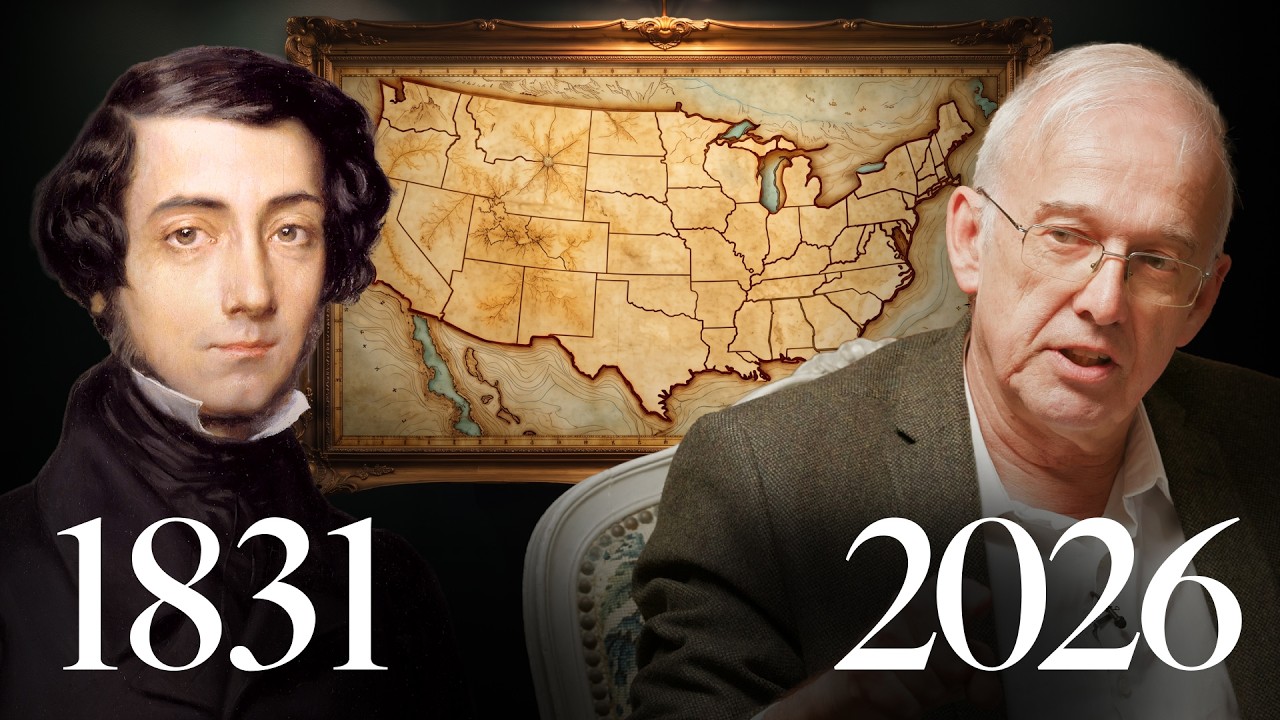
This episode features an interview at the Château de Tocqueville with Alexis de Tocqueville, a direct descendant of the famed author of Democracy in America, who is preparing to retrace his ancestor’s 1831 journey across the United States on the occasion of America’s 250th birthday; the conversation explores the original Tocqueville’s life, method, character, and enduring relevance, as well as the descendant’s own sense of duty and the purpose of the new expedition.
The descendant’s mission: retracing the 1831 journey to test democracy’s health
Alexis de Tocqueville (the descendant) aims to defend democracy and educate the people by redoing his ancestor’s tour, interviewing ordinary Americans across the country to produce documentaries, interviews, and a book.
He is motivated by Tocqueville’s central proposition: nations cannot prevent equality of conditions, but they determine whether equality leads to freedom or servitude, enlightenment or barbarism — a question he believes is more urgent today than ever.
The host (Jonathan) expresses skepticism, citing dramatic declines in jury participation, civil association (per Bowling Alone), decentralized governance, and the “mores” Tocqueville deemed more important than laws — such as the rich no longer hiding their wealth and citizens no longer suffering when excluded from politics.
The descendant acknowledges the worrying trends but retains confidence in human beings; he argues the critical question is what people hold in their hearts — whether they remain ready to manage their affairs, form associations, debate in the press, and insist on truth.
He invokes Tocqueville’s late-life reflection that man, for all his vices and weaknesses, remains “the most worthy object of interest, examination, pity, attachment, and admiration to be found on Earth.”
He emphasizes the role of an elite that considers it worth defending democracy and educating the people — his explicit ambition for the tour — as a bulwark against tyranny or revolution.
Tocqueville’s method: ground-level observation before theory
Tocqueville’s method was to observe and discuss on the ground first, without reading prior literature on a topic, testing his initial impressions against reality before turning to books to nuance and balance his views.
He never prejudged; he was a thinker of facts, not abstraction, which allowed him to make startlingly accurate prophecies — notably that America and Russia would become the two great world powers, a claim dismissed as absurd in 1835 when the U.S. had only 12 million people and 24 states.
A contemporary critic remarked that Tocqueville “began to think before he learned anything,” which the descendant confirms as perfectly true and central to his originality.
Family history and formative influences: survival, honor, and intellectual giants
Tocqueville’s existence was a “miracle”: his parents were imprisoned during the Terror and scheduled for the guillotine two days before Robespierre’s fall; nine members of the Malesherbes family (his maternal grandfather’s line) were jailed, only three survived.
His great-grandfather, Malesherbes, was a minister to Louis XVI, protector of the Encyclopédie and Enlightenment philosophers (Voltaire, Rousseau, Diderot), and voluntarily defended the king at trial, knowing it meant his own death — an act of honor that left a lasting imprint on Tocqueville.
Louis XVI’s final message to Malesherbes: “If I still had my throne, I would have to share it with you to make myself worthy of the half that would remain to me.”
The other towering figure in Tocqueville’s youth was Chateaubriand, his uncle by marriage and the “enchanting” founder of French Romanticism, who had traveled to America in 1791 and shared family theatricals at the Tocqueville estate.
These two figures — Malesherbes (moral courage) and Chateaubriand (literary genius) — shaped Tocqueville’s sense of duty, honor, and intellectual ambition.
Why an aristocrat became democracy’s friend: fidelity to observed reality
Tocqueville saw equality of conditions as a providential movement unfolding since the 13th century: from feudal landowners, to clergy, to lawyers, to philosophes — each step expanding equality.
His virtue was not superior intelligence but greater fairness to truth and better observation; he preferred truth to prejudice and class interest, even when it alienated his own brother (who accepted Louis Napoleon’s coup).
He viewed democracy not as a preference but as an inevitable historical force that had to be understood and guided.
Physically small (1.65 m), prone to severe depressive episodes (three or four in his life), which delayed his political entry.
Psychologically uncompromising: he refused to change his positions for office, resigning all mandates after Louis Napoleon’s 1851 coup and never forgiving his brother who accepted it — writing that their “profound dissidence” caused him more bitterness than “the ruin of liberty, my renunciation of public life, the humiliation of my country, the exile of my friends.”
Wrote 15,000 letters and vast notebooks; the letters reveal a spontaneous, attaching personality — the descendant feels he knows him as a best friend.
Married Mary Mottley in 1836: a “misalliance” (British, older, commoner, no fortune, not considered beautiful), but a profound partnership — she equilibrated his insecurity, read his moods instantly, and managed the household so he could think; he called her “your great art, Mary. You always reconcile me with the world and with myself.”
Loved the Norman people he represented locally; Mary ran the estate (this château) where he wrote parts of his works.
Political career: ambition for country, not vanity; despised the political class
He both adored and hated politics: adored it from ambition to play a first role for others and for France, not personal vanity; hated the “miserable small interests” and small-mindedness of actual politicians.
Briefly served as Foreign Minister for six months during the 1848 revolutions, but his health, weak voice, and refusal to compromise prevented a great parliamentary career.
The descendant believes Tocqueville despised his colleagues in the National Assembly for their petty maneuvering.
Religious views: lost personal faith, but saw religion as democracy’s first institution
At 16, reading Enlightenment authors and Pascal in his father’s library, his childhood Jansenist faith collapsed in “universal doubt,” plunging him into “blackest melancholy” and “extreme disgust of life.”
He never regained doctrinal faith; on his deathbed he accepted a priest for his wife Mary’s sake but told his closest friend Gustave de Beaumont: “I did it for Mary, but I don’t believe in it in my life.”
Yet he consistently valued religion socially, famously calling it “the first political institution” in America because it directs mores, restrains individualism, and sustains self-government.
Vices and struggles: duels, infidelity, insecurity rooted in parental trauma
Fought a duel (forbidden since Richelieu) to defend his honor over a woman; fell ill for four months afterward — seen in democratic times as excessive violence.
Nearly died in the American wilderness (sank in the Ohio River, froze in snow) before a pioneer saved him.
Was not totally faithful to Mary; a severe crisis in 1841 nearly led to divorce and triggered a depression; friends mediated a reconciliation.
His insecurity and doubt stemmed partly from his parents’ trauma: his mother emerged from 10 months in prison (watching daily guillotines) profoundly depressive; his father emerged with white hair at 25, suddenly head of a shattered family.
Tocqueville’s own obsessive drive — thinking “day and night” during the writing of Democracy in America — was fueled by a “passion for success, for being known, for renown” he later called “the little sin which is a habit of writers,” admitting he escaped it less than anyone.
The descendant’s relationship to the legacy: privilege, honor, duty, not burden
Grew up in the château surrounded by archives; from childhood met presidents, monarchs, scholars visiting to study Tocqueville.
Family authorized the United Way of America’s “Tocqueville Society” (major donors) to use the name and coat of arms, leading to annual gatherings where he spoke on Tocqueville’s relevance.
This fostered a conviction that education and transmission create bonds for the future — Tocqueville himself wished to be Minister of Education, not Foreign Affairs, seeing education as the key to the future.
The descendant gives lectures on great French figures (Richelieu, Mazarin, Talleyrand) and interviews thinkers, seeing this as his way to participate in Tocqueville’s educational mission.
He rejects the idea of heritage as burden: “It’s a privilege, obviously. It’s an honor, and it’s also a duty… such a big man… needs to be known above the usual quote that people who haven’t even read him do.”
The planned journey: listening to ordinary Americans and youth to understand deep trends
The expedition will follow Tocqueville’s footsteps, honestly listening to ordinary people and the young generation to grasp profound trends in American society and the technological shifts reshaping it.
The premise: when America faces something, the world soon faces it too; the journey is both homage and a practical effort at education and transmission.
The descendant is confident the project will succeed as a living continuation of Tocqueville’s method: observe first, judge later, and trust that the “confused mixture of good and evil” in human beings still makes them worthy of study and hope.