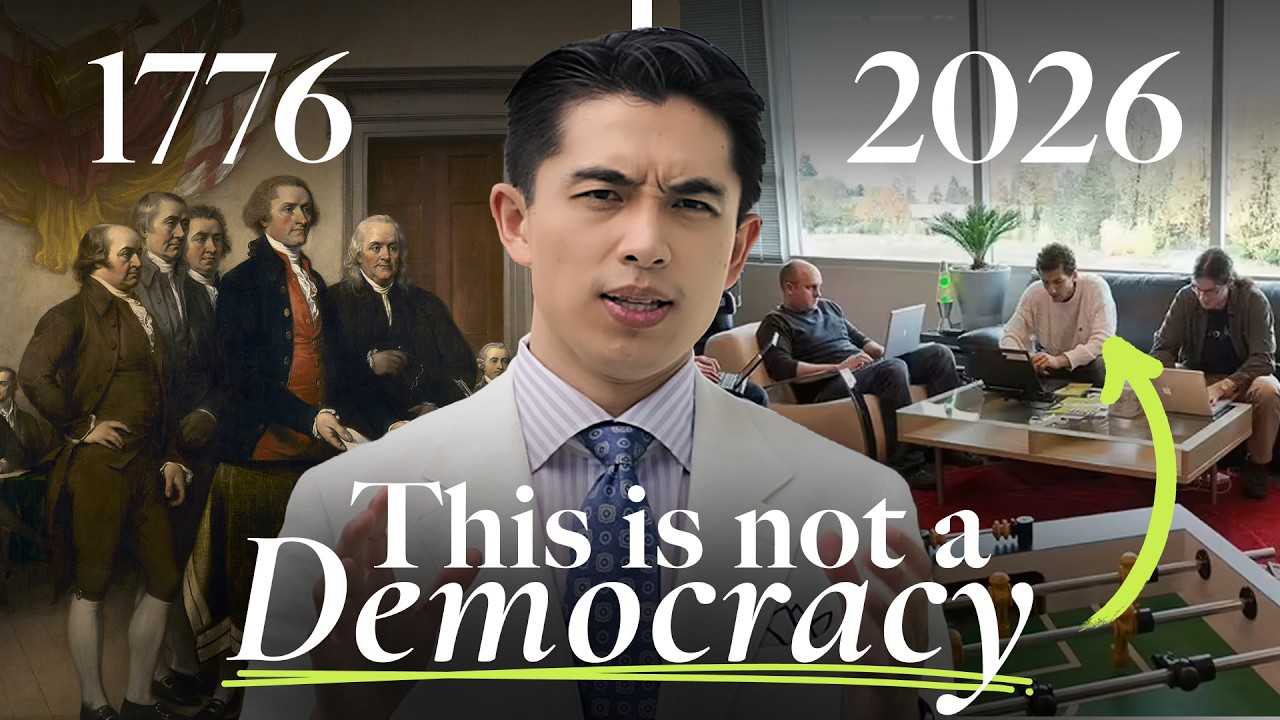
This lecture, delivered at the Château de Tocqueville for America’s 250th anniversary, argues that the United States has undergone a historic inversion: from the most equal nation in Tocqueville’s time to the only Western nation hospitable to greatness today, at the cost of its egalitarian identity and democratic spirit.
The Great Transformation: From Equality to Greatness
Tocqueville’s America was defined by egalitarian mores — social distance between classes was minimal, dignity was granted simply for being human, and the majority’s comfort came at the expense of the ambitious.
Today’s America is defined by radical inequality in its mores: hierarchy is pronounced, standards of excellence are stratified by class, and the “frenzy” of upward mobility drives a minority to extraordinary achievement.
The speaker, a Chinese immigrant who grew up in Canada and Beijing, came to the U.S. not for equality but for this inegalitarian energy that enables greatness; the best and brightest from other wealthy democracies now come for the same reason.
Tocqueville feared democracy would produce “impressive mediocrity”; instead, America escaped that trap but lost its treasured equality and its identity as a pure democracy, increasingly taking on the class features of the aristocracy it once opposed.
Why Equality Hinders Greatness
Envy and the tall poppy syndrome: In egalitarian cultures (Canada, China), envy traffics among equals and suppresses ambition; hierarchy loosens envy’s grip by creating distinct “species” with their own standards of honor and excellence.
Meritocracy as a cage: Tocqueville saw the Chinese imperial exams — equality of opportunity, not outcome — as suffocating greatness because the “competition of all against all” forces utilitarian focus on the next test, extinguishing imagination and taste for revolutionary thought.
Modern China’s Gaokao: The speaker’s experience in Beijing illustrates this: hyper-measured, hyper-competitive schooling from kindergarten, where even learning to code was forbidden because it wasn’t on the exam; youth is lost to “little preliminary exercises.”
American holistic admissions as unequal freedom: The U.S. system’s opacity, legacy preferences, and class-based feeder schools create inequality that paradoxically frees students from the war of all against all, allowing exploration of genuine interests — but at the cost of blatant injustice (e.g., a brilliant rural Egyptian student rejected while privileged peers game the system).
Relative immobility lifts the gaze: In aristocracy, secure possession (for nobles) and despair of acquisition (for serfs) both turn souls away from materialism toward higher undertakings; democracy’s fluid classes intensify materialistic striving.
Pathos of distance: A permanent underclass lets aristocrats conceive a high-minded self-image that elevates all souls; in democracy, the upper class imitates the lower, lowering cultural tone — the peasant in aristocracy is more noble than the rich man in democracy.
Tocqueville’s ambivalence: As an aristocrat, he preferred freedom and greatness; as a moral universalist, he accepted equality as more just and inevitable. Even slavery, which he condemned utterly, produced a pseudo-aristocracy in the South that gave America its greatest founders — a “characteristic ambivalence” that does not lead to inaction but to a project: given democracy’s inevitability, how to preserve aristocratic values within it.
Why Equality Hinders Freedom
Materialism: Democratic citizens prize well-being and safety; a nation demanding only order from government is “already a slave at the bottom of its heart” and can be chained by a despot who delivers comfort. Aristocratic honor is irrationally stubborn and unbribable; democratic freedom is fragile because it can be bought off with iPhones and GDP growth.
Individualism: Distinct from selfishness, individualism severs all social ties — refusing to vote, withdrawing into private life. Equality dissolves the reciprocal obligations of feudalism (lord protects peasant, peasant serves lord), leaving only weak contractual ties; when the worker is fired, he has no superior to appeal to and turns to the state, centralizing power and preparing despotism.
Tyranny of the majority: An all-encompassing thought control more effective than any monarch’s. In Tocqueville’s America, less independence of mind reigned than in aristocratic Europe because: (1) thought policing is ubiquitous — every citizen is politicized and becomes a deputy of the majority; (2) enforcement is social coercion, not violence — the majority says “you are free not to think as I do, but you are a stranger among us,” which is worse than death and prevents contrarian thoughts from forming at all. Russia imprisons dissidents; America has no dissidents because democracy itself is a 24/7 re-education camp.
Totalitarianism as democracy’s outgrowth: Tocqueville was not comparing democracy to totalitarianism but to aristocracy. Democracy paves the way for totalitarianism by: (1) giving autocrats more effective means of social control (the will of the people extends into society); (2) destroying the secondary institutions (aristocratic hierarchies, local loyalties, religious powers) that once halted sovereign power. The reactionaries who want to restore absolute monarchy miss that the world has transformed — their freedoms’ guarantors are gone.
Tocqueville’s Bulwarks Against Equality’s Excesses
The sole efficacious remedy is political freedom: Active participation in governance trains the “muscle of political freedom” and counters individualism and despotism.
Religion and family (private, non-political bulwarks): Tocqueville called religion the first political institution — it facilitates the use of freedom by creating a sphere the majoritarian will cannot bulldoze. The Tocquevillean family, with women wholly restrained to the domestic sphere, forms and transmits mores; the “superiority of American women” lay in their rational willingness to submit. Both have collapsed: religion no longer unifies, and gender roles are incomprehensible today.
Jury (formative over functional): The jury is not good at judging cases; it is a “free school” for jurors, educating them in law and self-governance. Lawyers as a class inject an aristocratic, conservative element that hedges democratic instincts. Today, <1% of cases go to jury (down from 5% in the 1960s), and lawyers’ moral influence has yielded to engineers — who love novelty and disruption, not tradition and deliberation.
Government (checking the will of the people): Tocqueville praised institutions that resist pure popular will: life-tenured federal judges, Washington defying popular sentiment on the French Revolution, the Senate’s original indirect election. Separation of powers holds up, but the Senate is now directly elected, eroding the check.
Administration (decentralized township as freedom’s primary school): Tocqueville distinguished government (great principles) from administration (daily execution). America’s hyper-decentralized townships were “mini feudal fiefdoms” creating local bonds that resist central tyranny. Participation taught citizens “this is your country.” Today, administration is centralized in three-letter agencies (FDA, CDC, EPA); townships have given way to anonymous metropolises where no one participates locally.
Associations and press (social ties and mobilization): Political and civic associations, each with its newspaper, trained the muscle of collective action. Form remains healthy, but substance declines: civic associations are disappearing (“Bowling Alone”), and social media is passive and sedating, not active and mobilizing.
Work (entrepreneurial labor as freedom’s training ground): In Tocqueville’s time, most Americans were agrarian entrepreneurs owning their means of production — developing mores of independence. Today, one-third of working-age men are out of the workforce, and over 90% of workers are employees in large bureaucracies, exercising no political freedom in their daily labor.
America Today: Soft Despotism and Industrial Aristocracy
Soft despotism: The external forms of freedom (laws, rights, voting, judicial tenure) remain intact, but the formative exercises (religion, family, jury, local administration, associations, entrepreneurial work) are gone. The “spirit of freedom” has departed the majority; Americans participate in politics as chore or performance art. The average New York white-collar worker is barely more free in the positive Tocquevillian sense than his Beijing counterpart — both work for transnational bureaucracies, doom-scroll the same platforms, are materialistic, withdrawn, a-religious, and family-avoidant. Checking a ballot every four years cannot train the daily muscle of freedom. Bad laws with good mores work; good laws with bad mores fail. America is in the latter state.
Industrial aristocracy: Tocqueville foresaw industry creating a new aristocracy. The Gilded Age realized it. Markers: exploding private clubs, class segregation in consumption/travel/healthcare/education, divergent mores. The rich no longer hide wealth but flaunt it; vices reveal the divide — democratic vice is understandable excess (Kraft at a $79 massage parlor); aristocratic vice is “sumptuous depravity” (Epstein) that feels incomprehensible to the people. Most critically, the master’s mind expands over a “far-reaching ensemble” while the worker’s shrinks to a single detail — they “have nothing alike, and each day they defer more.”
Ambivalence of the industrial aristocracy: Not a return to hereditary European aristocracy — formal mobility remains, fortunes are self-made (Forbes top 10: none inherited). Good: industrious culture, rule of law, less warlike. Bad: no noblesse oblige (no 500 generations of obligation), tasteless elite ($600B/year philanthropy, no Michelangelo), less generous in soul and body (dodging Vietnam vs. aristocratic sacrifice). History breaks the ambivalence: the political economy (economies of scale, zero marginal cost software, fluid capital) naturally favors this aristocracy; destroying it would require totalitarian force. The choice is not between egalitarian Eden and industrial aristocracy, but between a debauched, irresponsible aristocracy and a moderated, productive one. The task: tame and educate it — teach kings, not just the masses.
The New Aristocracy’s Gifts: Freedom and Greatness
Freedom via secondary institutions: The industrial fiefdoms (billionaire-funded research, mega-yachts in international waters, tech platforms) function as the secondary institutions Tocqueville hoped would resist sovereign power — aristocratic in nature, not democratic, but real. They create space for radical free thought (the no-fly-list extremist funded by an esoteric billionaire; Luther hidden by Frederick the Wise; Marx needing Engels). Their collisions with each other and with government create “power checking power,” guaranteeing freedom not just for a radical few but for all.
Greatness via technology: Technology elevates the industrial class’s sights — mastery requires developed minds, and ambitions expand from saving a penny on the pound (Tocqueville’s merchant captain) to curing disease, colonizing the universe, creating silicon intelligence, radical life extension. Bacon’s aristocracy sought immortality; Tocqueville’s Americans wanted bigger houses; today’s technological aristocracy is back to seeking immortality. Greatness has returned, available to a minority but felt by all.
Existential challenges ahead: AI and genetic selection of children alone will throw our political-philosophical foundations into chaos. The current of history is accelerating. Stewarding technology requires a new political science for a world altogether new — more urgent than the equality/freedom tension.
Conclusion
The speaker delivers a “difficult message” as a foreigner — only foreigners or experience can make certain truths reach Americans, who live in “perpetual adoration of themselves.” It is a love letter to America: not for who she was or wishes to be, but for who she has become.
Rome changed radically — kingdom to republic to empire — yet beauty persisted in each form (Regulus, Cicero, Cato; Virgil, the five good emperors, Christian martyrs). America has changed just as unrecognizably, but new things can be loved.
To egalitarians: “Don’t try it. Don’t try to go back.” To technologists and capitalists: “Tamper your enthusiasm.” All must focus on the monumental challenges of the technological era: resist despotism (not just despots), embed freedom into technology, tame the proud. A new political science is needed for a world altogether new.