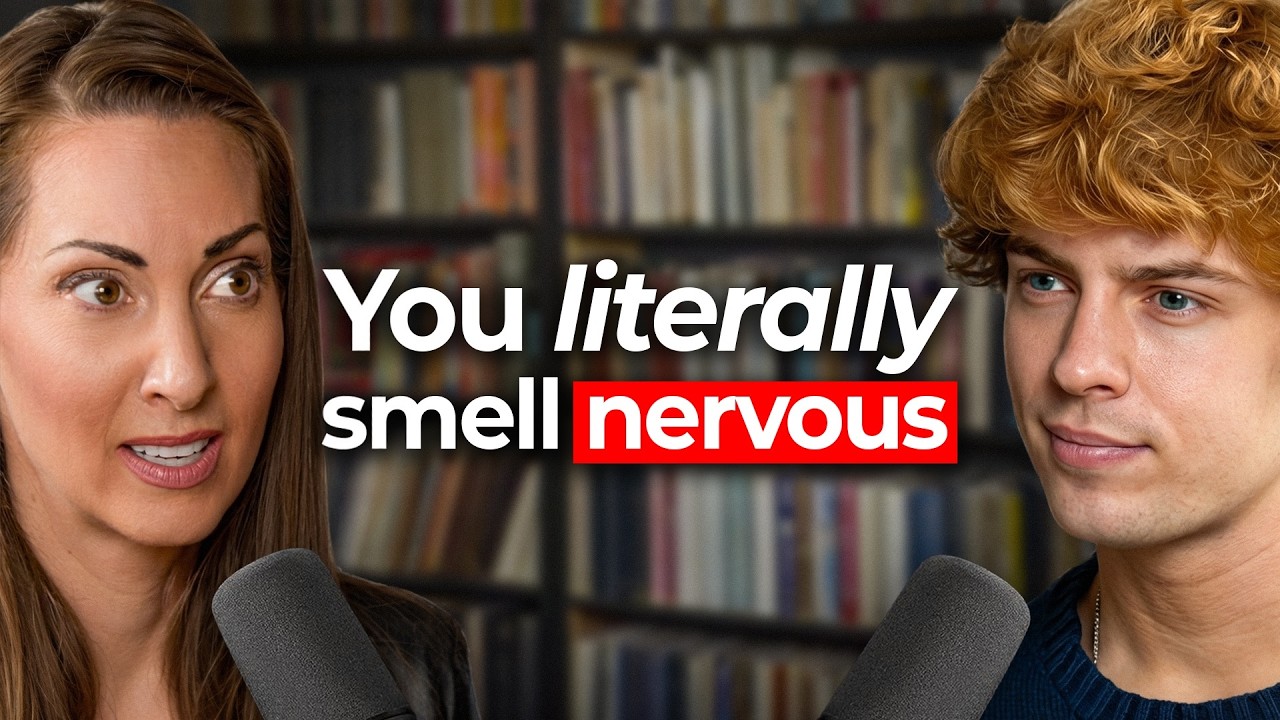
Vanessa Van Edwards is a behavioral scientist and author who studies how micro-signals in body language, voice, and word choice reveal anxiety, insecurity, trustworthiness, and hidden intentions. She argues that most people dramatically under-signal their warmth and intentions, that first impressions are decided in about three seconds, and that small, learnable cues—hand gestures, vocal tone, resting face, eye contact patterns, and conversational habits—have an outsized impact on whether people trust, like, and listen to you. She also warns about “high conflict people” who thrive on drama and manipulation, and she explains how to spot them and protect yourself.
First Impressions Are Decided in Three Seconds
Our brains treat the first three seconds of meeting someone as a rapid safety check: “Can I trust you? Can I rely on you?” If both answers come back positive, the brain can focus on conversation content. If not, the other person goes into fight-or-flight mode—either shutting down or going on the offensive.
A bad first impression doesn’t just hurt you; it actively punishes the other person. Research shows that when someone flashes a cue of social rejection (like an eye roll), the observer’s pupils dilate, their field of vision widens, and they enter survival mode, making it harder for them to think clearly or engage warmly.
Context matters. Meeting someone in a bar or at a networking event feels safer than meeting on a street, because the environment sets expectations. Vanessa deliberately used humor and a shared context (Valentine’s Day balloons) to create instant warmth with Jack.
People often make their first impressions worse by being overly formal because they know first impressions matter. Assuming the other person could be your next best friend or business partner—and letting that assumption bring warmth into your voice and body—is more effective than stiff professionalism.
Know What People Assume About You
Everyone has an “assumption gap”—the difference between how you think you come across and how you actually come across. Vanessa knew Jack would assume she was cold and analytical because of her YouTube content, so she deliberately dialed up warmth in her greeting.
People in high-competence roles (doctors, lawyers, experts) are often assumed to be cold and must work harder to signal warmth. People in warm, bubbly roles are often not taken seriously and must work harder to signal competence.
You can diagnose what people assume about you by paying attention to the first 10 words they say to you. Formal questions (“What do you do?”) signal they see you as competent. Warm questions (“How’s the family? Tell me everything.”) signal they see you as warm.
Vanessa recommends a free diagnostic tool at scienceofpeople.com/charisma where you and people who know you (partner, colleague, friend) take a quiz that places you on a warmth-competence scale, revealing blind spots.
The Body Language That Guarantees a Difficult Life
Disengagement cues: Leaning back, angling your face and body away, answering questions while leaning back or tilting your head back (which signals disdain). These are subtle cues of social rejection that trigger anxiety in others and make connection nearly impossible.
Vocal denial: Small dismissive words or tonalities—“I mean,” “not really,” “seriously?” “no way”—that signal the speaker thinks you’re stupid or boring. People don’t realize they’re doing it, but it immediately shuts the other person down. The alternative is vocal affirmations: “Oh,” “Uh-huh,” “Wow,” “Really?”—sounds that make people feel heard and encourage them to open up.
Resting bothered face (RBF): Vanessa’s own resting face looks sad and doubting because her mouth angles down and her inner eyebrows pinch together. An angry resting face involves permanent furrow lines between the brows. These set a negative baseline for every interaction before you even speak. She manages this with makeup techniques (winging eyeliner outward to look more awake) and conscious awareness.
Listening in disgust: One of Vanessa’s friends crinkles his nose and flashes upper teeth when listening, which reads as disgust. It affects his relationships, but it can’t be easily fixed—even Botox wouldn’t help with the nose.
You Can Literally Smell Fear
In a study, participants who smelled sweat from first-time skydivers (fear sweat) had their fear centers activate in fMRI scans, while sweat from treadmill runners (exercise sweat) did nothing. This means fear produces a detectable chemical signal—possibly adrenaline, norepinephrine, or cortisol—that is contagious.
Vanessa says she can literally smell the adrenaline of people who meet her for the first time, describing it as a metallic, “zingy” smell. This is how she knows she comes across as intimidating before she even speaks. Her response is twofold: put the person at ease, and protect herself from catching their anxiety.
Hands Reveal Trust, Fluency, and Deception
Visible hands signal trust. Hidden hands (under the table, behind the back) feel like someone is concealing something. Palm-to-palm contact (handshakes, high fives, hugs) is a primal signal of openness and safety.
Hand gestures make you a better speaker. In an experiment, people who sat on their hands while telling a story became less fluent and struggled to find words. Gestures help you think and communicate simultaneously.
Liars typically use fewer gestures because they’ve rehearsed their words and their hands don’t know what to do. Truth-tellers gesture naturally because their hands are underlining and emphasizing what they’re saying.
Vanessa tested whether she could lie convincingly while gesturing—and she could. This means gesture alone doesn’t prove truth, but in general, people who gesture are perceived as more fluent, confident, and trustworthy.
On Zoom, people should push their camera back so the tops of their hands are visible and deliberately use gestures, even though the medium has made everyone stiff and formal.
Contempt Is the Single Predictor of Divorce
Dr. John Gottman’s research followed couples for 30 years and found that the single best predictor of divorce was not anger, not frequency of fights—it was contempt. Contempt is a one-sided mouth smirk, often mistaken for boredom or half-smiling. It signals scorn, disdain, and a sense of “I’m better than you.”
Unlike anger or fear, which come in bursts and then regulate, contempt doesn’t go away. It sits and festers, eating away at respect until the couple can barely speak to each other.
Contempt is an opportunity, not a death sentence. When you see it—in a partner, colleague, or friend—you should immediately try to become their ally against whatever they’re contemptuous of. “We hate this together, and we’ll fix it together” is the reframe that saves relationships.
Contempt is often misdirected. The person may actually be contemptuous of themselves, a budget, a situation—not you. Verbally untangling what the contempt is actually about can bring people closer.
High Conflict People Are More Dangerous Than Narcissists
Vanessa argues that “high conflict people” are more prevalent and more dangerous than narcissists or psychopaths. They love drama and specialize in getting other people to act out their drama for them—they’re often one step removed from the conflict itself, making them hard to spot.
Warning signs: They get delight from others’ suffering. They’re annoyed by optimistic questions (“What’s good?” “Working on anything exciting?”). They love to complain and blame others. They bring the same problem to every conversation. They ask for advice but never take it. They know everything.
Vanessa uses optimistic conversation tools not just to create engaging dialogue but as “red flag getters”—if someone can’t or won’t engage with positive questions, that’s a signal.
Helpers and healers are especially vulnerable to high conflict people. Their self-narrative is built around being useful, so they keep trying to fix people who can’t or won’t be fixed. Vanessa tells healers to check whether someone has the capacity to heal by asking about past difficulties and whether they’ve ever overcome anything. If the answer is always “no,” you cannot help them—they’ll take you down with them.
Heroes (high achievers) and healers can form powerful partnerships, with the healer providing emotional support and the hero providing direction. But healers need to learn that they don’t have only to be useful to be lovable—relationships can simply be about enjoying each other’s company.
How to Reclaim Power When Someone Tries to Intimidate You
Non-verbally: Maximize the distance between your ears and shoulders (don’t shrink). Keep space between your torso and arms (don’t block or close off). Claim your physical space.
Vocally: Stay at the lowest end of your natural vocal range. Nervousness pushes pitch upward, which signals weakness. Speak on the out-breath, not while holding your breath—holding your breath creates tightness and vocal fry, which undermines authority.
Negging (backhanded compliments like “You’re not as mean as you look”) is a manipulation tactic. Vanessa’s response is to laugh first (to avoid fight-or-flight), then either walk away or respond with something cold and dismissive. “They’re not your person.”
Intention matters. There’s a fine line between optimizing your behavior and manipulating someone. If your intention is to understand and connect, the same tools are ethical. If your intention is to make someone feel powerless, it’s manipulation. Vanessa once consulted for a law firm that wanted to use her research to make opposing counsel feel small (lower chairs, no armrests, backlighting, warm water instead of cold)—she walked out.
How Much of Personality Is Genetic?
A lot. Research on facial structure shows that introverts and extroverts have measurably different facial features, likely shaped by hormone exposure in the womb. The same is true for perceived competence, agreeableness, and neuroticism.
Extroverts use more gestures, more facial expressiveness, more vocal dynamism, and bigger movement ranges. Introverts use less of all of these. But this doesn’t mean introverts can’t be charismatic—they just express it differently.
If you know you’re introverted and people tell you you’re cold or intimidating, you can deliberately dial up warmth cues (especially in the first impression) without changing who you are. The research is clear: high competence without enough warmth leaves people feeling suspicious.
Signal Amplification Bias: Why Smart and Attractive People Fail
Humans assume their thoughts, feelings, and intentions are obvious to others. They’re not. This is “signal amplification bias.”
Smart people think everyone knows how smart they are, so they under-signal warmth and wonder why people don’t trust them. Attractive people think everyone knows they’re interested, so they under-signal approachability and wonder why no one approaches them.
Dr. Monica Moore’s research found that less attractive people who signaled a lot (more than 10 glances, sometimes 17+) were approached more often than attractive people who signaled very little. Two or three glances aren’t enough.
To guarantee you’re never approached: look at your phone constantly, wear AirPods in both ears, never make eye contact, angle your body away, keep your feet in a closed position, cross your arms, and glance at people furtively.
Eye Contact Is More Complicated Than You Think
There’s a heated debate about eye contact. Western culture demands it, but for many people (especially those on the autism spectrum), eye contact is distracting and makes it harder to think and process language. This is called “gaze aversion affecting cognitive load”—a studied phenomenon where looking away is necessary for cognitive processing.
The popular myth that looking up and to the left means someone is lying is not reliable. Vanessa’s own research found no consistent pattern. People process memories and construct thoughts in different directions, and even handedness can reverse it.
Liars often make more eye contact, not less, because they’ve rehearsed their lies and are watching your face to see if you believe them. Truth-tellers often look away because they’re accessing real memories.
Vanessa wishes there were more research on how to be charismatic without constant eye contact, because many of her students struggle with it and the current cultural answer (“just make eye contact”) doesn’t work for them.
People Reveal Their Insecurities Through the Labels They Use
People who insist they are a certain way are often the opposite. “I’m so nice, I’m taken advantage of”—these people are often secretly mean. “I’m so spontaneous and go with the flow”—these people are often control freaks. The label is a wish, not a reality.
The words people use about themselves, others, their pets, and their environment reveal their internal ruminations. Vanessa theorizes that people who speak harshly to their dogs are harsh with themselves, while people who speak sweetly to their pets are kind to themselves.
Zoom backgrounds, car trunks, and personal spaces reveal personality patterns. High neurotics (people who approach life through worry) love motivational quotes, affirmations, and inspirational posters—they’re constantly reassuring themselves that they’ll be okay.
One Piece of Advice: Talk to People More
Conversation is a muscle, and we’re losing it. Social media, email, and one-directional communication (podcasts, videos, lectures) don’t give you the feedback loop you need to stay socially fit.
Real, in-person conversation is the only way to get the full cocktail of dopamine (I love talking to this person), oxytocin (I feel connected), and serotonin (I belong and can be myself).
Vanessa’s final advice: Have more conversations—with people who matter and people who don’t. Ask optimistic questions even if they feel “cringe.” The wrong person will reject you (which is useful information), and the right person will light up. Treat conversation like going to the gym: regular reps keep you socially fit and inoculate you against a future where we stop talking to each other entirely.