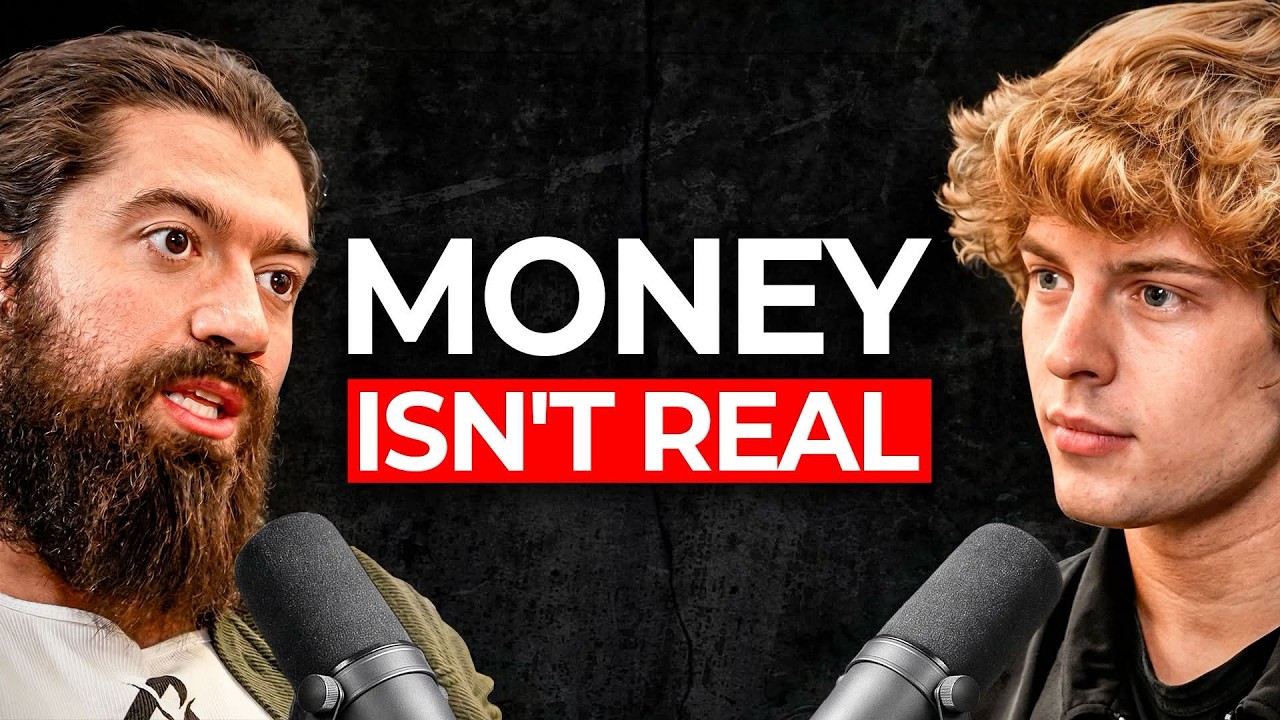
Alex Hormozi joins Jack Neel to discuss fatherhood, making money in 2026, AI’s impact on business, the nature of shame and respect, and what changes as you get older. He’s approaching the birth of his first child with a characteristically analytical mindset while admitting some things can’t be optimized. He also breaks down exactly how he’d go from zero to $100,000 in 3 months with no network, explains why most businesses don’t actually fail, and shares his framework for truth in marketing and communication.
Becoming a Dad Without Losing Yourself
Alex is about to become a father and admits he hasn’t overthought it, partly because Leila’s body is changing far more than his life is right now. He deals with things as they enter his queue.
He sees the nature-nurture split as roughly 50/50 and believes children learn primarily through modeling and direct teaching via demonstration and repetition.
The hardest questions for him aren’t tactical, they’re definitional: what does a successful parent look like, and what does a successful child look like?
Judging by outputs is tricky because some people with terrible upbringings become hugely successful.
He’s skeptical of “I just want my kid to be happy” as a definition of success because chasing happiness directly is self-defeating. Happiness tends to show up as a consequence of being useful, not as a goal in itself.
The skill he most wants to teach his child is courage, because it’s the gateway trait to everything else. Without courage, every other skill is neutered by fear.
Courage means acting in accordance with your values despite short-term aversive consequences.
Learning, failing, being wrong, being made fun of, all require courage.
He wants to equip his child with as many life skills as possible so they can navigate the widest range of environments and conditions.
How to Make $100K in 3 Months Starting From Zero
Alex argues it’s never been easier to make money because AI and digital tools give enormous leverage to people with work ethic and skill. Barriers to entry are flattened. But it’s also more competitive than ever, like The Wire’s “the game’s the same, just more fierce.”
If he had to go from zero to $100,000 in 3 months with no network, no connections, and no employees, here’s what he’d do:
Step 1: Start with an offer that already works for a specific local business. He used a weight loss challenge for gyms because he knew the economics.
Step 2: Record ads on his phone.
Step 3: Push ads to a landing page (even just a Google Sheet).
Step 4: Call every lead personally to schedule them.
Step 5: Meet the leads, present the offer, and collect payment.
Step 6: Let the business deliver the service. He kept the cash as an affiliate.
The key insight: when it’s hard to get a customer, that customer needs to be worth a lot. Don’t think about scalability first. Think about maximizing revenue per customer, even if the method is unscalable.
He literally did this after losing everything and made $100,000 in his first month back.
He targeted the most empty facilities because he knew he could fill them within 3 weeks.
For someone with basic AI skills today, he’d approach businesses and offer to observe their operations for free, then present an AI plan that saves them at least $100,000 in exchange for 20-30% of the verified savings. Nothing upfront, pure performance-based.
The real bottleneck isn’t opportunity, it’s that people lack skills and won’t do the work. Making money is straightforward: learn to do something, then do it for someone who doesn’t want to learn it.
Most time is wasted on everything that isn’t the work. The core activities that generate money are: let people know you exist, make them an offer that solves a specific problem, get their agreement, exchange money for service, deliver. Everything else is noise.
People get paralyzed trying to pick the perfect business. Almost no one’s first business is their last. The goal of a first business is to learn how to market, sell, deliver, hire, fire, and train.
AI, Content, and What Can’t Be Replaced
AI has allowed Alex’s team to triple their content output with the same headcount, producing over 1,000 pieces per week.
But AI doesn’t replace judgment. Models are agreement-biased and will confirm bad ideas. A good decision still has more leverage than AI itself. There are older businesspeople who don’t use AI making more money than kids who do.
What AI can’t replace: someone has to take responsibility and make the call. AI can’t start an LLC, file taxes, or be held accountable. Risk is the uniquely human contribution.
For content and education, stakes matter enormously. AI can easily replicate low-stakes content (entertainment, general information), but high-stakes advice requires proof of credibility.
Someone could copy Alex’s exact content word for word and it wouldn’t work because they lack his proof: a $46 million exit, a $250 million portfolio, 300 million in real estate.
The question before anyone invests time in your content is “Why should I listen to you?” AI can’t answer that for high-stakes domains.
Reality TV and human-driven content have a moat because people want to see real humans facing real stakes. Mr. Beast’s $5 million island competition only works if the money is real and the people are real. Robots competing for fake money would be unwatchable.
Content that compresses time performs well because it gives people a deal: 10,000 phone calls compressed into three lessons, or 13 years of business wisdom in an hour. People are trading time and want the best return on that investment.
Why Most Businesses Don’t Actually Fail
Most businesses die because the entrepreneur quits, not because the business model was fatally flawed. Businesses evolve, change models, pivot. That’s normal.
The real failure mode is never starting. Alex tells a story about a college-aged friend who, six months after saying he’d start a business, was still working on setting up his LLC. That’s not starting.
Service businesses especially shouldn’t fail because they can always be collapsed down to one person doing the work. The business only dies if you stop.
Physical product businesses have harder economics because of upfront costs, which is where pricing, branding, and distribution matter more. But that’s further down the road and not why most people fail.
Alex genuinely doesn’t know many people who have failed at business. He knows many who changed businesses repeatedly. Most people just don’t start.
The Book Launch That Added 70,000 Users in a Weekend
When Alex launched 100 Million Dollar Money Models, the smartest thing almost no one talked about was that he gave away the book’s content inside his platform School and offered 90-day free trials.
70,000 people signed up in a single weekend.
School lets anyone start a community and accept payments in 30 seconds without needing an LLC.
He also accidentally exposed a flaw in TikTok Shop’s payout system. A bug made it look like Alex was withholding $17 in affiliate commissions when it was actually a customer refund reconciliation issue. The story went to the top of TikTok and they fixed the flaw. His volume was around $350,000 per week in book sales at the time.
The Downside of Becoming a Billionaire
The pattern of behavior that creates financial success, constantly asking “what’s wrong, how can I fix it, how can this be better,” creates a chronic sense of deprivation. By the time you achieve a goal, you’ve already raised the bar.
Alex has a team member who jokes that if something goes great, he should have gone harder, and if it goes badly, he messed up. There’s no good outcome.
The skill is learning when to use that pattern and when not to.
On winning the lottery: at 20, Alex bought a Powerball ticket and felt genuine dread at the thought of winning because it would have robbed him of the chance to prove to himself that he could build something. Now that he has the proof and the skills, a billion dollars would just be a lump sum to move five years forward.
The magic card he references is “Burning Wish”: “They wish for a weapon, but not for the skill to wield it.” Most lottery winners lose everything within five years because they lack the skills to manage it.
His child will essentially be born into winning the lottery, and he’s thinking hard about how to make sure they feel they’ve earned their place. He’s considering whether to adjust their lifestyle so their view of reality stays accurate.
Most millionaires are self-made, not inherited, because inherited wealth distorts your model of reality.
He wants his child to know he’s proud of their effort above all, and if it’s a son, that he doesn’t have to beat his father to be worthy.
Shame, Respect, and What Men Actually Need
Shame is a real feeling, but it’s about breaking other people’s rules, not your own. Guilt is breaking your own rules. Shame is a social enforcement mechanism: break the group’s rules and you get ostracized, which in evolutionary terms could mean death.
Shame has legitimate uses. If someone does something that hurts people, they should feel ashamed. It’s a powerful prosocial punishment mechanism.
The problem is that the stakes are no longer life and death, but the feeling is just as intense.
Someone with no shame would be freer to think from first principles, which is why many successful entrepreneurs have reduced social feedback loops. To get outsized outcomes, you have to be willing to do things most people disagree with.
Larry Ellison’s framing: if you do what everyone disagrees with, either they’re right and you’re wrong (most of the time), or they’re wrong and you’re right, and that’s where you make tremendous money.
Shame doesn’t pay off in innovation, but it’s valuable for social cohesion.
On what makes men feel addicted to a woman beyond looks: it comes down to respect, specifically a woman who believes in him more than he believes in himself.
Surveys show more men would pick respect over love if forced to choose, and vice versa for women.
Respect means allowing someone to maintain their original function, showing deference, reinforcing them for who they already are.
Small behaviors matter: making dinner, rubbing his back when he’s stressed, clearing plates, asking if he wants a drink. But above all, the one thing is having someone who on his worst day says “you’ve got this.”
That statement only carries weight if it comes from someone he respects. Many men are married to women they love but don’t respect, which undermines everything.
A good partnership, business or marriage, requires aligned goals and agreed-upon behaviors for achieving them. If both people act as guardrails, the ball goes straight. If you want different things, you’ll both compromise and both be miserable.
The Whole Truth About Money
Money isn’t a deep mystery. It’s a generalized means of exchange, a unit of measurement for value. You don’t “make” money; you earn it by giving value. If value exchange is equal, no money needs to change hands. Money only enters when the exchange is unequal.
Most confusing financial content online uses vague, mystical language because the creators can’t be clear in observable terms. They confuse people with rhetoric because they can’t give actionable instructions.
The rarest and most powerful marketing message is the whole truth. Alex gives an example of a day trading course seller who initially gave a polished pitch. The real story was that trading ruined his life: he couldn’t sleep, lost weight, couldn’t date, and watched his health collapse the same way his father’s had. The compelling marketing message is: “Trading ruined my life. It’s the only thing I’m good at. If you want to make enough money to ruin your life, here’s how I did it. My hope is you make enough to stop.” That’s believable because it’s true.
Alex defines terms aggressively in every conversation because communication only works when both parties agree on what words mean. Every legal contract starts with definitions for this reason.
When someone asked him to be “kinder,” he asked what that meant. It turned out they just wanted him to phrase statements as questions. He did it immediately because it cost him nothing.
Words like kindness, empathy, energy, and vibe are used constantly but rarely defined. Until you define them, you’re just making noise at each other.
What Changes When You’re 85
Alex regularly talks to his 85-year-old self, Solomon. The question: what does he understand now that he couldn’t see when he was still chasing?
Specific numbers did change his behavior, but only because they changed his day-to-day life. If achievement doesn’t change how you live, it was pointless. He defines goals almost exclusively by what they’ll change about his daily experience.
He hasn’t had a magical revelation that it “wasn’t worth it.” The things he hoped would be true, becoming more useful and helping more people as he gained leverage, have been true.
At 85, he expects to still value being useful, but the form will change. Skills like pattern recognition, teaching, and explaining get better with age, not worse. Historians peak later than any other profession because their value is contextual pattern recognition.
The biggest maturation has been accepting that you cannot have it all. Every decision is a trade-off. Young people are obsessed with optionality and independence, never wanting to commit. But options only have value when they’re used, like money only has value when it’s spent.
If you die with a pile of money you never spent, you wasted your life.
Commitment means cutting off alternatives because something else is more meaningful. That’s a sign of maturity.
Some options have expiration dates. If you wait too long to have kids, that option disappears. If you sit on the sideline forever, you get neither the novelty you wanted nor the loyalty you needed.
You can’t have a house with a mountain view that’s also on the beach that’s also walking distance from shopping. These things exist in different places. Wanting everything and refusing to sacrifice anything is how you end up with nothing.