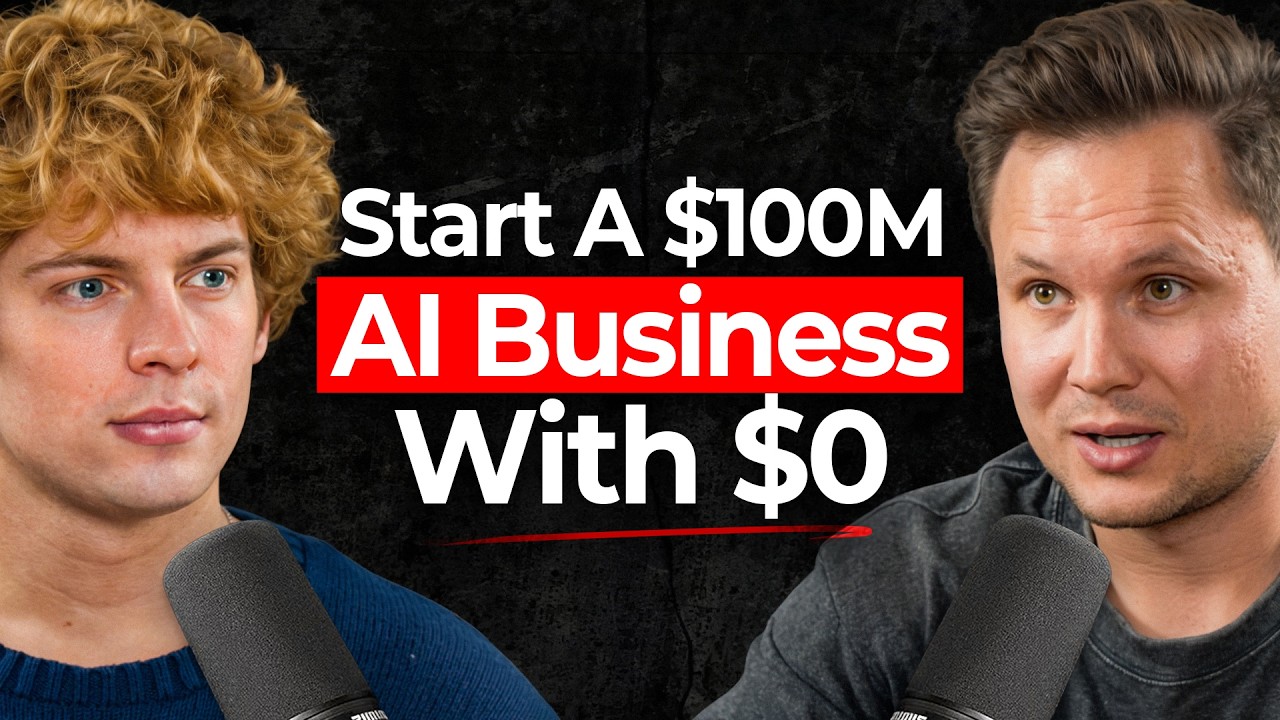
- Nazi and Kazi are college dropouts and co-founders of Poppy AI, a visual AI workspace built for content creators. They scaled it to a $100 million valuation in about 11 months, reaching $6M+ ARR, by combining deep expertise in both coding and content creation with an unconventional marketing and pricing strategy. This episode breaks down their step-by-step blueprint for building AI tools that go viral, their philosophy on founder-product fit, hiring, and why they believe 2026 will create more millionaires than any year before.
How Poppy AI Was Built and Scaled
-
Product-founder fit over product-market fit
- The founders built Poppy to solve their own problem: they loved digital whiteboards (like Miro) but were constantly switching between those, ChatGPT, and Google Docs when creating content.
- Poppy combines a visual whiteboard with built-in AI so creators can drop in a YouTube video or LinkedIn post, connect it to AI, and generate viral scripts—all in one space.
- They used it themselves every day before showing it to anyone, which gave them “psychotic levels of conviction” even when early feedback was negative.
-
MVP in 2 weeks
- They shipped a working prototype in about two weeks using their own coding skills.
- For non-coders today, tools like Cursor, Lovable, or Bolt can build an MVP fast, though real coding knowledge helps at scale.
-
Early marketing failures
- They tried everything with their own audiences: YouTube (1M+ subscribers), Instagram (150K each), email lists (300K people), webars, and influencer shoutouts.
- Result: zero sales. At one point they were two months away from bankruptcy, burning $40K/month with only $9K left.
- Their own large audience was actually a disadvantage—it gave them “statistically significant evidence the product sucked” and nearly killed the company.
-
The breakthrough: one TikTok video
- Nas reached out to a small creator (~30K followers) who genuinely loved Poppy.
- She made a 3-minute vertical long-form tutorial (unusual for TikTok) showing exactly how she used it, starting with the hook: “This website feels illegal to know.”
- The video got 1.5 million views and generated $150K in 1–2 weeks (~$10K per 100K views).
- Key insight: it wasn’t flashy or attention-hacked—it was a deep, authentic walkthrough focused on the problem it solved.
-
Onboarding calls as a growth engine
- After the first wave of sales, the founders did 200+ one-on-one onboarding calls over two weeks (8 a.m. to midnight, back-to-back).
- They acted as consultants: teaching customers how to use Poppy for their specific use case and leaving them with a finished asset (script, newsletter, etc.).
- They collected data on every customer—why they bought, what words they used to describe themselves—and fed that directly into their sales page copy.
-
Pricing strategy: yearly subscriptions at $98/year
- Instead of $10–50/month (standard SaaS model), they charged $98/year and initially offered no monthly option at all.
- This gave them ~8x more cash flow than typical monthly pricing, letting them reinvest in product and hiring.
- It also made affiliate commissions meaningful ($80+ per sale vs. $2–5), which attracted creators willing to promote on commission alone.
What Creators Get Wrong When Launching Products
-
Building for an audience instead of themselves
- Most creators copy trending products or build what they think will sell, rather than solving their own problem.
- If you don’t use your own product daily, you won’t have the conviction to push through failure.
-
Giving up too early
- Kazi and Nas tried dozens of strategies over months with no traction. The winning strategy (affiliate TikTok) came after nearly going broke.
- Lesson: “If it works for you, there is somebody like you out there. Do not give up.”
-
Over-reliance on big influencers
- Big creators often charge upfront fees and don’t convert well because they don’t genuinely use the product.
- Smaller influencers are more flexible, often underpriced, and convert higher because their content feels authentic.
- Ali Abdaal’s paid partnership video barely converted; Vanessa Lau’s (smaller creator) converted extremely well because she demonstrated a specific, personal use case.
How to Make Viral Hooks and Content for AI Tools
-
Reverse-engineer your sales page from customer language
- Every Poppy customer fills out a form explaining who they are and why they bought.
- The founders used this data to discover which words drove the most revenue: “content creator” ($100K/month), “founder” ($40K), “copywriter” ($10K).
- Their headline—“Made for founders, marketers, and copywriters”—is literally ordered by revenue impact.
-
Replicate what worked, but only with genuine users
- They tried to replicate the viral TikTok with other influencers and it failed—until they found someone who truly loved the product.
- Rule: never do a deal with someone who doesn’t genuinely use and love the product, regardless of their following size.
-
YouTube converts more consistently than TikTok or Instagram
- For Poppy, YouTube delivers ~$1,000 per 1,000 views; TikTok and Instagram are much more random.
- Most of their influencer relationships start via Instagram DMs, but the content that converts is on YouTube.
How to Get Influencers to Promote for $0 Upfront
-
Have them use the product first, pitch second
- Reach out, get on a call, show them how it helps their specific workflow, let them use it for free.
- Only after they love it do you propose an affiliate deal (commission-only).
-
Use case studies to recruit more affiliates
- After the first successful TikTok, they turned it into a case study and shared it everywhere.
- Existing customers started becoming affiliates on their own, replicating the formula.
-
Price high enough to make commissions worth it
- At $98/year, an affiliate earns ~$80+ per sale. At $10/month, they’d earn $2—not worth their time.
- This is why monthly pricing kills affiliate programs.
The Founders’ Background and Relationship
-
Met through Instagram in 2019 when Kazi reached out to Nas (who ran a popular Python coding channel). They collaborated on a JavaScript course, and Kazi moved from Michigan to California for what was supposed to be a one-week trip—it turned into a month, then permanently.
-
Built Clever Programmer together (a coding education YouTube channel with 1M+ subscribers), then spent a year apart pursuing separate ventures before reuniting to build Poppy.
-
“Broke up with their girlfriends” to move to San Francisco—partly tongue-in-cheek, but the point was about removing comfort and distraction to go all-in on building.
-
They’ve never had a major argument as co-founders. Their personalities are complementary: Nas takes things from 0→1 (ideation), Kazi takes things from 1→100 (execution and scaling).
Hiring and Culture
-
Culture fit over skill match, always
- They’ve repeatedly hired skilled people who were a culture fit mismatch, and it always destroyed value (e.g., a salesperson who closed $80–100K but caused mass refunds and internal conflict).
- No thumbs-up/thumbs-down emojis allowed on their team—only flame and 100 emojis.
-
Hire people who “run through walls”
- Their head of partnerships (Lance, formerly from Target) and operations lead (Amanath, who started as a student in their free Facebook challenge) were hired for energy and values, not résumés.
- The best hires anticipate needs and make decisions aligned with the company’s mission without being asked.
-
Hiring a key developer took 6 months of persistence
- Nas found a developer on Discord, stayed in touch weekly for 6 months, and closed him with a 45-minute video painting the vision of Poppy and why being a “number two” at a breakout company could be more impactful than being a founder.
Other AI Tools They Recommend (2026)
- Claude (Opus 4.5 with deep thinking enabled) — better reasoning, writing, and decision-making than ChatGPT in their experience.
- Cursor — best AI coding tool for developers.
- Lovable — best for non-coders to build apps by describing what they want.
- Notion — used across their entire company for operations, hiring (cross-referencing interview transcripts against a culture-fit scorecard), and knowledge management.
- Airtable — used for expense tracking (with an AI agent named “Bobby” that auto-categorizes every expense, replacing a $2–3K/month bookkeeper).
AI Predictions for 2026
- Physical AI automation (Tesla-style robots) will handle cleaning, cooking, and other repetitive tasks, freeing people to focus on creative work.
- Lifespans will extend dramatically (150+ years) due to AI-driven medical breakthroughs, with cancer treatments becoming over-the-counter.
- Neural interfaces (like Neuralink) will create “superhuman intelligence” by connecting AI directly to the brain.
- AI will not destroy humanity—historically, every major technology (electricity, tractors, the internet) created more jobs and improved lives despite initial fear.
Best and Worst Advice They’ve Received
- Best advice (Naz): His mother told him: “Either do something you love and make no money, or do something that makes you a fuckton of money—there’s no in between.” He chose to work for free at a startup for two years, which set up his entire career.
- Best advice (Kazi): “Relentlessly chase your curiosity.” This came from his father and ex-girlfriend, and it’s what led to Poppy.
- Worst advice (Kazi): “Validate your idea with money—if you can’t sell it quickly, it’s bad.” This would have killed Poppy, since they had zero sales for months. Also, the “discipline is freedom” / rigid routine advice didn’t work for his spontaneous personality type.