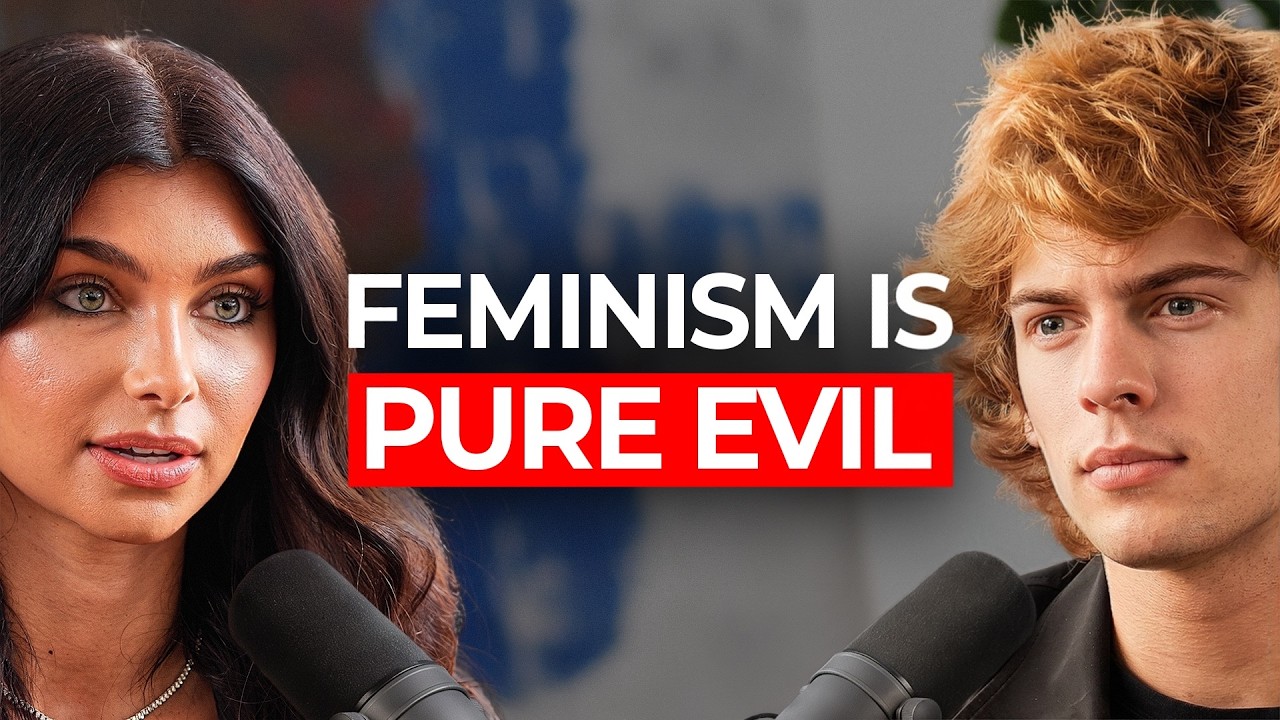
Savannah Faith Stone is a 20-year-old former model and pageant competitor who rejected feminism, left the entertainment industry over moral concerns, and now advocates for traditional Christian marriage and gender roles online. She grew up in Florida, competed in Miss Florida Teen USA, and was offered a million-dollar film role that she turned down because it required a nude scene. She married at 18, credits her husband and faith for her ideological shift, and now uses social media to argue that feminism has harmed women by pushing them into the workforce, destroying the nuclear family, and replacing spiritual values with materialism and sexual exploitation.
Why Gen Z Women Identify as Feminists
Most women call themselves feminists without understanding feminist history or ideology — they simply repeat what media, celebrities, and news outlets tell them, and feel social pressure to identify as feminist to avoid being seen as betraying women.
Gen Z women specifically tie every modern freedom — sexual empowerment, abortion, independence — to feminism, so rejecting the label feels like rejecting their own autonomy, even though Savannah argues feminism hasn’t actually granted women any new rights that didn’t already exist.
Women already had the right to work, speak publicly, and divorce before feminism — the telephone industry hired women immediately in the 1800s, wealthy women could do whatever they wanted, and class and race were bigger barriers than gender. The only real financial change was that women can now be held personally liable for debt, which Savannah sees as a negative.
The Real Origins of Feminism
The 19th Amendment was not a grassroots movement — most women didn’t want the right to vote. In Massachusetts, out of 575,000 women, only 4% voted in favor of suffrage. The anti-suffragist movement was actually larger than the pro-suffragist movement, but it has been hidden from history.
The amendment was funded by ultra-wealthy elite families. Alva Belmont, who received a $10 million divorce settlement (~$390 million today) from the Vanderbilt family, became the biggest financier of the National American Woman Suffrage Association. Her second husband was trained by the Rothschild family. Phoebe Hearst and other wealthy elites also funded the movement.
The elites wanted women to vote because they knew men would never support left-wing issues like abortion, DEI, and transgenderism. Women were seen as more emotionally driven and easier to manipulate politically. Anti-suffragists predicted that women’s suffrage would lead to declining birth rates, broken families, and the demonization of men — all of which Savannah says have come true.
First-wave feminism had deep roots in witchcraft and occult practices. Gloria Steinem’s Ms. Magazine in 1972 featured the Hindu goddess Kali, known for the destruction of men. Early feminists practiced Dianic Wicca and sex magic — orgies involving psychedelics to summon spirits. They rejected Christianity because they saw God the Father as patriarchal.
The waves of feminism progressed from voting (first wave) to sexual revolution (second wave) to abortion and birth control (third wave) to LGBTQ, transgender ideology, and DEI (fourth wave). Savannah argues each wave further eroded women’s uniqueness and pushed men into women’s spaces.
Why Feminism Has Made Women Unhappier
The happiest women are married mothers with children, yet over 50% of women ages 20–39 are now childless and unmarried. Female happiness has been in steady decline since feminism’s rise, a phenomenon called the “paradox of declining female happiness.”
Feminism created a gender war between men and women — the sexes have never been more divided, with each blaming the other for their problems.
Women can no longer define what a woman is. In 2022, Cambridge Dictionary changed its definition to include anyone who “identifies as female,” and Merriam-Webster followed suit. Biological men are winning women’s sports, being named Woman of the Year, and entering women’s bathrooms — all under the banner of feminism.
Government welfare programs have replaced the husband — Savannah references the Obama administration’s “Julia” prototype, a fictional woman who received all support from birth to death from the government, promoting the idea that women don’t need marriage or family.
The Dark Side of Planned Parenthood and Abortion
Margaret Sanger, founder of Planned Parenthood, was a eugenicist who wanted to create one “perfect” race. Planned Parenthood was marketed heavily toward Black women, and today Black women receive the most abortions.
Sanger fabricated the story that her mother died from having 18 births — her mother actually died of tuberculosis. The story was used to push birth control and abortion as necessary for women’s health.
Savannah believes abortion “rots your soul” spiritually and causes physical harm including infertility. She references unverified claims from the Epstein files about fetal organs being harvested for anti-aging serums used by Hollywood celebrities.
How Pop Culture Pushes Feminism on Young Women
Sex and the City is the most damaging show for modern women — it glamorized the “girl boss” lifestyle of sleeping around and avoiding commitment. Its creator, Candace Bushnell, later regretted prioritizing her career over marriage and family and warned women the show was a fantasy.
Other influential shows include Gossip Girl (high schoolers portrayed as wealthy, sexually active “girl bosses”) and She’s the Man (a woman only succeeds by pretending to be a man). These shows normalize the idea that women must be like men to be valued.
Music carries feminist messaging — Taylor Swift’s entire catalog is breakup songs about different men, and her song “The Man” complains that she couldn’t succeed unless she were male. Savannah notes that only artists with approved messages rise to the top, and now Sabrina Carpenter has replaced Swift as the voice of female empowerment through songs that mock men.
Doja Cat and Sabrina Carpenter’s music videos feature demonic imagery and the killing of men, which Savannah sees as evidence of a broader cultural trend. She argues you only reach the top of the entertainment industry if your message is approved by those in power.
The Modeling Industry’s Exploitation of Young Women
Savannah started modeling at 13 and competed in pageants, but the industry constantly pressured her to compromise her values. She was told to lose weight at 14 and 15, and the industry normalizes nude and lingerie shoots as necessary for success.
She was offered a million-dollar role in a major film with an NDA, but turned it down because it included a nude scene. Her rule was that if her father couldn’t watch it, she wouldn’t do it. The producer pressured her, saying it was “just flashing the top,” but she refused.
On one modeling set, a man was caught taking unauthorized backstage photos of underage models changing. When reported, the brand did nothing meaningful — they just moved him to the front of the stage. This kind of exploitation is common, and women in the industry are rarely protected.
Savannah believes single women without strong father figures or male moral guidance are far more vulnerable to exploitation — they lack someone to check the promises made by male producers and directors who lure them with money and career advancement.
She doesn’t think anyone under 18 should be modeling, especially given what has emerged from the Epstein files. She wouldn’t want her own children modeling or on social media.
Why Marriage and Submission Lead to Happiness
Savannah’s own ideological shift happened when she met her husband, Noah. She wasn’t a die-hard feminist but would have identified as one because she didn’t know the history. Through conversations — including about Andrew Tate, whom she initially hated — she began researching and became more radical than her husband.
She defines biblical submission as both spouses aligning on a shared mission, with the husband leading. It doesn’t mean a woman can’t have opinions or work — it means trusting her husband’s leadership when their goals are aligned. If a husband leads a wife away from God, she is not obligated to submit.
When Noah got a job opportunity back in their hometown, Savannah didn’t want to move — she had built a successful makeup artistry business where they were living. She prayed for God to show Noah he was wrong, but ultimately trusted him. Moving back was the best decision they ever made because it led to her starting social media and everything that followed.
“Happy wife, happy life” is a damaging phrase because it trains men to prioritize women’s short-term emotional happiness over long-term family goals. Women tend to think 3 months ahead while men think 5 years ahead, so if the man always defers, he sacrifices the family’s future and eventually resents her.
Savannah never refuses her husband sex, citing Ephesians 5, which instructs spouses not to deprive each other. She argues this is a foundational part of marriage, and that many men turn to porn or infidelity because their wives withhold sex.
She respects and submits to her husband, he makes household decisions, she does the laundry, and she doesn’t get upset over small things like socks on the floor. These are controversial positions, but she argues they create a healthy, functional marriage.
How Women Can Find a Good Husband
Savannah knew within two weeks that Noah was husband material. They had intentional conversations early on about politics, religion, money, sex, and children. She advises women to have these five conversations within the first few dates.
The five key areas to explore: political/religious views (abortion, transgenderism, feminism, immigration), religious practice, financial situation and goals, sexual history, and desired number of children. She directly asked Noah how much money he made, and he asked her the same — she sees this as equivalent to men asking about body count.
The most important trait in a husband is the protector-provider mindset — does he walk on the outside of the sidewalk, does he confront threatening situations, does he have strong work ethic? Women should focus on work ethic rather than current bank account balance.
Women should stop posting thirst traps on dating profiles and Instagram — this was the number one red flag cited by men in Savannah’s audience. She also advises against dating apps, which promote swipe culture and hookups over committed relationships.
Men fall in love with a woman’s softness, character, and the peace she brings him. Women fall in love with whether a man makes them feel safe and protected. Women who bring constant drama, insecurity, and trust issues drive men away.
Why Women Struggle with Money and Happiness
Women are more susceptible to consumerism because they’re constantly marketed to — skincare, makeup, bags, and clothes are sold as things that will make them more valuable. TikTok Shop and Instagram ads are specifically targeted at women, making it easy to impulse buy.
Women drive 80% of consumer purchases in the US, and “girl math” (rationalizing expensive purchases as “free” because they’re worn multiple times) reflects a broader inability to save. Savannah had terrible spending habits before marriage.
Social media algorithms show women what they don’t have, making them unhappy with their lives. Travel videos, luxury bags, and homes they can’t afford create a sense that another man could provide these things. Many of these influencers are actually escorts or OnlyFans girls funded by men, not self-made.
Women watch mommy influencers more than any other content, even those who say they don’t want kids — Savannah believes most women who say they don’t want children are lying to themselves because society has made them afraid of losing their individual freedom.
The State of Modern Dating and Relationships
Savannah gets all her hate from women, not men — comments include “I hope you get divorced,” “your husband is gay,” “you brainwashed bimbo,” and “kill yourself.” Women tell her she wouldn’t have the right to speak without feminism, which she calls historically illiterate.
Single women are the most vocal about dating advice but the least qualified to give it — Savannah has no single female friends, not intentionally, but because her social circle naturally formed around married couples. She believes single women keep other women single by normalizing bad advice.
Men and women can’t truly be friends — one usually develops romantic feelings, creating awkward dynamics. The only opposite-sex friends Savannah and Noah have are mutual friends they both know together.
Married women should not go to male concerts alone or watch male thirst traps — female lust is romanticized while male lust is demonized. Women post about shaving their legs for male artists while being married with children, but if a man did the same for a female artist, he would be vilified.
Girls’ trips and bachelorette parties often become sessions where women bond by badmouthing their husbands — Savannah’s married friend left a bachelrette party early after hearing married women flirt with other men and trash their spouses. Savannah believes marital issues should stay private between spouses.
Advice for Young Women
Savannah would tell a 20-year-old woman not to go to college and accumulate six figures of debt for a career she may not want. Instead, she should find something she’s passionate about that generates some income while prioritizing finding a good man — going to the gym, reading books, dressing well, and developing communication skills.
Society tells women to spend their most fertile years in school and careers, then consider marriage in their 30s — by the time they finish school, date, get engaged, plan a wedding, and try to have kids, they’re 35+ with significantly reduced fertility. Savannah advocates flipping this: marry and have kids young, then pursue education and career later.
The entertainment industry is extremely dangerous for young women — Savannah received dozens of emails daily from fake brands offering to fly her out for shoots, many of which were trafficking schemes. Young women without moral foundations get sucked in.
Women who want to be ultra-successful “girl bosses” should ask themselves what it’s all for — what’s the point of millions of dollars if you have no one to share it with and no legacy? At 80, will you be satisfied with 10 Birkins or grandchildren running around your yard?
The best advice Savannah ever received was “hot and cold make a tornado” (attributed to Noah, who got it from Andrew Tate) — you need both supporters and haters to create real change and visibility. She has learned to embrace backlash rather than retreat from it.