Professor Jiang is a Yale-educated high school teacher in China who has gained a large following on YouTube and Substack for making bold geopolitical predictions — Trump’s 2020 win, Russia’s invasion of Ukraine, America’s invasion of Iran — and for his unconventional analysis of history, power, and technology. He grew up poor in Toronto as the son of Chinese immigrants, attended Yale, and spent years in China working various jobs before turning to social media. His central claim is that the world is heading toward systemic collapse driven by environmental catastrophe, resource wars, and the rise of AI surveillance states, and that powerful elites operate through hidden networks rather than any single visible leader.
How Professor Jiang Makes Predictions
He started his YouTube channel during COVID out of frustration that people stopped questioning authority, and his strategy was to make specific, falsifiable predictions — if wrong, he’d be a laughingstock; if right, he’d gain credibility and access to larger platforms like Tucker Carlson.
He believes his accuracy comes not from insider knowledge but from studying historical patterns, game theory, and the behavior of elites he observed at Yale — though he says his time there was alienating and traumatic, and he left with a naive belief in meritocracy that took years of failure to unlearn.
He emphasizes that he has no confidential sources and no powerful connections; his analysis is based on publicly available information, logical deduction, and historical analogy.
The Coming Collapse: 2045 and 2060
By 2045, he predicts a Bronze Age-style total systems collapse triggered by environmental catastrophe — specifically a geomagnetic excursion event where the poles shift, weakening Earth’s magnetic field and exposing the planet to solar flares that would destroy the digital economy, telecommunications, power grids, and transportation simultaneously.
Nation states would give way to competing city states fighting over water and resources, with famine, pestilence, and drought creating a “perfect storm” of catastrophes.
He expects population collapse worldwide, driven by the disruption of supply chains and the end of the borrowed prosperity that sustains 8 billion people — he argues the middle-class Western lifestyle is an illusion financed by mortgaging the future.
He initially expected Israel to replace America as the global superpower through the “Greater Israel Project” (extending from the Nile to the Euphrates) combined with “Pax Judea” — a transnational capital-backed AI surveillance state headquartered in Jerusalem, using mercenaries and enslaved labor from Asia and Africa, powered by Middle Eastern oil and data centers.
However, the Iran war surprised him: he expected American incompetence to cause defeat, but instead Iran has strategically controlled the escalation ladder, dominated the narrative, and even gained American sympathizers. If Iran survives intact, it could become a counterweight to Pax Judea, forming a trade bloc with China and Russia.
By 2060, he envisions complete chaos — a new dark ages with no central authority, floods, earthquakes, possible nuclear war, and humanity at a fork in the road: one path leads to an AI-controlled surveillance state where people are “perfectly happy being microchips,” the other to a minority fighting to preserve human freedom, imagination, and spiritual exploration.
Israel, Transnational Capital, and the Endgame
He distinguishes between the Greater Israel Project (religious Zionists seeking the biblical promised land and the Third Temple) and Pax Judea (transnational capital seeing an opportunity to finance and build an AI surveillance empire centered in Israel).
He argues these categories blur because billionaires like Peter Thiel play both sides, having no loyalty to any nation or people — they simply position themselves to benefit from chaos.
He notes that ISIS never attacked Israel and that some captured extremists turned out to be Mossad agents, which fuels the belief in the Middle East that groups like ISIS and al-Qaeda were Anglo-American creations designed to destabilize rivals, counter nationalism and socialism, and strengthen Israel.
Satoshi Nakamoto and Blockchain
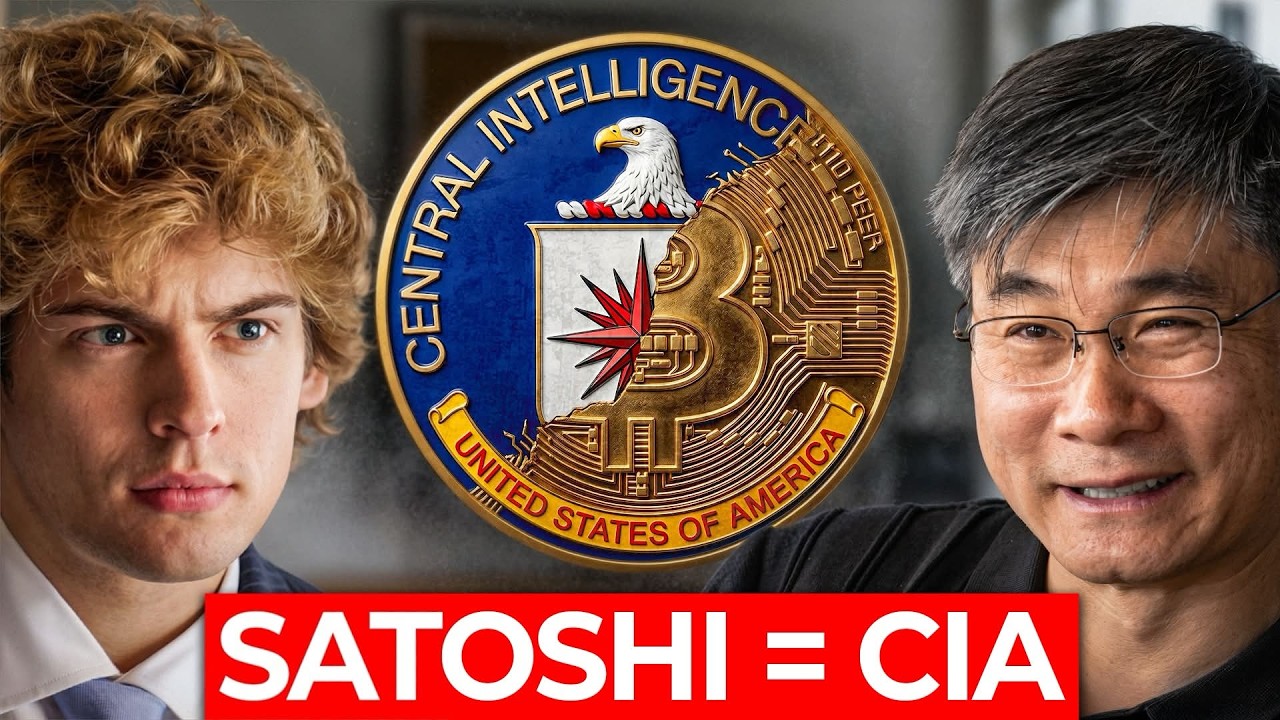
He believes Satoshi Nakamoto was the CIA or the American deep state, arguing that “Satoshi Nakamoto” translates roughly to “central intelligence.”
His reasoning: only an entity with DARPA/NSA-level expertise could create blockchain; the CIA benefits from blockchain for surveillance (a Trojan horse) and for financing black operations including drug trafficking; and secrecy is essential because if people knew it was a government project, it would have no value.
He points to the Winklevoss twins — non-technologists who put millions of dollars into Bitcoin when it was a novelty — as suspicious, suggesting they had insider knowledge.
Technology Front Men: Social Media and AI
He argues that figures like Steve Jobs, Bill Gates, Mark Zuckerberg, Elon Musk, and Sam Altman are not true inventors but “front people” for government projects.
In the 1970s, the Pentagon had invested heavily in the internet as a surveillance tool but faced a credibility crisis after Vietnam, Watergate, and the Church Committee hearings. The solution was to open-source computing to “nerds” to make computers seem safe and innocuous.
Steve Wozniak was an employee of HP (a defense contractor) when he designed the Apple computer; technically the IP should have belonged to HP, but HP deliberately disclaimed ownership — which Jiang finds suspicious and suggestive of a coordinated handoff.
He notes that the explosion of self-made billionaires is a recent phenomenon; Gilded Age billionaires like Rockefeller and Carnegie were actually agents of the City of London who disguised their true financial power through philanthropy.
Science as the Dominant Religion
He argues that science functions as the world’s most powerful religion precisely because it doesn’t feel like one — it prides itself on being above religion while shutting down debate and questioning.
During COVID, an mRNA vaccine was developed in under a year for a rapidly mutating virus, a process that normally takes a decade. Critics like Brett Weinstein were dismissed, and 80% of Americans took the vaccine with almost no public debate.
He suggests COVID itself was likely a bioweapon because viruses in nature don’t mutate that fast — the research was subcontracted to China after Obama banned gain-of-function research in the US, which he says reveals that US-China relations are not what they appear.
The Three Biggest Lies
Death is the final reckoning: He believes death is actually a beginning — a mechanism for rebirth and knowledge accumulation. Secret societies simulate death in initiations to allow members to let go of their old selves. Fear of death drives people to waste resources trying to live forever.
We are individually powerless: He argues that every person’s actions ripple through the universe (the butterfly effect), and that choosing to be kind, open, and generous genuinely makes the world better. The lie that we don’t matter absolves people of agency and responsibility.
History is teleological (progressing toward improvement): He rejects the idea that modern civilization is the pinnacle of human achievement, pointing out that we still can’t explain how the pyramids were built. Indigenous communities often have deeper purpose, joy, and self-worth than modern Westerners who are “empty vessels trying to increase the number in their bank account.”
Elites, Bloodlines, and Immortality
He believes elites claim descent from 13 sacred bloodlines tracing back to the Roman Empire, with additional groups like the Sabine Franks (Jeffrey Epstein’s alleged bloodline). They justify their power through blood purity myths — dragon blood, divine blood from Hercules or Alexander the Great.
He warns against using ancestry DNA testing services, theorizing that elites use these databases to identify and target rival bloodlines — potentially explaining human trafficking in the US.
On living forever, he argues elites are obsessed with longevity but focus on the wrong thing (the body). The real secret is the mind: if you can implant yourself in the consciousness of billions of people, their collective attention makes you eternal. He uses Donald Trump as a case study — Trump lives “rent-free” in the minds of billions, and Jiang raises the question of whether Trump can ever truly die as long as he occupies that psychic space.
Secret Societies and the Illuminati
He views the Illuminati as more of a PR campaign than a real power — founded by Adam Weishaupt, a Jesuit and crypto-Jew, who promoted the myth of a secret society infiltrating European nobility as a recruitment tool. The myth itself became the mechanism of power.
He argues that no single person is the most powerful in the world, and that the truly powerful stay hidden precisely because being named would make them a target. He is allowed to speak because he stays abstract — naming specific individuals and their actions would create legal liability and invite retribution.
He denies being a CCP, CIA, or MI6 asset, explaining that as a foreigner in China he exists outside the Chinese surveillance system, which is designed to monitor Chinese citizens’ social networks, not foreign English teachers. He stays off Chinese social media and doesn’t engage in lucrative opportunities in China, which keeps him beneath the system’s radar.
Spiritual and Philosophical Views
He follows hermetic philosophy: the universe is conscious and vibrational, fractal (as above, so below), governed by rhythm, correspondence across dimensions, cause and effect, polarity, and generation through the union of opposites.
He believes God is the universe itself — we are inside God and God is inside us. The purpose of life is eudaimonia (flourishing): being creative, learning, growing, and loving unconditionally, which opens the soul to collective consciousness and drives imagination.
He sees love as the unifying force of the universe and believes that what happens in our minds is reflected throughout the universe — if we are creative, the universe becomes more creative.
His personal transformation came through a period of deep depression after years of professional failure, during which he reinvented himself by deliberately entering humbling situations — cooking school (where he was the worst student), Brazilian jiu-jitsu (where he was beaten daily for a year), stand-up comedy (where he learned to love being laughed at), rock climbing, skydiving, and singing lessons. These experiences taught him humility, empathy, and resilience.
He met his wife during this low point, and she saved his life — giving him structure, purpose, and meaning. He describes them as soulmates, two sparks that found each other through chaos.
Studying Dante’s Divine Comedy was a turning point: after six months of confusion, he had a moment of clarity upon waking that the entire work is about love, and from that point the text began to reveal itself to him. He describes this as the universe speaking back to him because he opened himself to love.
Final Message
If all his lectures were deleted, he says it wouldn’t matter because he has already ignited a spark in people that compels them to seek truth for themselves. His videos are not meant to be scripture but inspiration.
The one truth he would leave: the universe is divine, alive, and conscious, and if you have faith and love in your heart, it will speak back to you and guide you to the light — but first you must open yourself to love.
His recommended books: Dante’s Divine Comedy (the greatest book ever written, “a word from God”) and Homer’s The Iliad (an easy, fun, transformative read that stays with you forever).
Best advice he ever received: “Don’t chase” — from the 94-year-old American writer Gay Talese, who learned this after his pursuit of sexual experiences for research destroyed his marriage (though he and his wife stayed together).