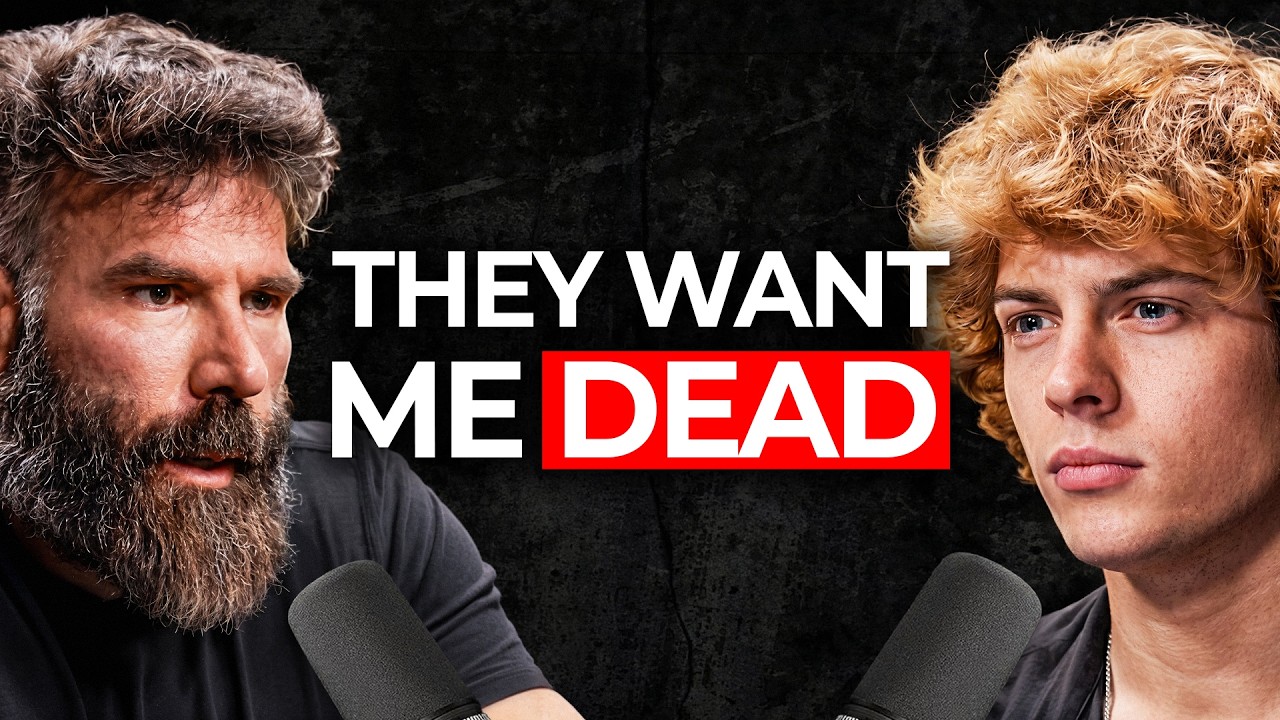
- Dan Bilzerian, a former poker player and social media influencer now running for Congress in Florida, explains why he has become one of the most vocal critics of Jewish political influence in American media, finance, and foreign policy, and why he frames this as a “Jewish supremacy problem” rather than simply an Israel or Zionism issue.
The Overton Window Has Shifted on Jewish Influence
- Bilzerian argues that talking about Jewish power used to be a career-ending taboo but has now become a trending topic and even a revenue source for some online figures, which he believes dilutes the seriousness of the issue.
- He distinguishes his own position from other commentators by saying he focuses on deeper structural problems of Jewish supremacy rather than surface-level triggers like AIPAC or Israel alone.
- He views the rhetoric around DEI, open borders, the “melting pot,” and the portrayal of white men in entertainment as coordinated attacks on white identity and masculinity, which he attributes to Jewish influence in media.
Why He Was Ranked the “#1 Antisemite in the World”
- Bilzerian claims he was ranked above figures like Tucker Carlson, Candice Owens, and Nick Fuentes as the most dangerous antisemite on earth because he talks openly about Jewish supremacy, the Bolshevik revolution, and historical Jewish overrepresentation in radical movements.
- He cites historical sources, including Churchill’s “Zionism versus Bolshevism,” to argue that Jewish involvement in the Bolshevik genocide of Christians predates the state of Israel and shows a long pattern of hostility toward Christian civilization.
- He points to the Bolshevik regime making it illegal to be Christian and illegal to criticize Jews, and argues this history is now accessible and widely understood by the public.
The Iran War and Who Benefits
- Bilzerian calls the Iran war one of the biggest lies of 2026, arguing that every justification used for it, including nuclear weapons claims, has been debunked by history and by Iran’s own documented compliance with non-nuclear agreements.
- He believes the war benefits only Israel and is catastrophic for America, the Gulf states, and the world, with potential to escalate into a global conflict involving nuclear weapons.
- He argues that half of the U.S. national debt can be traced to wars fought on Israel’s behalf, including the Iraq war, and that the current Iran war is costing $500 million per day with no benefit to Americans.
Trump’s Role and Motivations
- Bilzerian rejects the idea that Trump is a geopolitical mastermind, describing him instead as a skilled marketer who is financially compromised and primarily self-interested.
- He believes Trump did not want to enter the Iran war but was pressured into it, and that his presidency has been defined by personal financial gain rather than national interest.
- He notes that Trump has taken money from the Adelson family and is now doing the very things he once criticized others for doing.
Charlie Kirk, Erika Kirk, and the Kirk Assassination
- Bilzerian expresses deep skepticism about the official narrative around Charlie Kirk’s assassination, questioning Erika Kirk’s public behavior after the killing and suggesting she may have been a “honeypot” or handler placed to influence him.
- He believes Charlie Kirk was beginning to question support for Israel and was moving toward a position critical of Israel, which would have cost him his base, and that his assassination prevented that shift.
- He notes that Erika Kirk is now pushing for war in Iran, which contradicts what Charlie Kirk personally advocated to Trump on multiple occasions.
Why Talking About Jewish Power Guarantees Backlash
- Bilzerian describes being kicked off his company’s board, extorted by his business manager, and pressured by his lawyer to apologize after his early public stances against Israel.
- He argues that Jewish identity and tribal loyalty create a structural conflict of interest for Jewish Americans, who can obtain Israeli citizenship and effectively have a “get out of jail free card” for certain offenses.
- He points to Talmudic passages that he says are hostile to Christians and idol worshippers, and argues that Jewish elites are comfortable criticizing Muslims and Christians but react severely to any criticism of Jews.
The U.S.-Israel Relationship as Parasitic
- Bilzerian frames the U.S.-Israel relationship as parasitic rather than synergistic, arguing that money flows out to Israel and is never returned, while America bears the cost of foreign wars and financial support.
- He cites Brown University’s estimate that $8 trillion went to the Iraq war, which he says was fought on Israel’s behalf based on false intelligence promoted by Netanyahu.
- He argues that half the national debt, roughly $20 trillion with compounding interest, can be attributed to support for Israel and wars fought for Israel.
Why He Is Running for Congress
- Bilzerian says he is running because hedonism and wealth did not bring lasting happiness, and that he feels compelled to act while the country is at a crossroads.
- He is running against Randy Fine, a Jewish congressman he calls the “Hebrew Hammer,” who he says flies an Israeli flag higher than the U.S. flag and cares more about Israel than America.
- He points to Florida laws passed by Fine that criminalize antisemitism, including up to 15 years for a joke about Netanyahu in a group text, while Fine himself calls for the genocide of Muslims.
Israel’s Endgame and Eschatology
- Bilzerian argues that Israel’s territorial expansion reflects a “Greater Israel Project” aimed at seizing more land from its neighbors.
- He also argues that a religious sect in Israel actively wants to provoke global hatred and war to bring about the end times, the Antichrist, and a prophesied world in which Jews rule over non-Jews.
- He notes that some wealthy people are building bunkers and that a number of scientists doing anti-gravity research have died under strange circumstances, suggesting a coming paradigm shift.
What People Misunderstand About Him
- Bilzerian says most negative headlines about him, including claims that he went broke, threw a porn star off a roof, or acted cowardly during the Las Vegas mass shooting, are misleading or false when the full context is known.
- Regarding his appearance in the Epstein files, he says the photos were simply images he had already posted on social media and that being mentioned in Epstein’s communications does not mean he visited the island.
- He argues that the Epstein files show a pattern in which Jewish individuals and networks are heavily represented among those implicated, while investigations have focused on non-Jewish figures like Bill Gates and Prince Andrew.
One-Word Descriptions of Public Figures
- Ben Shapiro: “Assad”
- Andrew Tate: “Genuinely likes him personally” but criticizes him for walking back the “hell incident” rather than owning it
- Piers Morgan: “Disingenuous” — knows the truth about Israel and Palestine but defended Israel long after he knew it was indefensible, only changing when it became financially necessary
- Kanye West: “Attention-seeking child” who folded completely after backlash and was still attacked anyway, proving capitulation does not protect you
- Nick Fuentes: Respects him as an early pioneer but criticizes him for drifting into sensationalism, bad takes, and profiting from the movement rather than staying focused on the core issue
- Randy Fine: “Jew” — his entire identity, putting Israel before America
The Most Important Message
- Bilzerian says hedonism, money, and pleasure are fleeting and cannot fill the void; what actually makes people happy is helping other people, spending time with family and friends, and doing things that do not depend on endless escalation of stimulation.
- He warns that chasing pleasure is like a drug tolerance curve: each high requires more and more to feel anything, while happiness is sustainable and does not diminish with repetition.