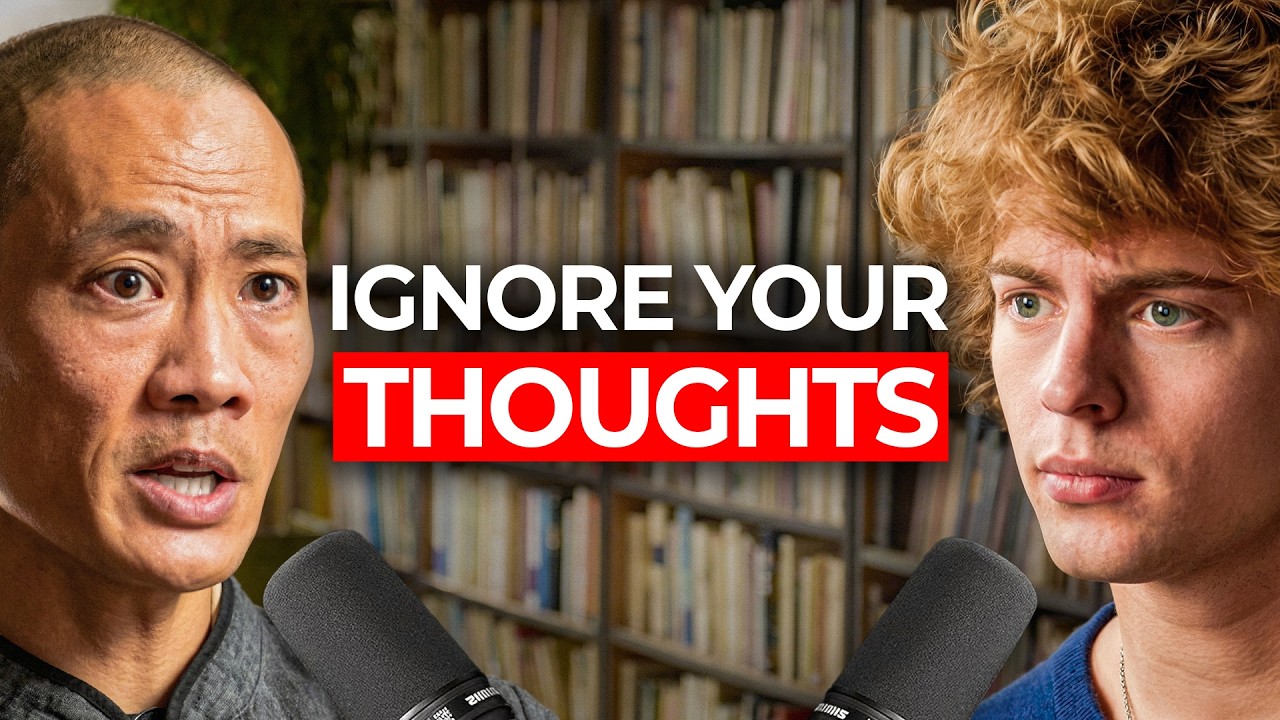
Master Shi Heng Yi, born in Germany to Vietnamese refugees, is a Shaolin warrior monk, martial artist, and spiritual teacher who has spent over 35 years training in Shaolin kung fu, qigong, and Zen Buddhism. He rose to global recognition during the COVID lockdowns by sharing physical and breathing exercises online, eventually becoming one of the most followed spiritual teachers in the world. In this episode, he explains how the mind works, why most people are enslaved by their thoughts, how to break the cycle of suffering, and what it truly means to find inner peace — not through comfort or external achievement, but through self-mastery and awareness.
The Core Principle: You Are Not Your Thoughts
If it’s not on your mind, it doesn’t bother you. This is the foundational insight Yi keeps returning to. Most suffering comes not from external events but from what the mind latches onto.
You cannot control what thoughts arise. Yi invites listeners to try predicting their next thought — most people realize they have no idea what will pop up. This means blindly following every thought is irrational.
The two choices: master the mind or be enslaved by it. When a thought arises, you can either let it pass or get “hooked” by it. Being hooked — grasping onto thoughts, emotions, and reactions — is the pathway to misery.
Thoughts arise from nowhere and return to nowhere. Like a sound that appears and fades, thoughts have no permanent substance. The problem isn’t the thought itself — it’s holding on to something that by nature is designed to pass.
Karma as cause and effect. Thoughts and emotional reactions often come from subconscious programming — childhood experiences, cultural conditioning, past trauma. A smell from a Christmas market can trigger a thought decades later, not by choice but because something was implanted in the past. The cause is the root; the effect is what surfaces in the present.
Social Media and the Pollution of the Mind
Your mind is a container, and social media is filling it. Whatever you consume mentally eventually consumes you. If you constantly watch content without awareness, you lose the ability not to think about it.
Algorithms exploit emotional tension. Yi compares social media to amusement parks — people seek emotional rushes (anger, outrage, adrenaline) because tension keeps them engaged. The difference is that amusement parks have safety nets; real life does not.
Life is like a movie — don’t take it too seriously. Yi references the ancient teaching that life is like a simulation or matrix. If you take your persona, your body, and your thoughts too seriously, life will break you. The solution is not to stop participating but to stop over-identifying.
The Physical Body as a Bridge to Mental Mastery
Unused energy becomes anxious thinking. Yi explains that when people don’t move their bodies, all that energy has nowhere to go — it goes into the head, creating problems, anxiety, and worries that don’t actually exist in their lives.
Physical practice is a bridge, not the destination. Yi started sharing kung fu and qigong exercises not to teach people how to fight, but to get them moving so their energy regulates naturally, leaving less fuel for obsessive thinking.
The body is fragile — and that’s the point. Training martial arts reveals how easily the human body can be broken. This realization can go two ways: it can make you dangerous (if the mind is untamed) or deeply compassionate (if you understand the fragility of all beings).
Real strength is non-reaction. Yi describes being held at gunpoint in Romania after 14-15 years of martial training. The experience shattered his ego and taught him that true strength isn’t physical skill — it’s the ability to stay calm, process internally, and respond consciously rather than react from anger or aggression.
The Illusion of External Validation
Looking up to someone means lowering yourself. Yi asked to be called by his name, not “master,” because titles create hierarchy and separation. When people elevate a teacher, they diminish themselves.
Persona and role are not the self. Whatever you achieve — fame, reputation, appearance — is a role you’ve built. It’s not what you are. Investing your entire identity in a persona leads to suffering because it cannot be maintained.
Looksmaxxing and attachment to appearance. Yi ties the modern trend of men spending heavily on plastic surgery and steroids to the same trap as any other external attachment. You cannot maintain youth and appearance forever. The more extreme the reliance, the more extreme the suffering when it fades. He references the story of Prince Siddhartha, whose father tried to shield him from aging, sickness, and death — but the prince eventually saw all four and realized these facts of existence cannot be denied.
No outcome, no expectation. Yi says he has no desired outcome from this podcast or any public appearance. He speaks as if talking to himself. This freedom from expectation is what allows him to be authentic and at peace.
Death, Religion, and the Nature of Reality
Death is the disappearance of what once appeared. Yi does not fear death because he sees it as part of a natural cycle. Whatever appears will disappear. There is something beyond that cycle — a stable, unchanging background — and that is what he identifies with.
Heaven and hell are not places — they are states of mind. Yi believes heaven and hell exist here, in this moment, depending on the observer’s inner state. If you wouldn’t want to repeat your current experience, that’s hell. If you’d happily continue, that’s heaven.
Jesus and the Buddha point to the same truth. Yi notes that Jesus said “the kingdom of heaven is within,” which aligns with Buddhist teachings to stop searching outside yourself. He respects all religions and sees them as different paths to the same essential question: Who am I?
God must be here right now — or God is not almighty. Yi argues that if ultimate reality or God is not present in this exact moment and location, then it is not truly infinite or omnipresent. The ultimate truth must be accessible right now, without special practices or years of isolation.
The observer is the observed. There is no real separation between inside and outside. What you experience is constantly shifting, but there is a silent background that witnesses everything without saying anything. That witnessing presence is stable and unchanging.
Language, Experience, and Knowledge
Language is a box. Yi acknowledges that every language is limiting. Nonverbal communication — reading energy, emotional states, and receptivity — is often more important than words. Speaking truthful words to someone whose energy is closed will not reach them.
Silent retreats reveal nonverbal communication. In traditions where speaking is forbidden for days or weeks, people discover they can communicate through presence, looks, and energy alone.
Knowledge from books is not the same as lived experience. Yi distinguishes between intellectual understanding (reading, studying, becoming a professor) and experiential wisdom (living, facing hardship, developing character). Some of the wisest people have never read a book. Some of the most educated people cannot live a good life.
You cannot learn the ultimate truth from YouTube. Direct transmission — a wordless, experiential pointing to the nature of mind — cannot be captured in content. It must be experienced.
Judgment, Compassion, and the Roots of Evil
Judging others reveals your own conditioning. Yi says he catches himself judging but immediately asks: What did this person go through? What shaped them? People behave the way they do not by conscious choice but because of subconscious programming from their past.
Evil comes from temptation and inner demons. Yi believes people choose evil because the pull of temptation is strong. Freedom is not free — it is earned by fighting inner demons, not giving into what feels easy but carries consequences.
Unhappiness drives blame. People who are unhappy with themselves need someone to blame. If everyone around you were genuinely blissful and joyful, no one would think to do something harmful. Negativity arises from an unhappy baseline.
Incompleteness is created by the mind, not by nature. Yi rejects the idea that God or the universe creates incomplete beings. The feeling of incompleteness comes from media, comparison, and societal messaging — not from actual deficiency.
Childhood, Fatherhood, and Breaking the Cycle
Yi’s father pushed him relentlessly — and it shaped everything. From age four, Yi trained in martial arts under a shifu (teacher-father) while his biological father demanded academic excellence. Both father figures communicated the same message: It’s never good enough.
This created a high achiever and perfectionist. Yi became an overdeliverer — pushing himself relentlessly in every project, driven by the belief that love and affection must be earned through achievement.
Success didn’t fill the void. Despite fame, reputation, and global recognition, Yi felt something was still missing. It wasn’t money, fame, or followers — it was a sense of arrival, of being enough as he was.
Healing the inner child. Yi describes sitting with himself, acknowledging the little boy who never got the attention he needed from his parents, and telling him: I am here to carry you now. Nothing to prove. This was the turning point — the moment he stopped needing external validation.
Forgiving his parents by understanding them. Yi initially couldn’t understand why Westerners struggled to forgive their parents — in Asian culture, you simply owe gratitude to your parents for giving you life. But after becoming a father himself and reflecting on his parents’ history as war refugees who fled Vietnam by boat, he understood: their obsession with safety, education, and financial security came from trauma. They were passing on the wounds of survival.
Break the cycle or pass it on. Yi’s core message for parents: The demons you don’t fight in this lifetime, your children will have to face. His book is called The Way to Self-Mastery with the subtitle Don’t Change the World, Fix This One. The work is to remove your own triggers, face your own pain, and stop passing unresolved trauma to the next generation.
Suppression leads to sickness. Unreleased emotional energy stagnates and can manifest as physical illness, including cancer. Pain must be acknowledged and allowed to flow — not hidden or suppressed.
Suffering Has a Pattern
Suffering follows habits — both mental and physical. The mind has patterns just like the body has routines. These patterns can be observed and changed.
The key habit to teach the next generation: The ability to distinguish between thought and emotion as they arise, and to not be hooked by them. No matter how strong a feeling is, there is something stable within you that can witness it without being swept away.
Find the root. Yi’s greatest wish for his son and for everyone is to find the stable root within — the place where nothing is happening, the silent background that is always there, even after all the fireworks.
Desires, Attachments, and Living Fully
You can have desires — just don’t be attached to them. Yi clarifies that Eastern philosophy doesn’t demand the elimination of desire. You can want success, strength, and recognition. The problem is attachment — building your identity and self-worth around these things.
Don’t get lost in your creation. Whatever you build — a body, a career, a reputation — accept that it will disappear. Create freely, but don’t go down with your creation. You are the creator, not the creation.
Material excellence often compensates for inner darkness. Yi observes a correlation: the more picture-perfect someone’s external life appears, the more likely they are running from something dark inside. The outside light compensates for the inside void.
Would you be able to live nameless? Yi challenges listeners to imagine living without needing to maintain a name, reputation, or image. His own rise to fame was real, but he recognizes it as impermanent — something that appeared and will eventually disappear.
The Single Most Important Piece of Advice
Wake up. Yi’s Zen master told him the greatest gift he could give his son is to truly wake up — to deeply contemplate the question Who am I? Not the body, not the thoughts, not the role — what is the essence?
This one question replaces 8 billion problems. If you ask 8 billion people what their problem is, you get 8 billion answers. But if you answer the question Who am I? at the root level, all those problems lose their grip.
Lightness enters when you stop running. Since Yi began truly dedicating himself to this inquiry — contemplating, sitting in silence, listening to dharma talks — a lightness has entered his life. He wishes this for everyone: the possibility that what you believed about yourself is not the final answer.