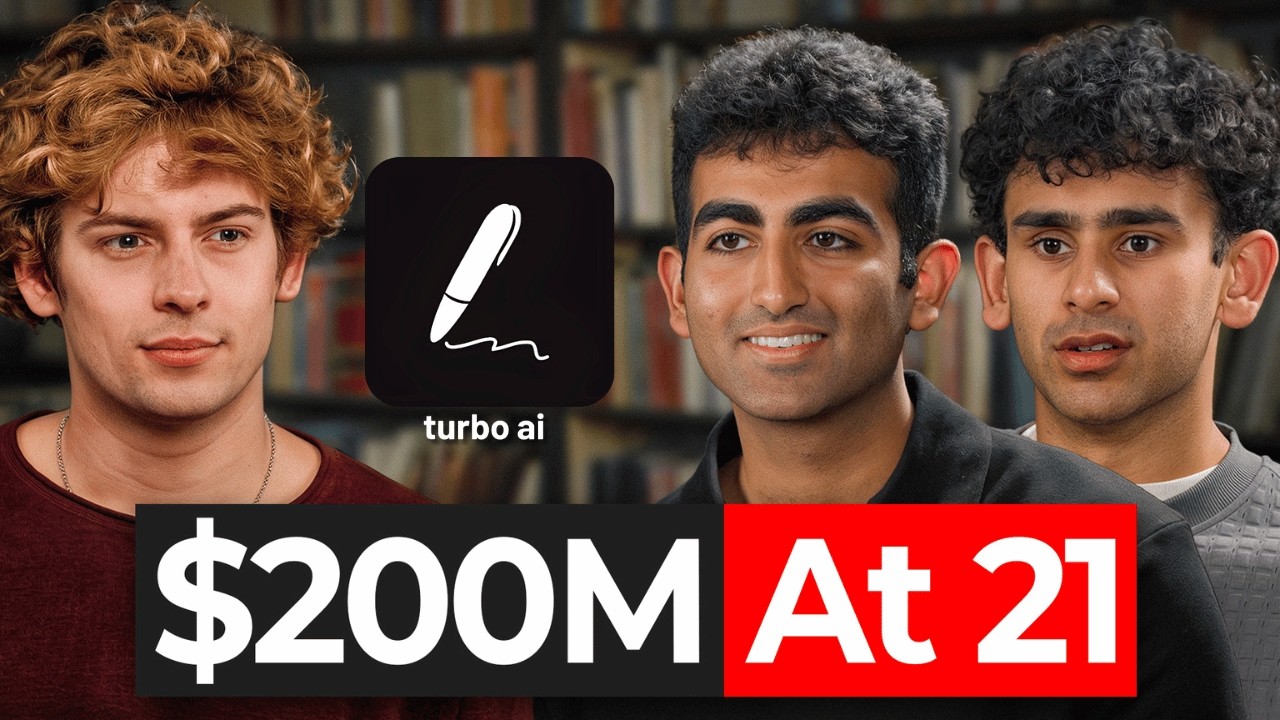
Two childhood best friends from Texas, Rudy Aurora and Sarthik Dalan, dropped out of Duke and Northwestern to build Turbo AI, an AI-powered study tool that converts lecture recordings and PDFs into notes, flashcards, quizzes, and interactive podcasts. At 21 years old, they are generating over $1 million in monthly revenue with 8 million users and a company valued at over $100–200 million. Their journey reveals a blueprint for building viral consumer AI apps, the importance of retention over vanity metrics, and why they believe college is increasingly a scam in the age of AI.
How They Got Started
Childhood friendship and early projects: They met in middle school in Texas and began building software together in 9th grade. Sarthik built Gradeify, a grade-tracking app that reached 40,000 daily active users through word of mouth. Rudy then proposed WorkBe, a marketplace for Christmas light installation, which they ran throughout high school, generating $60,000 in revenue over 2.5 years with thin margins.
WorkBe taught them the pain of low-margin, labor-intensive businesses: they manually managed sales over text, dealt with unreliable contractors, and personally fixed problems like installing lights at a customer’s house when a contractor ghosted.
This experience drove them toward software: recurring revenue, high margins, no physical logistics.
The Birth of Turbo AI
Personal pain point: The summer before college, Sarthik was already using GPT to generate flashcards and study materials for AP exams but found the workflow clunky. He envisioned an app that could automatically convert any input (lectures, PDFs) into notes, flashcards, and quiz questions.
Name and MVP: They named it TurboLearn (later Turbo AI) by combining “turbo” and “learn” from a rhyming dictionary. The MVP took 2–3 months to build without AI coding tools (GPT-3.5 was too weak). It used the GPT API to convert PDFs into study materials, though the quality was initially poor.
Early scrappy marketing: Instead of making TikToks, they stole cookies from dining halls and set up booths on campus offering cookies in exchange for sign-ups. They also put posters inside bathroom stalls at Duke with a poop emoji and the tagline “Shitty professor who talks too fast? Use Turbo.” These tactics were ineffective but became campus lore.
The UMAX Detour
Joining UMAX: During their freshman year, Sarthik was introduced to Blake Anderson, founder of UMAX (an AI app that rates your attractiveness from a photo). Sarthik took a gap semester to move to San Francisco and help scale UMAX from 4,000 to 20 million users, reaching over $1 million in their best month.
UMAX monetized through a paywall (5–8% conversion rate) and affiliate products (looks-maxing supplements).
Key lesson: UMAX had high churn—people scanned once and left. It was a “leaky bucket” that couldn’t sustain long-term growth.
Rudy kept Turbo alive: While Sarthik was in SF, Rudy spent 20–30 hours per week on Turbo, experimenting with TikTok marketing and growing revenue to $30,000/month. This proved Turbo had real traction, and they decided to go all-in together.
Scaling from $100K to $1 Million per Month
Growth timeline: It took about a year to reach $100K/month in revenue. From $100K to $1 million/month took roughly 7–8 months.
No exponential growth myth: They emphasize that even the best companies grow linearly, not exponentially. The key is sustaining a high linear growth rate through discipline and volume.
Primary growth channel: UGC (User-Generated Content) creators: Their main unlock was hiring hundreds of college students to run social media accounts that appear organic but exclusively promote Turbo.
How it works: Instead of obvious brand accounts (e.g., “@TurboAI”), they create accounts like “@SarahsLife” where every post promotes Turbo but looks like a real influencer’s content. Viewers on their For You page think they’re watching an organic recommendation.
They manage over 500 creators, paying flat rates per video plus incentives. Their top creator earned nearly $30,000 in a single month and is now a full-time employee.
Creator management: Seven full-time creator managers (all influencers themselves) oversee the program. They’ve found that building genuine relationships with creators—treating them like friends, not contractors—is key to retention even when competitors offer higher pay.
The Secret to Viral Marketing
The aha moment principle: For a product to go viral, it needs a clear “input → output” transformation that’s visually compelling in a short video (e.g., “put in a PDF, get notes and quiz questions”). Products without a singular aha moment (like Calm for meditation) struggle with viral marketing.
Making ads look organic: Their CMO (an influencer himself) realized that viral storytime creators are always doing something—shaving, cooking, making smoothies. They had creators cut fruit in every video, making Turbo ads feel like authentic influencer content. This defined their brand for 2–3 months and generated hundreds of millions of views.
They’ve since evolved beyond fruit (which became a recognizable ad signal) to other props like stirring Kool-Aid.
Engagement hack: Adding visual motion in the first second of a video (like placing a camera down) captures attention during fast scrolling.
Reverse-engineering virality: They maintain five different TikTok accounts, each tuned to a different niche (e.g., “depressed white girl crying over her ex,” manifestation content). They identify formats that have gone viral in other niches and adapt them to Turbo.
Example: They took the viral “manifestation candle” trend and flipped it: “Diva, I’m going to manifest really good grades for you this semester. Use TurboAI.” Creators filmed in purple LED lighting with a psychic vibe, and the format generated massive views.
Viral vs. converting: The hardest problem in marketing is that the most viral videos often don’t convert. A video about recording your mom yelling at your dad and turning it into notes goes viral for the wrong reasons. The best videos make the product the solution to the problem the video sets up.
Good example: K Shami’s “Mogwarts” format (teaching looks-maxing in Harry Potter style) plugged UMAX as the tool used—the product was the solution.
Bad example: A video talking about basketball for 30 seconds then randomly plugging Turbo feels like a bait-and-switch.
Validating and Building an App from Zero
Two-step validation framework:
Can it go viral? Work backwards from a viral moment. Create a short demo video and see if it gains traction.
Will anyone pay? Put up a paywall with a short free trial (3–7 days) before building the full app. If zero people convert, the idea lacks legs.
Don’t build first: Most people waste time building an app nobody wants. Validate demand before writing code.
For non-coders: Use Claude Code (not low-code platforms like Lovable, which create lock-in). Ask Claude extremely basic questions (“How are apps built? What is Swift?”) and follow the chain of unknown terms. Within a month, you can get something on the App Store.
Key insight: Slow the AI down. Before coding, make a detailed plan. Define the absolute minimum viable product clearly. The less clear your vision, the more confused the AI output.
Caveat: LLMs are great at building things that have been built 19,000 times before (tic-tac-toe apps). But businesses that make money are usually doing something new, which is fundamentally harder for AI.
Why AI Changes the Economics of Software
Unit economics are flipped: Historically, software had great margins (e.g., Discord costs little to maintain per user). But AI businesses require expensive LLM inference. A user paying $20/month might cost more than $20/month in AI usage.
Example: Cursor has to use the best (most expensive) models to satisfy developers, so their gross margins on paying subscribers are poor. Turbo’s engineering team alone spends $20,000–$30,000/month on Claude Code.
Retention is everything, but harder in AI: High retention builds stable recurring revenue, but if your AI costs per user exceed subscription prices, retention alone doesn’t make a good business.
Why College Is a Scam (And Why It Might Not Be)
ROI perspective: If you’re going to college purely for financial ROI—to become more employable and land a higher-paying job—it’s often not worth the cost and time, especially at expensive private schools. Trade school can yield similar salaries.
The filtering mechanism argument: In an AI world where anyone can learn anything and skills are commoditized, employers face overwhelming noise in job applications. College prestige (especially Ivy League) becomes an even more important initial filter because it’s one of the few remaining signals.
Ivy dropouts are the ideal hire: Getting into an Ivy serves as a filtering mechanism for intelligence and drive. Actually graduating matters less. The founders have hired Northwestern dropouts and value the admissions signal over the degree.
What college is still good for: Social experiences, friendships, exploring interests out of genuine curiosity, and networking (they met UMAX’s founder through a college connection).
Their parents’ reaction: Initially opposed to dropping out. Came around when the company was doing $600,000/month while they were still enrolled. They’re technically on “indefinite gap semesters” (Duke allows up to seven years before you lose admission).
How AI Changes Education and Admissions
Perfect test scores are now trivial: AI can generate unlimited practice questions for SAT/ACT. The barrier to top scores has collapsed.
Extracurriculars are “cooked”: Pre-AI, writing a 20-page research paper or building an app was impressive. Now anyone can vibe-code an app or one-shot a paper with GPT. Colleges can’t differentiate based on achievements anymore.
SAT/ACT are becoming more important: After a wave of test-optional policies during COVID, many schools are requiring scores again. Standardized tests are the least biased filter—rich kids no longer have an advantage in test prep when everyone has access to AI tutors.
Company Culture and Philosophy
Live and work together: They operate out of a giant company house with all employees (friends, all around 21–22). They work six days a week, hang out on Saturdays, and go out together. It’s like a frat aligned around shared goals.
Fighting is healthy: They argue and yell frequently but reach resolutions because of mutual respect. Productive conflict requires believing the other person is smarter than you in their domain.
Hiring for excellence, not skills: They don’t care about specific programming languages or courses. They look for a history of excellence in anything—being top 0.1% at rowing, gaming, or any discipline. The skills that make someone elite in one area transfer. If someone can’t point to anything they’re the best at, it’s a negative signal.
Biasing toward action: Their best advice is to compress the time between thought and action. Planning and thinking feel productive but often aren’t. They’ve realized how often they lie to themselves about being productive when they’re actually just pacing and thinking.
Business Beliefs Others Would Disagree With
Founder brands don’t matter much for consumer apps: Building in public and putting your face out there mainly benefits your personal brand, not the company. At scale, distribution comes from all your social channels, not you as the face.
Your competitive advantage prevents scaling: The things that make you different (like their hands-on creator management) are often the things that don’t scale easily.
Hire for trajectory, not position: They look for the fastest-growing startups for marketing inspiration, not the incumbents. The 18-year-old who figured out a TikTok algorithm trick teaches them more than OpenAI’s marketing team.
The Future
AI predictions for 2026: More jobs will become automatable as AI agents connect to real tools and workflows, not just generate text.
Most valuable skill in the age of AI: Focus and depth. Information is infinitely accessible, so the hard part is choosing one thing and sticking with it long enough to become excellent. Shiny object syndrome is the enemy.
What they want to build next: Hardware and biotech—areas where AI integration still has high barriers to entry. Software’s barrier has dropped; physical sciences haven’t.
Applying their marketing playbook beyond apps: They see huge potential in taking their UGC viral marketing formula (hundreds of creators promoting a product through seemingly organic content) to industries outside software—music, consumer goods, etc.
Targeting older demographics: Most short-form content targets under-30s. There’s a massive untapped opportunity in creating content factories for 60–70 year olds on platforms like Facebook Reels.
Personal Reflections
Weirdest Turbo use cases: Someone uploaded a PDF of their school suspension for punching a kid and asked Turbo to draft a response email. Another person uploaded social security documents.
Do they want to be billionaires?: They see billionaire status as a side effect of building something massive, not the goal itself. The difference between $10 million and $1 billion in happiness is negligible. They care about building something that sustains itself independently.
Why they’ll never sell: They believe Turbo can be worth well over $1 billion. Selling now would be premature. Their goal is to be worth more than $2.5 billion (making them both billionaires) within five years, by age 26.
Childhood formative moments:
Sarthik: As a preschooler, he asked his teacher for multiplication problems after learning a few facts from his sister. That small moment of being “the smart kid” became a self-fulfilling prophecy.
Rudy: After years of winning business competitions and being told they were exceptional, an investor told them their Christmas lights business was unscalable and their pitch was full of fluff. This humbling moment made them realize they were competing against the world, not just their hometown.