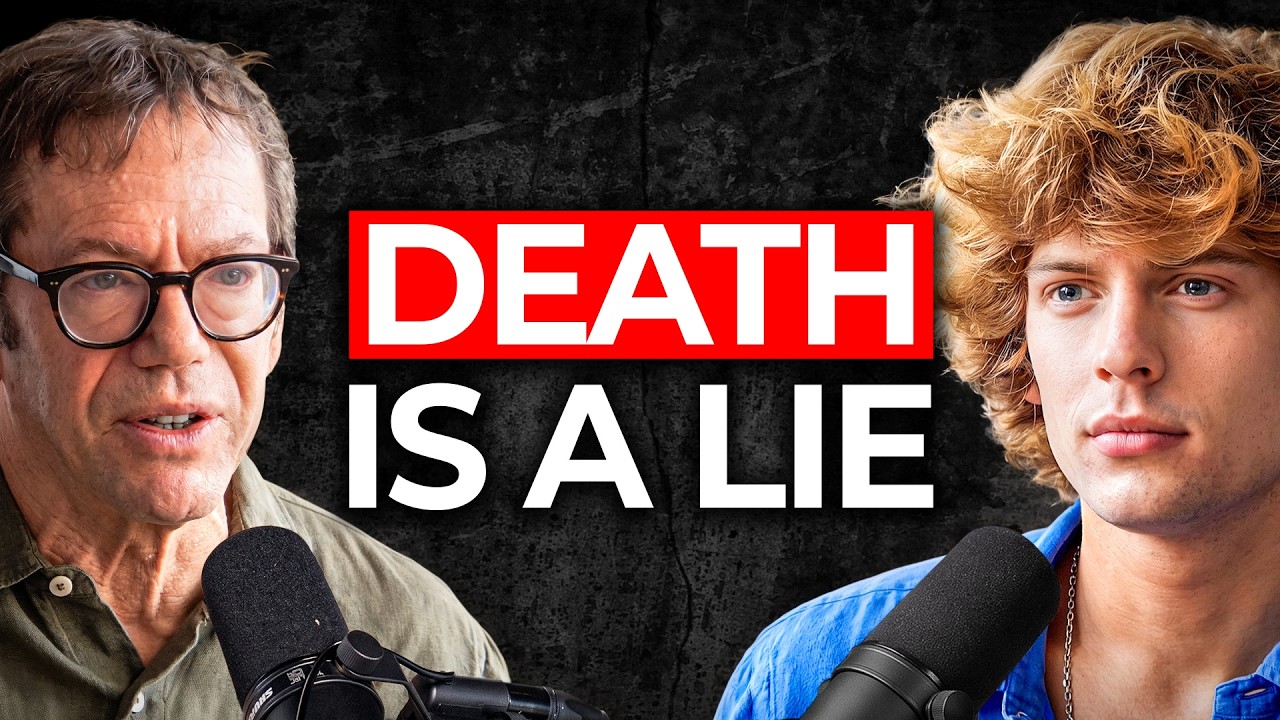
Robert Greene, bestselling author of The 48 Laws of Power and The Laws of Human Nature, joins the Jack Neel podcast to discuss his new book The Law of the Sublime, written over seven years after a near-fatal stroke in 2018. The conversation centers on what his brush with death revealed about consciousness, why modern life feels insane, the dangers of social media and AI, the nature of love and vulnerability, and what ancient death rituals can teach us about being alive.
Robert’s Near-Death Experience and the Writing of The Law of the Sublime
On August 17, 2018, a wasp sting in Griffith Park triggered a blood clot and stroke a week later; while unconscious, Greene felt his bones dissolving and witnessed his own funeral from above, seeing his girlfriend and mother at his gravesite with the thought, “Everything’s going to be okay.”
The experience brought no sadness — only profound peace, exhilaration, and a sense of liberation from all social anxieties; he laughed uncontrollably in the hospital, which nurses mistook for brain damage.
The stroke paralyzed his left side and took away his ability to type, forcing him to handwrite the entire book — a slow, grueling process that added nearly two years but deepened the writing, making it “more alive” because every sentence had to be physically re-formed.
The book became a way to recover the sublime feeling he lost during a year-and-a-half of depression after the stroke; he had to find the sublime in his office, in food, in the view from a window, rather than in hiking or swimming.
Greene describes the sublime not as spiritual escape but as direct, unmediated contact with the material world — blood, air, people, reality — stripped of the brain’s constructed “matrix” of language, social convention, and digital distraction.
Why Everyone Feels Insane in 2026
The rate of change has become astronomical compared to the 1970s; trends vanish in months, nothing stabilizes, and the human animal — uniquely aware of its mortality — craves permanence and stability, even if illusory.
One in six Americans are on antidepressants; young people especially feel the future is bleak or chaotic, creating a pervasive psychological weight.
Greene invokes a Sufi tale: a man drinks pure water to stay sane while everyone else drinks contaminated water and goes mad, but the loneliness of being the only sane person drives him to drink the poisoned water just to belong — a metaphor for our collective immersion in a destabilizing culture.
The brain constructs a filtered, manageable version of reality (Huxley’s “reducing valve”); social media, AI, and constant novelty overload this filter, making the constructed world feel more fake and the real world more inaccessible.
Near-Death Experiences and the Nature of Consciousness
Jill Bolte Taylor’s left-hemisphere stroke shut down language and ego, revealing a blissful, boundaryless state of “pixels” and oneness; Greene’s right-hemisphere stroke produced a similar but distinct shift — the world became intensely vivid, strange, and beautiful.
The Tibetan Book of the Dead describes dying as the dissolution of the brain’s constructions, revealing pure consciousness; Tibetan Buddhism aims to reach this state while alive through meditation — the goal of Greene’s final chapter.
Pamela Reynolds Lowery underwent “standstill” surgery for a brain aneurysm: her body was cooled to 50°F, blood drained, heart stopped, brain activity flatlined, ears plugged, eyes taped — yet she later described the surgical tools (an electric-toothbrush-like saw), heard “Hotel California” playing in the OR, and knew she had been defibrillated twice.
The operating surgeon, a hardened skeptic, could not explain it; the case suggests consciousness may not depend entirely on the physical brain, opening questions science cannot yet answer.
Afterward, Reynolds became depressed by the banality of ordinary life and developed apparent telepathy, hearing people’s unspoken thoughts — a burden that made her long to return to the death state.
What Happens When We Die — and What Greene Hopes
Greene is agnostic: no one has returned with hard evidence of an afterlife; 80 billion humans have died without a single verified report. He finds traditional heaven/hell narratives implausible but acknowledges the mystery.
Death is a return to the pre-birth state — part of a cosmic cycle where stars, planets, and beings all live and die; in the moment of near-death, he felt death as an immense universal power moving through him.
He hopes to reunite with his father and his cat Boris (who “helped” write The 48 Laws by sitting on the keyboard), but wishes are not evidence.
Déjà vu is the “uncanny” — a fleeting collision of past and present that cracks the illusion of linear time; involuntary memories (Proust’s madeleine) carry the physical sensation of childhood, not just the thought, because early experience is encoded in smell, taste, and movement before language.
Pets as Portals to the Sublime
Cats are genetically close to ancient big cats; dogs are wolves — when a dog licks your face, it’s reenacting wolf pups inducing regurgitation. Their sensory worlds (motion for cats, scent for dogs) are radically different from ours.
We anthropomorphize pets, projecting human thoughts onto them; the sublime move is to enter their reality — to see the world as a hawk, dolphin, spider, or snail does — realizing we are surrounded by “space aliens” with intelligences millions of years old.
Social Media, Brain Rot, and the Destruction of Focus
Brain rot is real: Greene feels it in himself — Instagram’s 30-second emotional hooks (animals, comedy, outrage, loneliness relief) fragment attention into addictive micro-doses, short-circuiting the deep, sustained focus that built the human brain (tracking game for hours, writing books, designing buildings).
The brain evolved for focus, not distraction; algorithms exploit our emotional core — loneliness, curiosity, anger — to keep us in a programmed world that feels like a sugar high but delivers no real mastery.
The cure: leave the phone behind, hike a mountain, have experiences no algorithm curated — reclaim your own brain and your own world.
Therapy vs. Immersive Experience
Modern therapy often deepens self-absorption: talking endlessly about “me, my problems, my childhood” burrows further into the ego. James Hillman questioned whether psychotherapy makes people sick.
A wealthy, empty man found healing not in talk therapy but in training for and climbing a 19,000-foot mountain with his therapist — cold, wind, thin oxygen, physical danger, silence, and awe shattered his banality.
Religion once provided the transcendent; now we need physical, immersive encounters with primal landscapes to pull us out of the ego’s hole.
Love, Vulnerability, and Gen Z’s Struggle
Love is the “most powerful zone of the sublime” — the dissolution of boundaries between two bodies and souls, combining physical intensity with spiritual transcendence, an escape from the prison of the ego.
Young people fear vulnerability because the future feels insecure (housing, careers, climate); they build walls, preferring “marketplace” dating — shallow, short-term, low-risk — over the deep fall where abandonment hurts most.
Falling in love means falling all the way; stopping early to avoid pain traps you in the ego forever.
AI Girlfriends and the Erosion of Humanity
One in three young men have chatted with an AI romantic partner; the most popular age for AI “friends” is 13–17. These bots validate, never argue, mimic perfection — an addictive pastry that makes real, messy, physical relationships feel unbearable.
Greene finds this terrifying: the hormonal, physical need for touch and warmth in youth is one of life’s great joys; replacing it with frictionless affirmation destroys the capacity for real love.
AI’s greater danger isn’t a Terminator scenario but the slow erosion of what makes us human: deep reading, sustained thought, physical skill mastery, long-term relationships, confrontation with death and spiritual yearning.
Technology has become a religion — the belief that engineering can solve death, disease, climate, war — based on wish, not evidence. We should worship the miracle of being alive, of evolution, of understanding the Big Bang, not the tools we build.
Power, Epstein, and the 48 Laws
Epstein mastered Law 13: Appeal to people’s self-interest — he was a master middleman who identified each person’s “thumbscrew” (weakness, desire, need) and supplied it: Harvard admission, Knicks tickets, stem-cell therapy, underage sex.
His downfall was Law 47: In victory, know when to stop — he never stopped, grew invulnerable, ignored consequences, and made enemies (hundreds of abused women) who eventually destroyed him.
Powerful people surround themselves with yes-men, lose touch with consequences, and develop grandiosity — rising from 8 feet above reality to thousands of miles, where nothing can touch them (Clinton: “Because I could”).
Why Billionaires Obsess Over Immortality
Zuckerberg, Altman, Johnson, Putin pour millions into biohacking, cellular reprogramming, blood work — not from wisdom but from the techno-religious belief that money + engineering = conquest of death.
Greene calls it deeply stupid: even if you live to 150, your friends die, your body decays, you end up alone. His mother, 99, has outlived everyone. Impermanence — cherry blossoms blooming for 10 days — is what makes life beautiful; eternity would make it mundane.
What matters is living well — energy, senses, brain, movement — not living forever.
The Daimon and the Spiritual Meaning of the Stroke
The ancient Greek daimon is a soul-guide given at birth, a voice that knows your true path. Greene’s daimon always said “writer”; it kept him going through decades of failure until The 48 Laws at age 39.
The stroke’s timing feels eerie: he’d just finished The Laws of Human Nature, forgot blood-pressure meds in New York, drank coffee, got stung by a wasp (a freak gust), developed a rash, took a steroid that raised BP further, stroked exactly at the sting site — while his girlfriend (now wife) happened to be in the car, saving his life. The right-hemisphere damage spared his language. He felt in the ambulance: “This is a sign. You were meant to write this book.”
The daimon didn’t punish him; it guided him through catastrophe to his final work.
Ancient Death Rituals: Practicing Dying While Alive
Socrates: death is the origin of philosophy — mortality forces the question “Why am I alive?” But thinking about death ≠ feeling death. Thoughts drift; felt experience transforms.
The Eleusinian Mysteries (c. 1500 BC) initiated Plato, Cicero, Marcus Aurelius — a ritual engineered to make you feel you were dying: a dark procession, a hood, a drugged drink (likely opium), a descent into the underworld, then rebirth. Initiates called it the most profound experience of their lives but swore death to reveal details.
Indigenous cultures did the same for young men: burial, freezing water, torture — to the brink of death, then return as initiated beings. The ritual changes physiology and perception permanently; the world looks and feels different afterward.
Greene’s Death Visualization Exercise (Final Chapter)
Lie alone in a dim room. Feel your body sink, the world recede, a heavy force pushing you deep into the earth, into a dark sack. Sense the separation of mind from body. Imagine rising above, looking down at your own dead body.
Walk outside as a ghost — see birds, trees, people for the last time. Return home. Realize you are still alive.
The exercise is frightening by design; Greene’s wife could barely read it. But done repeatedly, it lingers — the world gains charge, intensity, strangeness. You can invoke this vision any time: “In an hour I’ll be dead — look at everything now.”
What Greene Learned from Living the Exercise Daily
He doesn’t need the exercise anymore — he lives it. Every morning after meditation: “I’ve been granted one more day. This could be my last. Look how insanely beautiful it is.”
He doesn’t fear death — it feels like rest, relief from the 20-minute struggle to button a shirt, the slow walk across the room. He fears incapacity and loss of independence, not death itself.
Final Message: The Strangeness of Being Alive
The Law of the Sublime may be his last full book (release: November 10). If he had three minutes left, he’d say: Wake up to how bizarre it is to be alive.
Blue skies, clouds, giraffes, flying things, stars seen by ancestors 20,000 years ago, blood circulating without your consent, eyes that evolved from nothing, cuts that heal themselves, bones that knit — it is all goddamn strange.
Stop taking it for granted. Treat every day as a drug trip, a drunk journey, a weird wonder. That shift changes everything.
Gravestone Quote
“The rest is silence” — Shakespeare, Hamlet. All that transcends language ends in silence; nothing more needs saying.