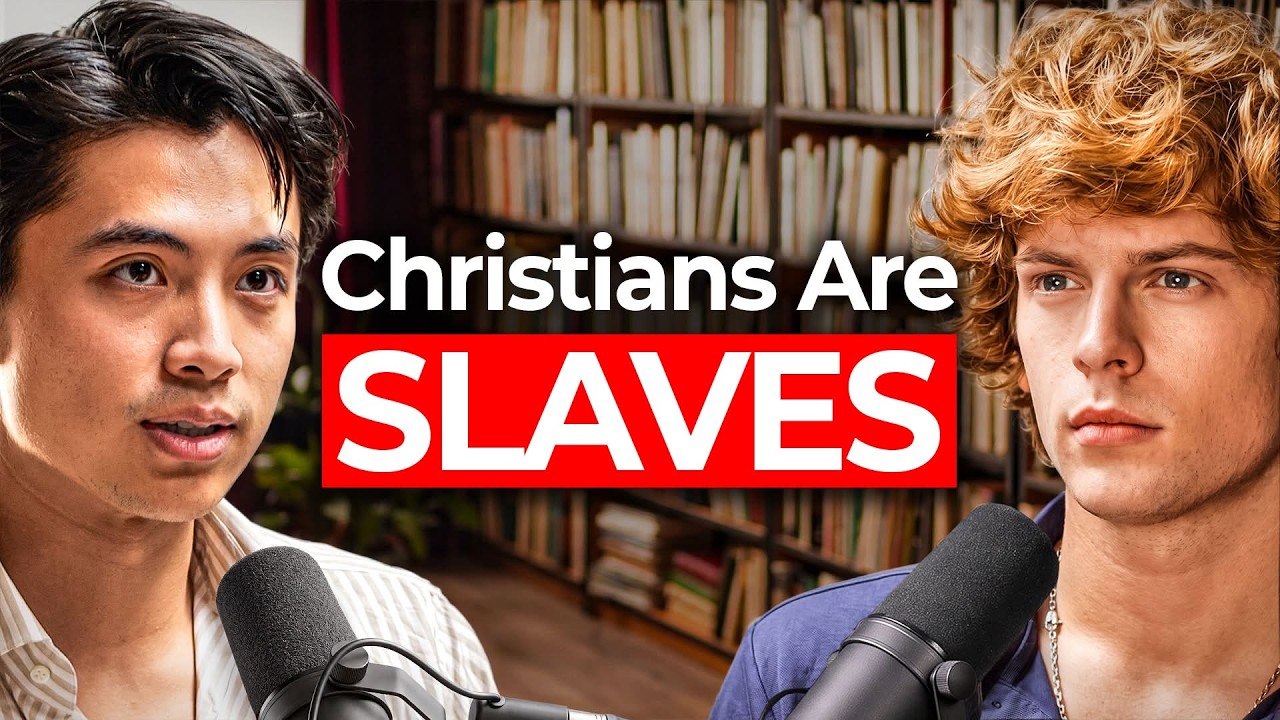
Jonathan B, a philosopher and former startup founder, explores how mimetic desire — the idea that we want things because others want them — shapes major life decisions, and how philosophy can help distinguish authentic desires from socially mediated ones, drawing on René Girard’s mimetic theory, his own trajectory from elite Chinese STEM education through Columbia, a failed startup, a successful fintech exit, and a turn toward philosophy and religious inquiry.
Mimetic desire shapes intimate and high-stakes choices more than we realize
Desire is not purely internal; we often want objects, partners, or careers because they are associated with prestigious models, not because they intrinsically satisfy us.
Celebrity endorsements (e.g., Kanye’s $100 white t-shirts) make this obvious, but the same dynamic operates in romance and career.
Jonathan’s college girlfriend became desirable only after a respected friend dated her, triggering jealousy and sudden desire where none existed before.
He dropped out of Columbia on a full ride to build a startup not because he loved the work, but because dropping out was the prestigious move in his CS peer group; day-to-day he regretted it and lacked intrinsic motivation.
Realizing his desires were a faulty compass — that he could spend his life “fighting a battle he didn’t want to win” — was terrifying and drove him to philosophy.
Distinguishing authentic from mimetic desires requires historical self-examination and thought experiments
Trace the genealogy of a desire: Jonathan had never built a company before dropping out; the desire came from watching Steve Jobs videos at 15, not from experience.
Run the “invisibility test”: if no one could know you’re doing this — dating this person, building this career, posting nothing on LinkedIn or Instagram — would you still want it? If the answer changes, the desire is socially mediated.
Pursuing something for its own sake yields joy and flow; pursuing it for external validation creates alienation and fatigue, even if you succeed.
Jonathan left a thriving fintech company (Opto Investments, ~$500M valuation, product-market fit achieved) halfway through his vesting schedule because the daily work wasn’t nourishing; he chose philosophy because the activity itself was worth it regardless of outcome.
Childhood in Beijing’s hyper-competitive STEM system erased the capacity to ask “what do I want?”
Beijing represents an extreme of modern Western Enlightenment rationalism: STEM elevated, humanities marginalized, education reduced to raw test scores from second grade onward.
30+ hours/week of math puzzles from age 8 required total disconnection from authentic desire; the system runs on mimetic prestige logic pushed to its limit.
Collapse at 18–19 forced the question earlier than Western peers, who often hit it at midlife after making partner at a prestigious firm.
Philosophy became the “API document for human nature” — a condensed manual for figuring out where to direct one’s life.
Academic philosophy replicates the same mimetic prestige ladder; Jonathan chose entrepreneurship to fund independence
PhD programs and professorships operate on KPIs: publish in top journals, network with tenure-deciders, climb the ladder — same structure as corporate or startup prestige games.
He joined a founding team at Opto Investments (with Joe Lonsdale, Palantir co-founder) explicitly to make money, not “save the world,” rejecting Silicon Valley’s mimetic self-delusion.
After three years, product-market fit achieved, he left — giving up millions in unvested equity — because even a $100B exit would mean spending his 20s on work he didn’t love.
Paradoxically, doing what he loves (philosophy content) has since opened more lucrative opportunities (investment partnerships, hiring influence) than the company did.
The pull toward external validation (legacy, audience growth) corrupts even authentic pursuits
Early on, Jonathan read Girard in private, caring nothing for audience; as his channel grew, he caught himself optimizing for lecture performance, thumbnails, guest selection for reach — confusing the map (content) for the territory (living well).
Great philosophers (Socrates, Jesus, Buddha, Epictetus, Marcus Aurelius, Confucius) wrote no books or wrote only private journals; they cared about living the good life, not legacy.
Needing legacy to justify one’s life signals a lack of congruent, full engagement in the present; if you live each moment authentically, the desire for legacy evaporates.
Social media amplifies this by making external validation immediate and quantifiable, turning every creator into a potential “athlete who goes pro and loses love for the game.”
Girard’s mimetic theory explains social conflict, scapegoating, and the Christian revelation
Mimetic desire converges people on the same objects → competition creates artificial scarcity (e.g., West Village real estate) → mimetic contagion (war of all against all).
Cultures survive by unanimously scapegoating a victim (historically Jews, or Oedipus in Thebes), expelling them, and restoring peace through a founding lie.
Rituals and prohibitions (caste systems) evolve to prevent mimetic rivalry by fixing hierarchical difference.
Democracy and social media erase those differences, making everyone equal mimics, inflaming mimetic frenzy globally — Girard predicts apocalypse.
Christianity breaks the scapegoat mechanism by telling the story from the victim’s perspective (the Gospels), exposing the mechanism as unjust and satanic (Satan = the scapegoat mechanism that maintains worldly order through deceit).
Christ’s revelation weakens the mechanism: larger groups must now be scapegoated for the same effect (20th-century class/race genocides).
The Antichrist is not Satan but a perversion of Christian rhetoric: using “protect the victim” language to persecute new victims (e.g., Soviet communism, modern woke dynamics), making it more dangerous because it wears the mask of compassion.
Nietzsche and Girard converge on Christianity as a victim-centered morality, but diverge on its essence
Nietzsche’s Genealogy of Morality: pagan “good/bad” (aristocratic/masterly) flipped to Christian “good/evil” (slave morality) via resentment; the meek inherit the earth, appealing to the weak and preventing self-actualization.
Girard agrees this is how Christianity historically spreads (a cope for the low), but insists the core is the revelation of the scapegoat mechanism and the teaching of true love/truth.
Girard also credits Christianity with enabling science: not because reason defeated myth, but because Christ taught us to stop persecuting witches, creating space for truth-seeking.
Jonathan finds Nietzsche’s life — rejecting Wagner, choosing poverty and alienation for authenticity — a devastating mirror of his own compromises.
Investigating supernatural phenomena (levitation, reincarnation, NDEs) challenges materialism but doesn’t settle on one religion
Yale historian Carlos Eire’s They Flew documents levitating monks via rigorous Inquisition records; thousands swore on their souls across Europe — hard to dismiss as fraud.
UVA’s Division of Perceptual Studies (DOPS, founded by Xerox founder) has 2,300 reincarnation cases; ~33 with pre-identification written records of children’s specific past-life claims later verified (e.g., Ryan Hammons, Turkish child with Armenian/Greek Orthodox details).
~10% of cases show birthmarks/defects matching fatal wounds of the previous personality, corroborated by autopsy records.
Near-death experiences add further empirical weight; Jonathan estimates 60–70% certainty that consciousness survives death, but this doesn’t imply a theistic God (could be simulation, reincarnation, etc.).
Every major religion has miracles; accepting Christian miracles doesn’t make Jesus the Trinitarian God — each tradition reinterprets the others as lesser revelation or demonic.
Orthodox Christianity and Buddhism both fail Jonathan’s scrutiny, though each offers crucial insights
Christianity: Book of Daniel is likely 2nd-century BCE ex eventu prophecy (predicts Alexander, gets Antiochus Epiphanes’ death wrong); Jesus quotes it as true prophecy, undermining omniscience claims. Christology escalates across Gospels (early: “only the Father knows the hour”; late: “I and the Father are one”). Removing ~10 key verses collapses the Trinitarian case.
Buddhism: Profound on suffering (dukkha), emptiness, meditation; but over-elevates suffering-removal and compassion as the entire telos — a good life isn’t just absence of suffering.
Both traditions encode deep wisdom but are socially/psychologically constructed into dogmatic systems that can’t all be exclusively true.
Current stance: intelligent design / supernatural likely; religion as empirical investigation, not leap of faith
Materialism is almost certainly false; consciousness likely precedes/outlives the body.
Jonathan treats religious claims as empirical hypotheses: telepathy, remote viewing (Duke/Parapsychology), reincarnation, NDEs — testable through serious labs.
He’s distanced from orthodox Christianity and Buddhism but continues studying them + other traditions (Judaism, Islam) and empirical parapsychology.
Priority has shifted: living authentically (philosophy as lived practice) now supersedes religious truth-seeking, partly because “next life” focus can become a crutch to avoid this life (Nietzsche’s critique).
America produces both billionaires and school shooters because both stem from grandiosity untethered from hierarchy
Entrepreneur and criminal share the same archetype: deviate from tradition, break molds, prove superiority.
PayPal founders: 4 of 6 built bombs in high school (Thiel, Zero to One).
Elliot Rodger (incel shooter) and Silicon Valley founders both feel undervalued by society; the difference is competence and available channels.
American “you can be anything” rhetoric inflames mimetic grandiosity; most fail, a few build SpaceX, a perverted few shoot schools to force recognition.
Traditional caste systems suppressed this by fixing “know your place”; democracy + social media removed the lid.
Advice is deeply personal and stage-dependent; the only universal is philosophical inquiry
Best advice Jonathan received: “be less timid, more courageous, follow authentic desire” — but giving this to his 18-year-old self would have caused rebellion and skill atrophy.
For the highly talented: follow your heart even if it’s “be a clown” — you’ll be the best clown.
For most: follow the herd, secure the 9-to-5, clown on weekends.
The Bible’s most repeated command: “do not fear” (though not 365 times).
Philosophers disagree on everything (time, free will, equality); the common thread is that philosophical inquiry itself — deep introspection on “where to row” — is the only discipline that tells you where to direct effort, while all others only teach how to row harder.
Philosophy doesn’t just give you something useful (like pickup artistry or investing); it changes you — and that’s both exciting and terrifying.
Jonathan’s work and where to find him
YouTube: Jonathan B (spelled J-O-H-N-A-T-H-A-N) for long-form philosophy lectures and interviews.