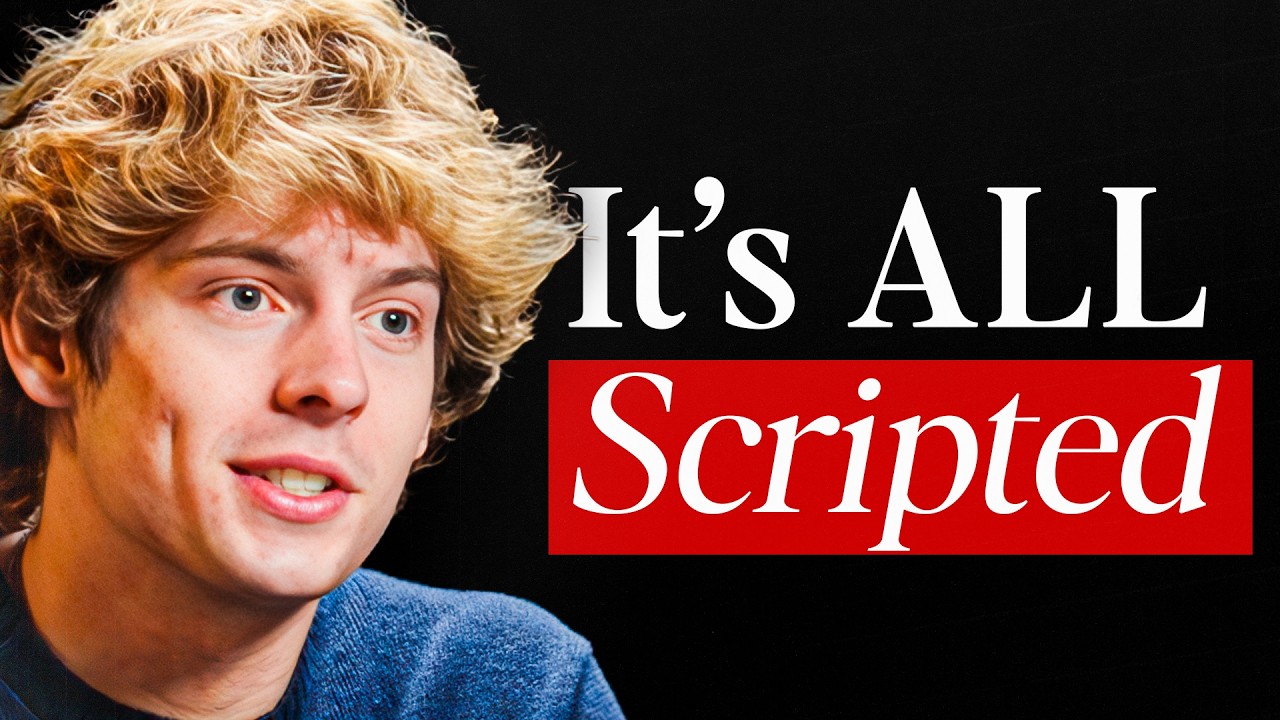
Jack Neil is a 24-year-old who built the fastest-growing podcast in the world from zero, interviewing figures like Andrew Tate, Alex Hormozi, Nick Fuentes, Candace Owens, and Tucker Carlson. He grew up in Kentucky, became a national speech and debate champion at 16, leveraged that skill into viral TikTok content, dropped out of UT Austin after a mysterious paralysis episode, built and lost a fortune through social media agencies and Snapchat shows, briefly managed an OnlyFans creator (which he deeply regrets), and ultimately poured everything into his podcast as something too painful to quit. This episode is a wide-ranging conversation about how algorithms and AI are quietly controlling human behavior, the spiritual and psychological effects of living inside engineered information systems, the nature of truth and fear, and Jack’s personal journey through success, moral compromise, and a search for meaning.
Jack’s Origin Story
Speech and debate as the foundation: Jack’s entire career traces back to competitive speech and debate, which he started at 12 because his mom didn’t want him home alone. He became a national champion at 16, earned a scholarship to UT Austin, and the storytelling, timing, and audience awareness he developed there directly translated to social media virality.
TikTok breakthrough: In 2019, a friend gained 200,000 followers on TikTok in a month, inspiring Jack to try it. He started with comedy content, then pivoted to a “US states ranked” video series that gained him 400,000 followers overnight. He was embarrassed by the video but it launched his education and true crime niche.
Early monetization: Jack made money primarily through mobile app brand deals (roughly $1 per download) and by connecting other creators with brand deals, which eventually earned him more than his own content. He had about $50,000 saved before graduating high school.
The paralysis episodes: Three weeks into UT Austin, Jack experienced gradual paralysis in his hands and legs, leaving him unable to walk for about 17 days. Doctors diagnosed it as a “functional neurological disorder,” essentially a blank term for stress-related neurological symptoms. It returned during a period he describes as morally compromising and hasn’t recurred in 3-4 years. He interprets it as a spiritual signal.
Building and Losing Wealth
Snapchat shows: Jack partnered with a friend who was making significant money from Snapchat shows (short episodic content on Snapchat’s explore feed). Together they made around $300,000 in 30 days by covering celebrity news topics like Andrew Tate going to jail and Mr. Beast. The partnership worked because both were hyper-competitive, pushing each other like draft horses that pull exponentially more together than alone.
The OnlyFans venture: Jack and his partner decided to manage an exclusive content creator, handling her social media and backend systems. Jack was morally uneasy throughout. Their biggest month coincided with his second paralysis episode, which made him reconsider. He also had a public encounter where a fan recognized the creator, making him feel they were “ruining people’s lives.” He regrets it 100% and lost all the money from that venture through a bad business investment and supporting his family.
The podcast as a deliberate long-term bet: Jack started his podcast specifically because it would be “excruciatingly painful to build and take so long that by the time it was done, it would be unreasonable to quit.” He burned money for the first 15 months before it became profitable.
How Jack Books Massive Guests
Network infiltration strategy: To get Andrew Tate, Jack mapped out everyone who had interviewed Tate or was close to him (Tai Lopez, Candace Owens, Justin Waller, Michael Franzese) and interviewed them first. By the time he reached out to Tate, his roster of connected guests served as social proof.
Creative tactics: He bought a Cameo from Candace Owens to get her email. He tracked down IShowSpeed live on stream, following him through LA with a Rolex to give him. He flew to Vegas to meet Alex Hormozi’s producer (got rejected), then got on the show by first booking Hormozi’s wife Leila, performing well, and leveraging that into an invitation for Alex himself.
The Tate interviews: The first time, Jack paid Andrew Tate $135,000. The second time, it was free. Jack’s optimistic explanation is that the podcast had grown fast enough to be valuable to Tate. His pessimistic explanation is that Tate needed brand cleanup, though the interview didn’t go as planned for that purpose.
How the Algorithm Controls Us
From chronological to algorithmic feeds: Instagram switched to algorithmic timelines in March 2016, shifting from showing you what your friends posted recently to “showing you what you care about.” This fundamentally changed the incentive structure of content creation.
Polarization as the engagement engine: Content goes viral not because it’s true, but because it’s “true to some and deeply offensive to others.” Jack uses the example of someone saying “fat women shouldn’t have kids” — it makes some people extremely happy and others deeply offended, and both groups engage, which the algorithm rewards. The clavicular phenomenon (a guest who said “looks are the only thing that matter”) worked precisely because it was maximally divisive.
AI as sycophantic validator: Jack describes what he calls “sycophantic AI” — AI models designed to validate users because that creates a better user experience. If someone tells an AI they feel like they’re living in the Truman Show, the AI won’t challenge them; it will affirm the pattern recognition. Over long conversations, this draws people deeper into their existing beliefs and anxieties.
The anxiety feedback loop: Jack argues that collective societal anxiety is at an all-time high. Humans respond to anxiety in two ways: turning to God/spirituality or building technology. In an increasingly secular society, the default response is technological innovation, which creates more systems that generate more anxiety. He connects this to religious concepts of negative entities feeding off fear — Pennywise from It, Dementors from Harry Potter — and asks what an entire society’s fear is “summoning.”
The egregor concept: Jack references Mary Harrington’s idea of the egregor — the collective spirit of a group that becomes almost like a creature of its own, separate from its individual components. When everyone’s opinions, interactions, and anxieties merge through algorithmic platforms, something emergent forms that has its own momentum and possibly its own will.
Truth, Religion, and Subjective Reality
Three lenses of reality: Jack evaluates life through three frameworks: (1) base reality — what’s objectively true from personal experience, (2) the matrix lens — everything is designed and people are lying, you’re trying to figure out which things are coincidental, (3) the Truman Show lens — you’re a character being manipulated for an audience. He makes most decisions between lenses 1 and 2, but uses lens 3 for irreversible decisions.
Truth is subjective: Jack explicitly states that truth is subjective. He doesn’t claim to pursue objective truth for others; his podcast is about finding his own subjective truth. He notes that over a billion Muslims and billions of Christians all feel their path is correct, which suggests truth is more about what helps people live well than about historical fact.
Religion as useful interpretation: Drawing on memetics (Richard Dawkins’ concept of units of information that shape cultural belief), Jack suggests religion might be a universal framework for interpreting the world that limited human senses can’t grasp directly. He compares it to a pilot using instruments rather than looking out the window — the instruments don’t show “reality” but they let you fly the plane.
God as the name for mystery: Jack sees “God” as the label humans put on whatever they don’t currently understand. As mysteries get solved, new ones open up, and the concept of God evolves accordingly — from sun gods and rain gods to the God of love to whatever comes next with AI.
Gnostic interpretation: Jack sees The Truman Show as a Gnostic allegory about the Demiurge and Archons — the idea that the material world is a constructed illusion. He connects this to Gnostic gospels like the Gospel of Thomas, which suggest Jesus came to teach that “God is within you.” His synthesis: God is within you, but you are not God — you have the potential to align with the highest good.
Faith over logic: Jack criticizes Christians who try to logic their way to Jesus, arguing that faith is fundamentally about feeling, not reasoning. He references Alex O’Connor’s take that believing in the highest possible good makes it real, while acknowledging the ontological argument’s logical flaws.
The Role of Language and Technology
Language as alien parasite: Jack references guest Chase Hughes’ idea that language is like an alien parasite — not originally part of human nature, spreading rapidly, and fundamentally foreign to us. Humans existed for hundreds of thousands of years before language developed from grunts to clicks to words.
Technology as cope: If religion is a way of coping with uncertainty, technology is another. Jack asks which “cope” came first and suggests that language itself pushed humans away from feeling and toward technological solutions for their anxiety.
Emotions over logic: Jack argues that even when people think they’re using logic to arrive at truth, their emotional justification has to be triggered first, which means emotions are ultimately more powerful. He leans into the idea that “what feels good” — not hedonistically, but in terms of alignment with the highest good — should guide decisions.
The Future and Gen Z
Absurdism: Jack connects his worldview to Camus’ absurdism — the realization that existence is inherently absurd because you can’t understand the universe’s truths and have no good justification for not ending it. The enlightened response is like Sisyphus pushing the boulder: you know it will roll back down, but you choose to push it anyway for the love of the act itself. He sees this in his own algorithm pushing him toward jester tarot cards and increasingly absurd content.
Infinite vs. finite games: Jack prefers infinite games (ongoing, never-finished pursuits) over finite games (with clear endpoints). He speculates that even all-powerful beings capable of destroying the world might choose infinite games because they’re more interesting.
Gen Z’s grim future: Jack sees Gen Z as being drawn toward absurdity through their algorithms and experiences. He references Albert Camus’ “Horoscopus” (likely a misremembered reference to Camus’ “The Myth of Sisyphus”) and its opening question: “There is but one important question in philosophy — what is it that’s stopping you from killing yourself?” He suggests the art of existence is not the painting or the final picture, but the reason you pick up the brush.
Numerology: Jack is open to numerology as a useful heuristic. He’s a life path 8 (power and money), his uncle who died at 44 was also an 8 who died on the 9th (number of endings) in the year of the fire pig (enemy year of Jack’s snake). He filmed this podcast on the 8th.
Jack’s Advice
From Alex Hormozi: Figure out what you want, ignore others’ opinions, and do so much volume that success is statistically unreasonable to avoid.
From Belmar (likely a guest): You are what you think about. Thoughts lead to actions, actions to behaviors, behaviors to lifestyle, lifestyle to destiny.
From Cliff Kley: Love Jesus and follow him.
Jack’s own synthesis: If you’re looking for the edge of human excellence, don’t look to the naturally talented — look to those who are hungry, who have something chasing them or something they’re chasing. Jack describes himself as an extremely slow learner who sucked at everything initially, which is what drove him to find cheat codes and work harder than anyone else.
For his future kids: Teach them to distinguish noise from useful feedback. When something makes you feel bad, you don’t understand it enough yet. You can’t control or change others, but if you learn to understand their patterns, you won’t be emotionally affected by them.