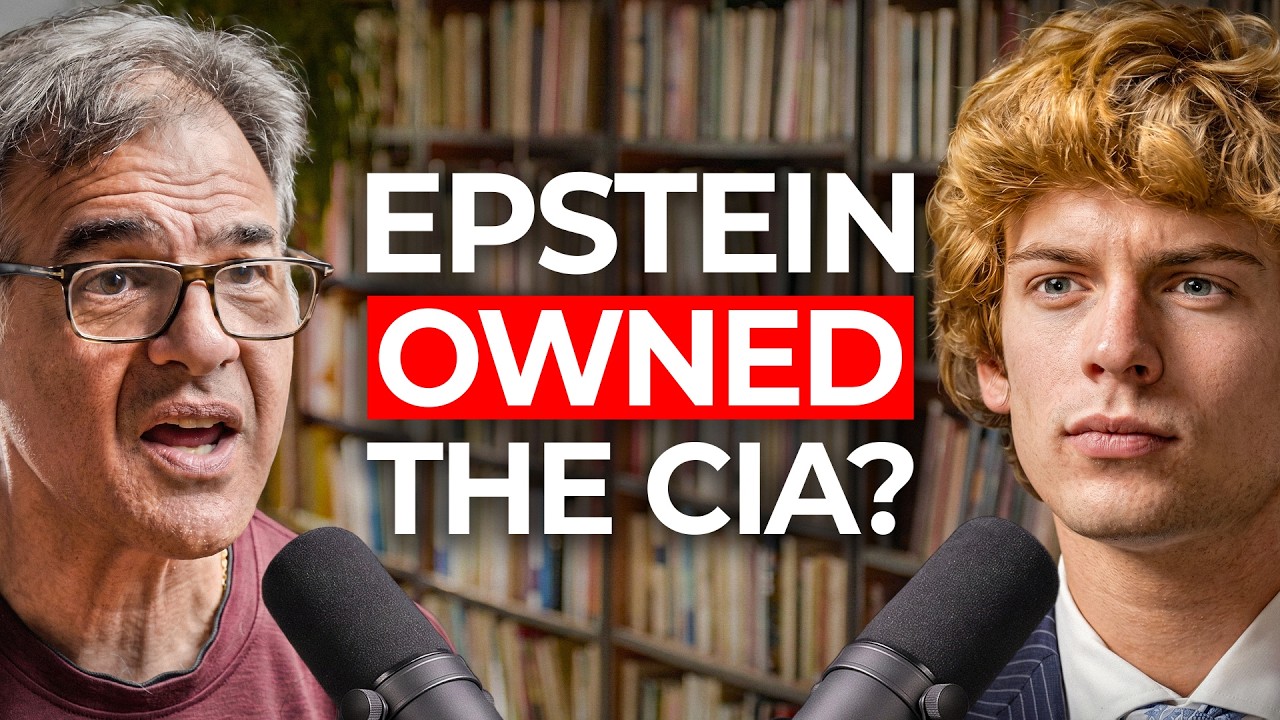
John Kiriakou spent 14 years as a CIA officer, helped capture high-profile terrorists, then became the only person connected to the CIA’s torture program to go to prison — not for torture itself, but for confirming a colleague’s last name to a journalist. His case exposes how the US intelligence system protects its own, punishes whistleblowers, and operates with minimal accountability.
The CIA’s Torture Program and Why John Went to Prison
In a 2007 TV interview, John stated that the CIA was torturing prisoners, that it was official US policy, and that it had been personally approved by the president. This triggered a federal investigation.
The government could not prosecute him for the disclosure itself, so they charged him with five felonies including three counts of espionage. The conviction came from confirming the last name of a former CIA colleague — a “John Doe” — to a journalist writing a book about the Abu Omar rendition case.
Abu Omar was a cleric in Milan kidnapped by the CIA and sent to Egypt for torture. John had no involvement in the kidnapping program.
He was offered a “best and final” plea deal of 30 months. His legal team — 11 attorneys described as “legal titans” — initially encouraged him to go to trial, then reversed course and begged him to take the deal, warning he’d face 12–18 years if convicted.
He served 23 months. Zero other people involved in the torture program — not the architects, not the approvers, not the practitioners — were ever imprisoned.
James Mitchell and Bruce Jessen, the contract psychologists who designed the torture program and personally tortured Abu Zubaydah, received $18 million of taxpayer money.
What Prison Taught John About the System
The US has 5% of the world’s population but 25% of its prison population — worse than China, Russia, or Iran.
Congress creates roughly 50 new felonies every year, criminalizing things that were legal the previous year.
He recounts the case of a NOAA employee in Hawaii who took tourists whale watching on weekends. After orcas fed on a seal carcass near her boat, the FBI raided her apartment, seized her boat and computer, and charged her with a felony under the Endangered Species Act for “interfering with the feeding of a wild animal.” She lost her job, pension, boat, and friendship with her business partner. The charge was eventually knocked down to a misdemeanor.
Private prisons like Geo Solutions have financial incentives to keep every bed occupied and to cut costs on food and medication.
John’s personal experience in prison included being fed food marked “feed use only, not for human consumption,” dog food served by accident (which he says tasted identical to the regular ground beef), and a dead rat found in the Kool-Aid dispenser.
Official Corruption and the Incentive Structure
John describes the system as “official corruption” — not necessarily illegal, but structurally corrupt.
The Citizens United Supreme Court decision allowed corporations and individuals to give unlimited money to political campaigns and PACs. John points to a congressional race where $35 million was spent on a seat paying $180,000 a year, almost entirely from outside money.
He argues this money buys loyalty to AIPAC and Israel’s political agenda, noting that roughly 88% of Congress members have taken AIPAC money. Politicians who aren’t 100% pro-Israel get primarized.
How the CIA Selects Its Officers
A CIA psychiatrist told John the agency actively seeks people with “sociopathic tendencies” — not full sociopaths (who have no conscience and can’t be controlled), but people willing to operate in legal, moral, and ethical gray areas.
During his interview process, candidates were asked how they would obtain classified Indonesian economic figures if a recruited source proved unrecruitable after six months. The other candidates suggested working harder on the recruitment through wives and social pressure. John said: “You break into the Indonesian embassy and you steal it.” That was the correct answer.
He was also selected because of his writing style — punchy, concise, and to the point. His graduate school adviser was actually a CIA officer undercover, who flagged John’s writing and recruited him.
MK Ultra, Psychic Experiments, and Mind Control
MK Ultra ran from the early 1950s to about 1975. The CIA panicked after learning (incorrectly) that the Soviets were ahead in psychic research and ESP, and launched MK Ultra to catch up. The name was arbitrary — “MK” was a digraph for a scientific operation, “Ultra” was randomly generated.
When Senator Church ordered the CIA not to destroy MK Ultra documents, the director went back and destroyed about 85% of them anyway.
John never personally encountered anyone he believed was an MK Ultra subject, but notes that the CIA benefits from the rumor — many people who feel overwhelmed in life default to blaming the CIA as a way of externalizing their problems. Psychologists told him this is one of the most common entry-level mental illnesses they diagnose.
Project Stargate was a CIA program exploring psychic espionage and remote viewing. John never participated, dismissing it as unreliable. However, he did participate in a real operational hypnosis session that produced verifiable intelligence.
A Remarkable Hypnosis Operation
A walk-in at an American embassy claimed to have witnessed the aftermath of a major assassination — seeing men on motorcycles load their bikes into a van behind a chapel. The FBI dismissed him as crazy, but he knew details he shouldn’t have known.
The CIA flew him to a third country with a psychiatrist who was a professional hypnotist. Under hypnosis, the man’s arm stayed raised for 4.5 hours. He read off a license plate number as if squinting at it. The plate came back as stolen — confirming the account was real.
After the session, the man vomited and had no memory of what he’d said. The psychiatrist said he’d read about this in literature but never seen it happen.
The case later fell apart when the same man faked his own kidnapping recording to try to force the CIA into action, claiming the Minister of Interior was leading the terrorist group.
Propaganda, Mockingbird, and Spying on Americans
Project Mockingbird was the CIA’s program to recruit American journalists. The Church Committee made this illegal in 1975.
In 2015, the Obama administration rescinded this prohibition in the National Defense Authorization Act of 2016, making it legal again to propagandize Americans. The immediate trigger was TV Marti — anti-communist Cuban propaganda that was accidentally broadcast to a sliver of southwestern Florida via Dish Network. Rather than fix the signal, the government legalized domestic propaganda.
Investigative journalist Jason Leopold used FOIA requests to obtain emails between the CIA’s Office of Public Affairs and journalists. He found that NBC’s Ken Dilanian was sending articles to the CIA for clearance before sending them to his own editor. Another independent journalist killed his own story after the CIA threatened to cut off his access.
John argues the CIA no longer needs to formally recruit American journalists — many do it voluntarily, either wanting to be insiders or afraid of losing access.
Surveillance Technology and the Private Sector
DARPA’s Lifelog program aimed to track every email, photo, location, and purchase a person made. It was killed on February 4, 2004. The next day, Mark Zuckerberg filed the LLC for Facebook. John rates the coincidence a 1 or 2 out of 10 — essentially not a coincidence at all.
He notes that senior CIA, FBI, and NSA officers routinely move into Facebook, Instagram, Twitter, LinkedIn, and OpenAI, blurring the line between intelligence agencies and tech companies.
Will Herd, a former CIA case officer John mentored, served three terms in Congress, briefly ran for president in 2024, and ended up on OpenAI’s board.
The CIA’s venture capital arm, In-Q-Tel, was created after 9/11 with a congressional waiver. Its first investment — $1.5 million — went to Palantir, now a multibillion-dollar company. John fears Palantir because it operates at classification levels above top secret with no oversight.
Clearance levels go far beyond “top secret.” John held TS/SCI with TK, Gamma, and six additional compartments. Some intelligence is so restricted that even senior officials in the same briefing room aren’t cleared to see it.
Secret Societies, Fraternities, and the CIA
John was asked during his CIA intake whether he belonged to any secret societies. He said no, then mentioned his fraternity. The interviewers specifically asked if it was secret. He said they had a silly handshake and raised money for scholarships. They let it go but seemed interested.
Years later, visiting Mount Athos in Greece — a peninsula of 32 monasteries exempt from EU law where no women are allowed — a priest asked him the same question during confession: “Are you a member of any secret societies?” When John mentioned his fraternity, the priest called it a sin.
John notes that many CIA officers were members of actual secret societies like the Freemasons, and wonders whether the agency was probing whether he’d be a good fit for such networks.
Jeffrey Epstein as an Intelligence Broker
Based on the latest document releases, John believes Epstein was working for Mossad and likely also for the CIA, FBI, MI5, MI6, and German intelligence. He describes Epstein not as a recruited asset but as an “intelligence broker” — someone who collects intelligence and sells it to multiple agencies.
The source of Epstein’s wealth has never been established. A New York Post journalist who tried to investigate him in the 1990s found that no one on Wall Street had heard of him. She called him a “financial mystery man” in her article.
John’s theory: foreign intelligence services recruit people with access to the world’s most powerful people — billionaires, former presidents, royalty — rather than trying to recruit those powerful people directly. Epstein had exactly that access.
Epstein repeatedly tried to get a meeting with Vladimir Putin. The Russians offered him a meeting with Putin plus two officials. Epstein refused — it had to be just Putin. The meeting never happened.
Abu Zubaydah: The Torture That Still Haunts John
Abu Zubaydah was the highest-level terrorist captured at that point after 9/11. John’s entire life changed the night of the capture. He was believed to be al-Qaeda’s number three, but turned out to be a logistician — not even a member of al-Qaeda. There were two men using the name Abu Zubaydah, which led to wildly exaggerated threat assessments.
He was tortured to within an inch of his life. A footnote in the Senate torture report says he will never be released, and when he dies at Guantanamo his body will be cremated and ashes scattered as if he never existed.
John was the first former CIA officer to call for his release, doing so on the BBC in 2015. He is now in touch with Abu Zubaydah’s attorneys.
The worst torture techniques were not waterboarding. John identifies two that were worse:
The cold cell: Prisoners chained naked to an eyebolt in the ceiling in a 50°F cell, doused with ice water every hour. People died of hypothermia. The response to deaths was to “dig a hole and bury him.”
Sleep deprivation: Prisoners chained to the ceiling under industrial lights with death metal playing at full volume 24/7. The American Psychological Association says people begin losing their minds on day seven and organs start failing on day nine. The CIA was authorized to keep people awake for 12 days.
Abu Zubaydah is a gifted artist. He drew pictures of his own torture in a diary confiscated the night of his capture. The CIA classified all the drawings top secret — no one has ever seen them.
Gina Haspel, who later became CIA director, was known as “Bloody Gina” because she flew to secret black sites to sit in on torture sessions because it energized her.
John’s Personal Life: Divorce, Angry Birds, and the CIA’s Role
John has been divorced twice. He says the CIA played an active role in one of his divorions but is under a court order not to discuss the details.
He is obsessed with Angry Birds 2, playing every single day for nearly nine years (over 2,800 consecutive days at the time of the interview). He wakes up an hour early just to play. His ex-wife used the game as a convenient excuse for divorce.
He also plays Clash Royale and describes it as “like chess but with more luck so you have an excuse for losing.”
Why the CIA Didn’t “Disappear” Him
John believes he’s too high-profile to be made to disappear — it would be too obvious. He references the killing of Charlie Kirk as a reminder that such things happen.
He receives death threats regularly, including messages that include his home address. He has applied for a presidential pardon partly to regain his firearms rights for self-protection.
He believes his prosecution was meant to silence him but instead gave him a “reason for being.” His ex-wife told him: “If they thought this was going to silence you, they didn’t know you at all.”
John Brennan, who insisted on prosecuting John, is now himself facing prosecution.
Cameos, Mental Health, and a Friend’s Suicide
After going viral on TikTok, John joined Cameo and broke the all-time record for most cameos in a single month. He charges $99 (algorithm-adjusted), and his cameos run 3–4 minutes compared to the typical 60–90 seconds. He has a 4.98 out of 5 star rating.
Three to four times a week, someone tells him a cameo message talked them out of suicide.
John shares the devastating story of his friend James, who repeatedly threatened suicide over years. James eventually drove to a Walmart parking lot with a gun but was stopped by an off-duty ATF agent. He was sentenced to a mandatory minimum five years as a felon with a firearm. After losing access to his son, he called John sounding at peace. Two days later, he killed himself. His sister called to say James left a note: “Please tell John I said I was sorry.”
John relates this to a story Pete Seeger told about Phil Ochs, who called Seeger before killing himself. Seeger was rushing to catch a train and hung up. He spent decades angry at Ochs for the selfishness of that act — an anger John now understands.
What John Wants to Leave the World
If every interview, book, TikTok, and cameo were erased, the one thing John wants remembered is: he told the truth.
The best advice he ever received came from Senator Jennings Randolph of West Virginia, whom he cold-called as a college student. Randolph told him: “Always do the right thing. This city is too full of people who are willing to do the expedient thing.” John wrote it down and still has it.
Where to Find John
John is on Instagram, Facebook, X, and LinkedIn. He is launching a new podcast on YouTube in July called “Real John Kiriakou” and is asking people to subscribe at youtube.com/@RealJohnKiriakou so they don’t miss the first episode.